Private equity's appetite for insurance distribution shows no sign of slowing. EQT has agreed to buy a majority stake in McGill and Partners, the London specialty broker built from scratch by former Aon group president Steve McGill CBE, in a deal valuing the business at USD 2.0 billion. The Swedish buyout house is acquiring the stake from Warburg Pincus, the US private equity firm that bankrolled McGill's 2019 launch. McGill's management team will retain a meaningful ownership stake going forward.
It is a significant return for Warburg, which backed Steve McGill and a founding senior team including chairman John Lloyd, Stephen Cross and Karl Hennessy when the firm launched seven years ago, describing it at the time as an ambition to build a transatlantic market-leader in risk solutions. That bet on a challenger brand has paid off. McGill and Partners has grown from its founding into a scaled global specialty business with revenues in excess of $250 million, more than 600 colleagues across seven countries, and over 1,000 sophisticated insurance and reinsurance clients.
McGill and Partners has never been a conventional broker. Built around complex, high-value risk in sectors including aviation, marine, energy and financial lines, the firm has operated from the outset on a no-legacy-technology, no-bolt-on-acquisitions model, and on a unified technology stack the firm describes as designed for clean, structured data and seamless integration. Its backers argue that architecture has made it faster to modernise than rivals carrying decades of stitched-together systems.
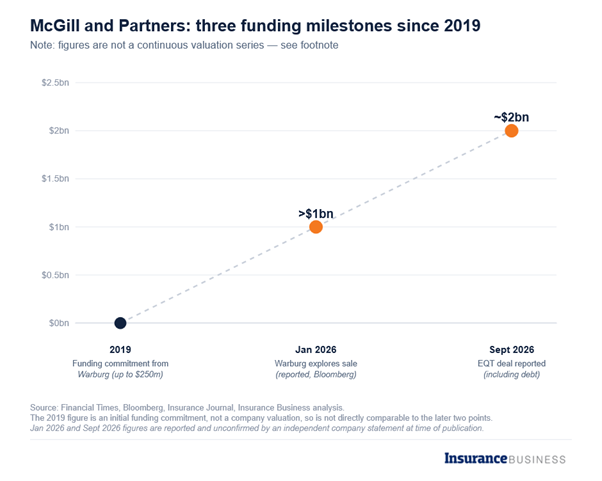
That pitch appears to be resonating with clients. The broker posted organic revenue growth of more than 20% and a 79% jump in adjusted EBITDA in the first half of 2025 compared with the same period a year earlier, and it topped up its firepower with a $300 million refinancing from Morgan Stanley, Permira and Bridgepoint last September. Reports first surfaced in January that Warburg was sounding out advisers about a sale that could fetch north of $1 billion. The final $2 billion figure is double that early guidance.
Under EQT's ownership, the plan is to accelerate organic growth through talent recruitment, further development of technology and data capabilities, and expansion of the firm's US and international client portfolio. Miriam Tawil, partner at EQT Private Equity, said the firm's growth mindset was well-aligned with McGill and Partners' vision and that the focus would be on accelerating growth of its US and international client portfolio, further connecting the world to the Lloyd's and London market.
Steve McGill CBE said turning what was an idea seven years ago into a $2 billion global specialty enterprise was an achievement the whole firm was incredibly proud of, and described EQT's track record of backing high-growth, technology-enabled businesses as making them the right partner for the next stage. He added that the firm was deeply grateful for the backing and guidance of Warburg Pincus across the seven years of their partnership.
Matthias Wittkowski, global co-head of services and partner at EQT Private Equity, said McGill and Partners had established a strong position in specialty insurance broking underpinned by impressive organic growth, and that EQT was thrilled to partner with McGill and the team at an exciting point in the business's growth trajectory as they scaled what he described as a clearly differentiated platform.
James O'Gara, managing director and partner at Warburg Pincus, said the firm had had enormous conviction from day one in the shared vision for what McGill and Partners could become, and that the outcome spoke for itself.
Read next: CFC welcomes major investment
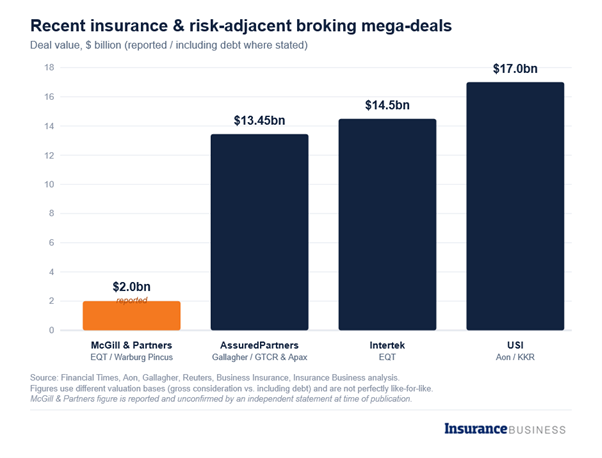
McGill is only the latest specialty broker to change hands for serious money this year. The deal lands in the same week that KKR agreed to sell USI Insurance Services to Aon in a transaction reported at approximately $17 billion - a deal that reportedly delivered KKR roughly six times its original investment and ranks among the largest single-deal gains a public private equity firm has recorded. KKR first backed USI in 2017 in a deal valuing the business at $4.3 billion.
Put the two deals side by side and a clear theme emerges. Private equity firms that got into insurance distribution years ago are now exiting at eye-watering multiples, while buyers - whether other PE houses like EQT or listed giants like Aon - keep paying up regardless. Specialty and mid-market broking has become one of financial services' most reliably profitable corners, largely because commission-based revenue holds up better than most sectors when markets get choppy. Brokers earn on premium volume and renewal business rather than underwriting risk directly, giving them the kind of steady, predictable income stream that suits a leveraged buyout model.
EQT has other insurance bets in play. It is separately said to be weighing a possible London listing for CFC, the cyber-focused specialist insurer it has backed alongside Vitruvian Partners since 2021, with speculation suggesting a valuation north of £5 billion.
Read next: CFC investors hire advisers over potential sale or IPO
There is a slight wrinkle in the timing. Pricing across specialty insurance lines has been softening, and listed broker valuations at the largest firms have come under some pressure. Add the lingering question of whether AI eventually automates parts of the placement process, and caution from buyers might be expected.
Instead, the opposite is true. The commission-based revenue model and high client retention rates that define specialist brokers make them exactly the kind of asset private equity is prepared to pay a premium for. That is arguably the real driver behind the recent run of major deals, from Arthur J. Gallagher's acquisition of AssuredPartners to the USI-Aon tie-up to now McGill.
For UK brokers and MGAs watching from the sidelines, the message is consistent. Scale, technology investment and a clean balance sheet are what buyers - whether trade players or financial sponsors - are willing to pay up for. McGill's founders built precisely that kind of business from nothing in seven years, and every shareholder involved has benefited accordingly.