Riot cover used to be the low profile passenger in a commercial property policy. After recent events it isn’t any more.
As a wave of cost-of-living protests rolls across Europe, insurers are cutting the limits they offer for strikes, riots and civil commotion (SRCC), pushing up deductibles and, in a handful of high-risk locations, walking away from the cover entirely. Policyholders who assumed the peril was simply "in there" may be in for a surprise at renewal.
The trigger is obvious enough. On 17 October more than half a million people marched in France, and in several cities the day ended in looting and arson. Interior Ministry figures put arrests at 2,397, according to Insurance Business reporting at the time. Protests over rents, prices and public services have since flared in Belgium, Italy, Portugal and Spain, with large marches in Germany too.
Read next: France's riot bill could hit €1.2bn - and its new state backstop won't share it
The industry's worry isn't any single smashed shopfront. It's thousands of them, in dozens of towns, on the same weekend.
Rating agency Morningstar DBRS has been making this argument for a while. Its analysts Marcos Alvarez and Elisabeth Rudman say civil unrest now acts more like a natural catastrophe than an everyday property peril, because claims across commercial property, motor, public buildings and business interruption land at once as disorder jumps from city to city. Alvarez told Bloomberg that riots that once stayed in one city for a couple of days are now correlated across a whole country, or several, which puts a very different strain on capital.
DBRS reckons the October unrest could cost French insurers up to €1.2bn, with shops and public buildings taking the brunt. That would comfortably top any previous French riot bill:
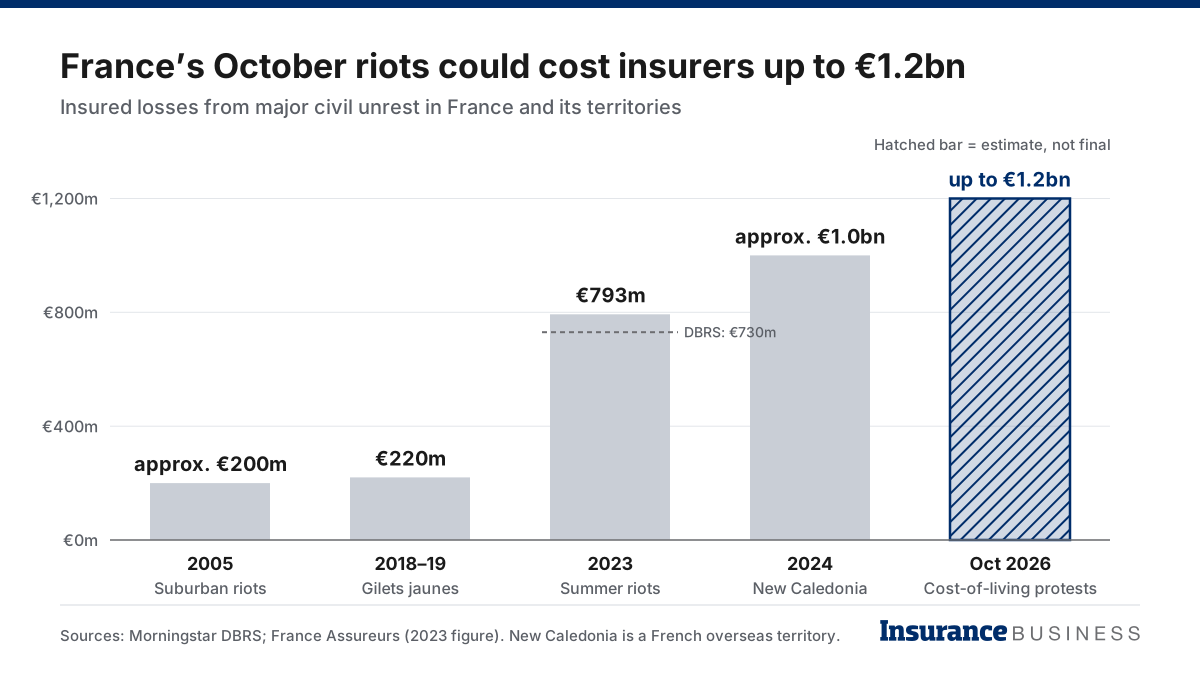
The €1.2bn is a current ceiling, not a final number. It assumes no fresh flare-up, and business interruption claims are still coming through. DBRS also warns that the true economic hit to retailers - lost trade, uninsured stock, excesses - is likely to be several times the insured figure.
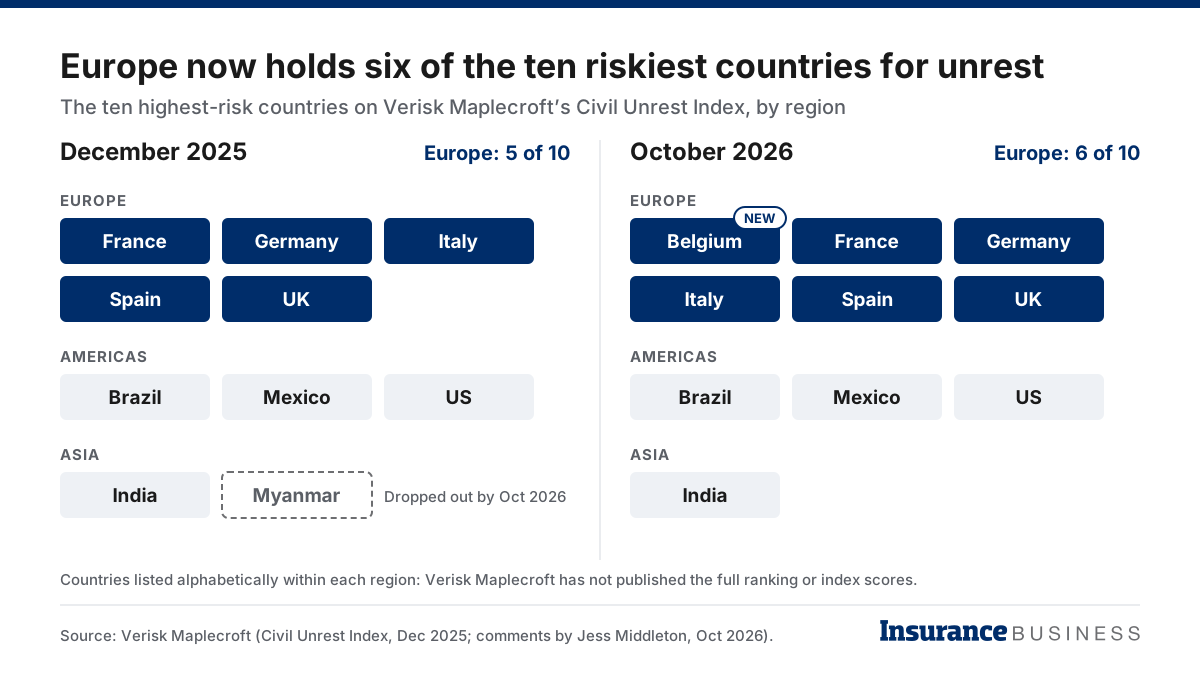
Risk consultancy Verisk Maplecroft says Europe already ranks as the highest-risk region in its Civil Unrest Index, with Germany, France, Spain, Italy, the UK and Belgium all among the ten riskiest countries worldwide.
Read next: France's riot losses put insurance cover and state recovery in focus
For years SRCC was bundled into commercial property cover more or less as a matter of course. That's changing. In a commentary published on 23 October, credit rating agency AM Best said insurers are increasingly carving the peril out and underwriting it separately, and that it expects these events to become more frequent and to escalate faster, helped along by social media and messaging apps.
DBRS expects repeated outbreaks to keep pushing up SRCC pricing, deductibles and underwriting scrutiny, while keeping limits tight. Its verdict is that civil commotion can no longer be treated as an incidental property peril, particularly in France.
Not everyone is reaching for the scissors. Ian Humphries, who runs Allianz's political violence and terrorism unit in London, told Bloomberg the insurer is not imposing blanket restrictions in response to the latest protests. Instead it is judging risks one by one, looking at factors such as how close a site sits to areas prone to unrest.
That site-by-site approach needs data, and the market is scrambling to build it. In September, Howden Re launched UNREST, an analytics tool built with Lloyd's Lab graduate Synthetik that uses property-level data and event simulation to show where SRCC exposures pile up. The pitch is that older, postcode-level models miss how disorder actually travels - along protest routes, high streets and transport hubs - so two buildings on the same street can carry very different risk.
Read next: Portsmouth protests expose SRCC gap insurers already knew about
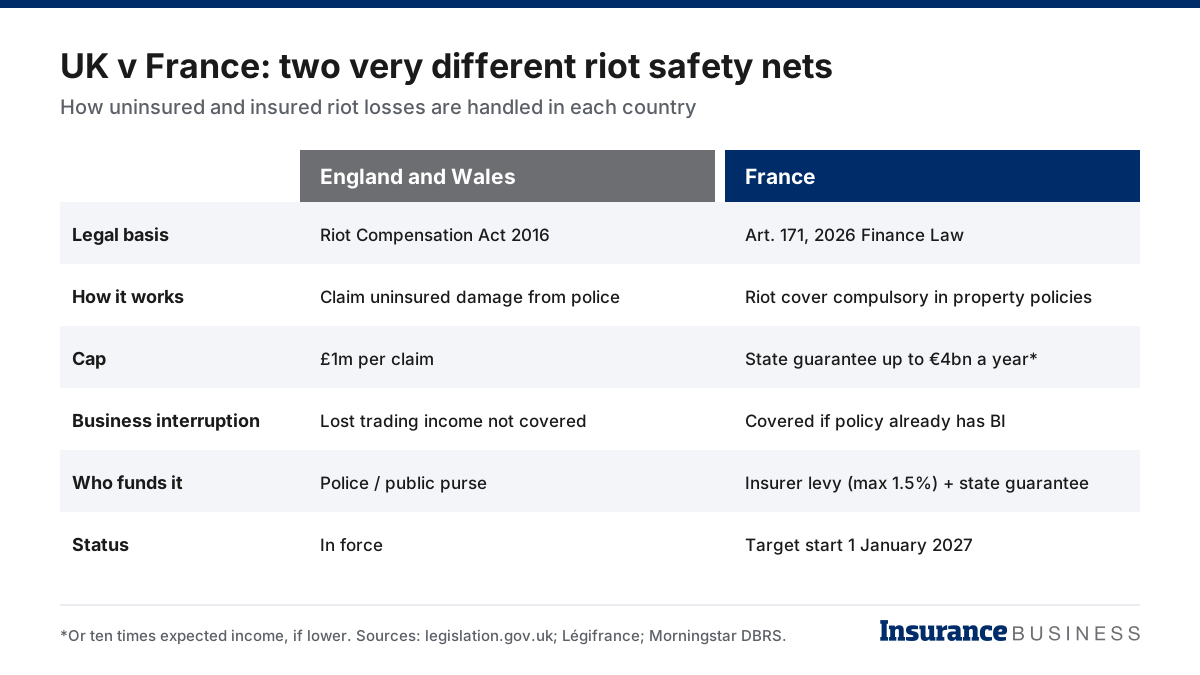
France has already decided the private market can't carry riot risk on its own. Article 171 of the 2026 Finance Law, promulgated in February, makes riot cover compulsory in qualifying property policies, with no exclusions allowed, and extends it to business interruption where a policy already includes that cover.
The money sits in a mutualisation fund run by state reinsurer CCR, which will reimburse at least 90% of the riot losses insurers cede to it - leaving carriers holding roughly a tenth. The fund is financed by a solidarity levy that the law caps at 1.5% of relevant premiums, with the actual rate set by decree; reports suggest a figure of around 0.8%, which critics in France have already branded a "riot tax". The state guarantees the fund each year up to €4bn or ten times its expected income, whichever is lower.
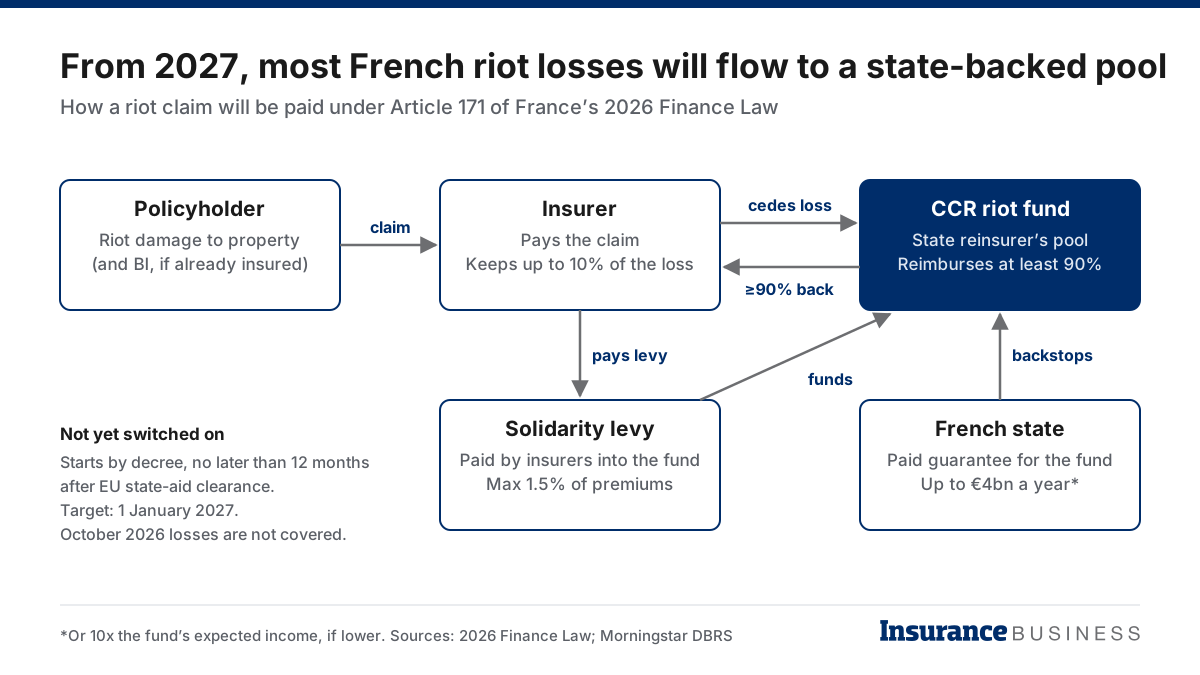
The scheme only switches on by decree, no later than 12 months after the European Commission clears it under state aid rules. France Assureurs is working towards 1 January 2027, but DBRS is clear the pool won't pick up October's losses. Those will be split the old-fashioned way: primary carriers first, then reinsurance panels, then specialist SRCC and political violence cover written in London.
For the London market, the longer-term picture is mixed. Once French property policies carry compulsory, CCR-backed riot cover, demand for primary riot capacity for French risks is likely to shrink, with London's role narrowing to filling the gaps around the state scheme. Brokers running multinational programmes will also need to check how their master policies sit on top of that new local layer.
Read next: Why is demand for strikes, riots and civil commotions insurance increasing?
British brokers would be unwise to treat this as a French problem. The UK has its own scars: the disorder that followed the Southport stabbings in summer 2024, which Morningstar DBRS expected to cost the market less than £250m, and more recently the clashes at Portsmouth and Dover in September over small-boat arrivals.
The statutory safety net is narrower than many clients think. The Riot Compensation Act 2016 lets businesses in England and Wales claim uninsured riot damage from the police, but caps claims at £1m and doesn't cover lost trading income. Over the past decade many carriers have trimmed SRCC limits or stripped the cover out of standard wordings, nudging bigger clients towards standalone placements in the London market. UK civil unrest is becoming a major risk for insurers, and modelled scenarios from Synthetik put potential UK SRCC losses anywhere from about £0.3bn to £4.7bn.
Businesses are already feeling it directly. A Gallagher survey of more than 500 UK business decision-makers, carried out in January 2025, found that more than one in four firms had been hit by civil unrest during 2024, and nearly two-thirds saw it as a major concern for the year ahead.
Read next: London braces for large-scale protests as Crawford & Co warns of major risks
So what should brokers be asking now? Whether SRCC sits in the property policy or a standalone wording; what the sub-limits and deductibles look like after the latest renewal; whether looting is capped separately; and, crucially, what happens to business interruption when a road is shut or a shop closes as a precaution but nothing is actually damaged. That last gap is where clients tend to get caught out.
A peril once filed under "emerging markets" is now being priced, modelled and capped like a catastrophe in Europe's wealthiest economies. For anyone placing property risk on a high street, that's no longer a footnote.
Read next: War is now the risk every boardroom fears most, and insurers are hiring accordingly