AXA has given its AI strategy a name, a number, and a set of receipts. At its Investor Day on the 15th September, chief executive Thomas Buberl unveiled "Growing Forward," the group's strategic plan for 2027 to 2029. He explained the name as a deliberate double meaning: continuity ("going forward") combined with an explicit focus on gaining market share ("growing forward"). At the centre of it is a target to generate between €500 million and €700 million (roughly £428 million to £599 million) a year in recurring AI value by 2029.
AXA's presentation describes it as pre-tax value, net of the implementation costs and the extra running costs those tools bring. It isn't a gross saving that ignores what the technology costs to deploy. On the call, Guillaume Borie, AXA's Global Head of Finance, Strategy, Underwriting, Risk & Technology, made the same point in plainer terms, describing AXA's operating model as one built to manage those implementation and running costs directly. As he put it: "AI today doesn't sit in a lab within AXA. It's live, and it's already everywhere."
One analyst asked Buberl directly whether rivals copying AXA's AI-driven retention push could erode the advantage over time. His answer: most insurers don't have both the financial means and the workforce buy-in to make AI pay off at this scale. Pointedly, he named Microsoft's Copilot as an example of the wrong way to think about it: "The key is are you able to engage your employees and your agents to use it," he told analysts, not whether you've licensed the best tool.
The same idea came up again later in the call. Asked about growth through AXA's agency network, Buberl described a recent meeting where agents were pushing him for faster access to AI tools, not resisting them. "If you push AI on people, nothing will happen," he said. "If they want it, it will happen."
AXA says 80% of its employees already use AI regularly, which gives that adoption push a baseline to build from. On retention specifically, one of the plan's core growth levers, only 30% of AXA's business units currently outperform local competitors. That's the gap the AI push is aimed at closing.
The plan sets out specific targets by business line. In commercial underwriting, AXA wants AI-augmented submission triage and risk scoring to be standard practice for its highest-value opportunities by 2029.
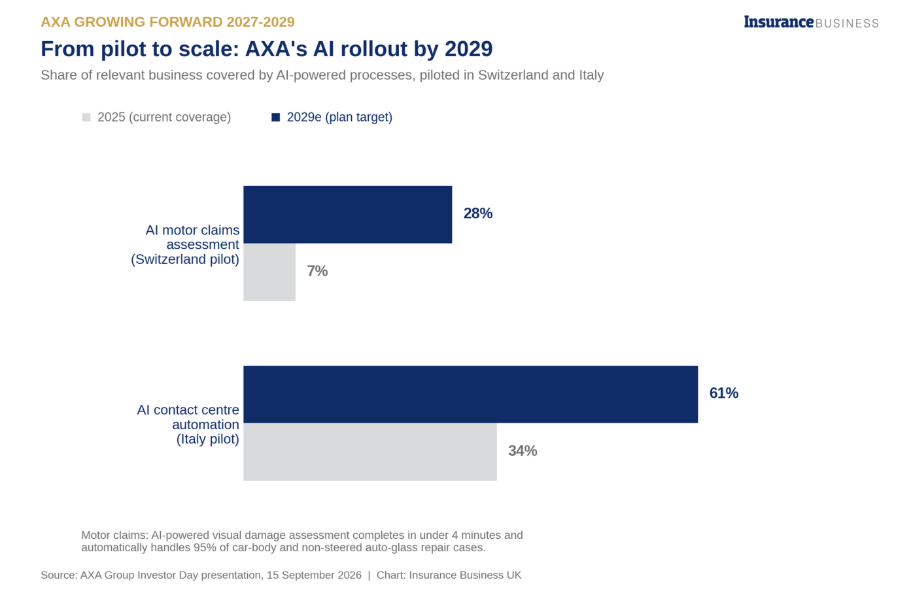
In motor claims, a programme piloted in Switzerland uses AI-powered visual damage assessment that completes in under four minutes and automatically handles 95% of car-body and non-steered auto-glass repairs. AXA plans to scale that from covering 7% of its retail motor book in 2025 to 28% by 2029. In contact centres, a similar transformation piloted in Italy has cut average handling time using AI-powered agents and automated call transcription, and is set to expand from 34% of retail premium volume covered today to 61% by 2029.
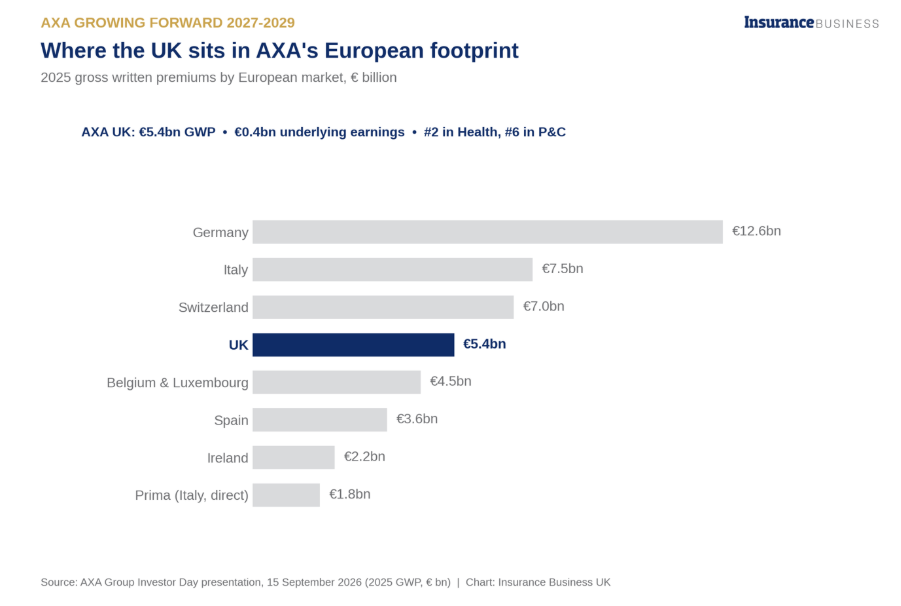
AXA's UK business generated €5.4 billion of gross written premium in 2025 and €0.4 billion of underlying earnings, ranking the insurer second in health and sixth in P&C in the UK, according to the investor materials. The most striking UK-specific comment came in the Q&A, though, when Buberl was asked whether a softening cycle at AXA XL's large commercial accounts could spread into mid-market and retail.
He singled out the UK as a market to watch. Retail and SME business on the continent is largely distributed through tied agents, a channel new entrants struggle to break into, so AXA doesn't expect softening to spread there. The UK is different, he said, specifically because it's "much more in a broker market," where capacity can move in and out more easily.
Buberl also pointed to the UK as one of the markets where AXA had already taken its pricing medicine early. He said the group closed its retail pricing gaps "straight ahead" and "immediately," in contrast to competitors who spread the same adjustment over several years. The message to investors was that AXA's UK retail book isn't carrying hidden pricing risk into the new plan.
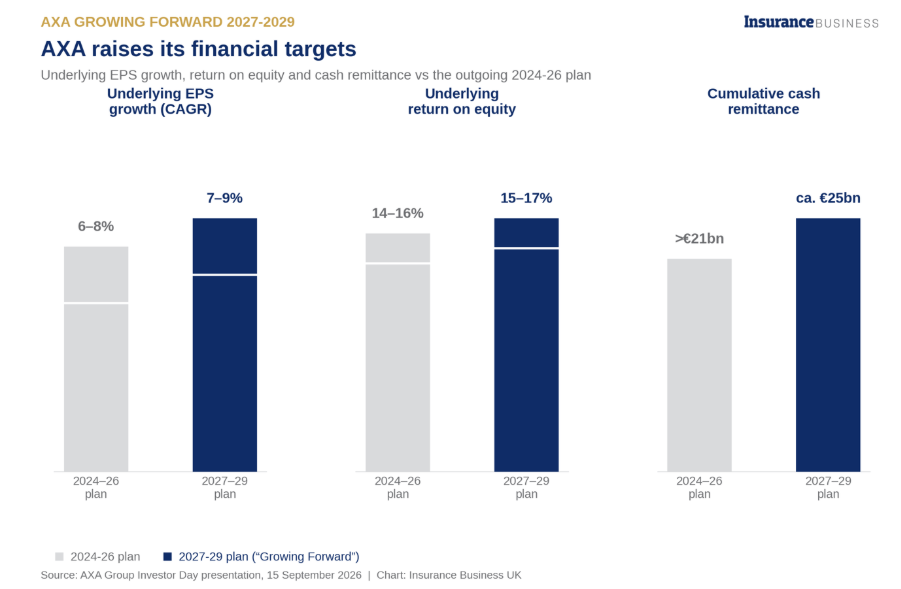
AI sits inside a broader set of targets that "Growing Forward" raises versus the outgoing 2024-2026 plan. Underlying earnings per share growth is targeted at 7-9% annually. Group CFO Alban Nesle broke this down as 6-8% from underlying earnings growth plus roughly 1 point from share buybacks, a smaller buyback contribution than in the current plan because AXA's higher share price now makes buybacks less accretive per euro spent.
Underlying return on equity is targeted at 15-17%, up from 14-16%, and cumulative cash remittance to the group over the plan period is targeted at around €25 billion, up from more than €21 billion previously. The payout ratio stays at 75% of underlying earnings, split between a 60% dividend and 15% share buybacks, with the remaining 25% reinvested in the business.
That reinvested slice sits behind a new metric AXA is introducing for the first time: book value per share growth, including dividends, targeted at a "mid-teens" compound annual rate. Nesle described the logic as reflecting the value created by ploughing the 25% that isn't paid out into a business generating 15-17% returns on equity. By 2029, AXA is targeting more than €10 billion in underlying earnings, an expense ratio below 10% excluding commissions, and around 100 million customers group-wide, up from 92 million at the end of 2025.
AXA's bet on AI value creation lands at a moment when the technology is doing measurable work in the wider UK economy too. Figures from the Office for National Statistics showed the economy grew by 0.4% in July, ahead of economists' expectations of no growth at all.
The ONS pointed specifically to computer programming, consultancy and IT firms tied to AI and cloud computing as the standout contributors to that surprise. For an industry that has spent the past couple of years running AI pilots cautiously, that kind of macro tailwind adds weight to the argument that the spending is starting to show up on the other side of the ledger.
AXA's full-steam-ahead approach comes just days after one of the AI industry's own leading figures argued for the opposite. Dario Amodei, chief executive of the AI company Anthropic, unrelated to AXA, published an essay titled "We Must Pace the Frontier". He warned that AI capabilities have been "advancing drastically faster" since the summer and that, left unchecked, the technology could outrun the industry's ability to understand and control it.
Amodei isn't arguing for a halt to AI development, and his concerns are aimed at frontier labs racing to build more powerful general-purpose models, not at insurers deploying narrower, task-specific tools for underwriting or claims triage. Still, the contrast lands at an odd moment: one wing of the AI industry pushing for a slower pace of development, while a major insurer puts a firm number on how much faster it plans to move.
AXA has put a specific figure on what "AI at scale" is worth to a major multiline insurer, and a detailed roadmap for getting there. Buberl's comment on the UK's broker market is a reminder that the company is watching distribution structures as closely as its own technology rollout, and UK brokers and insurers will want to keep an eye on both.