
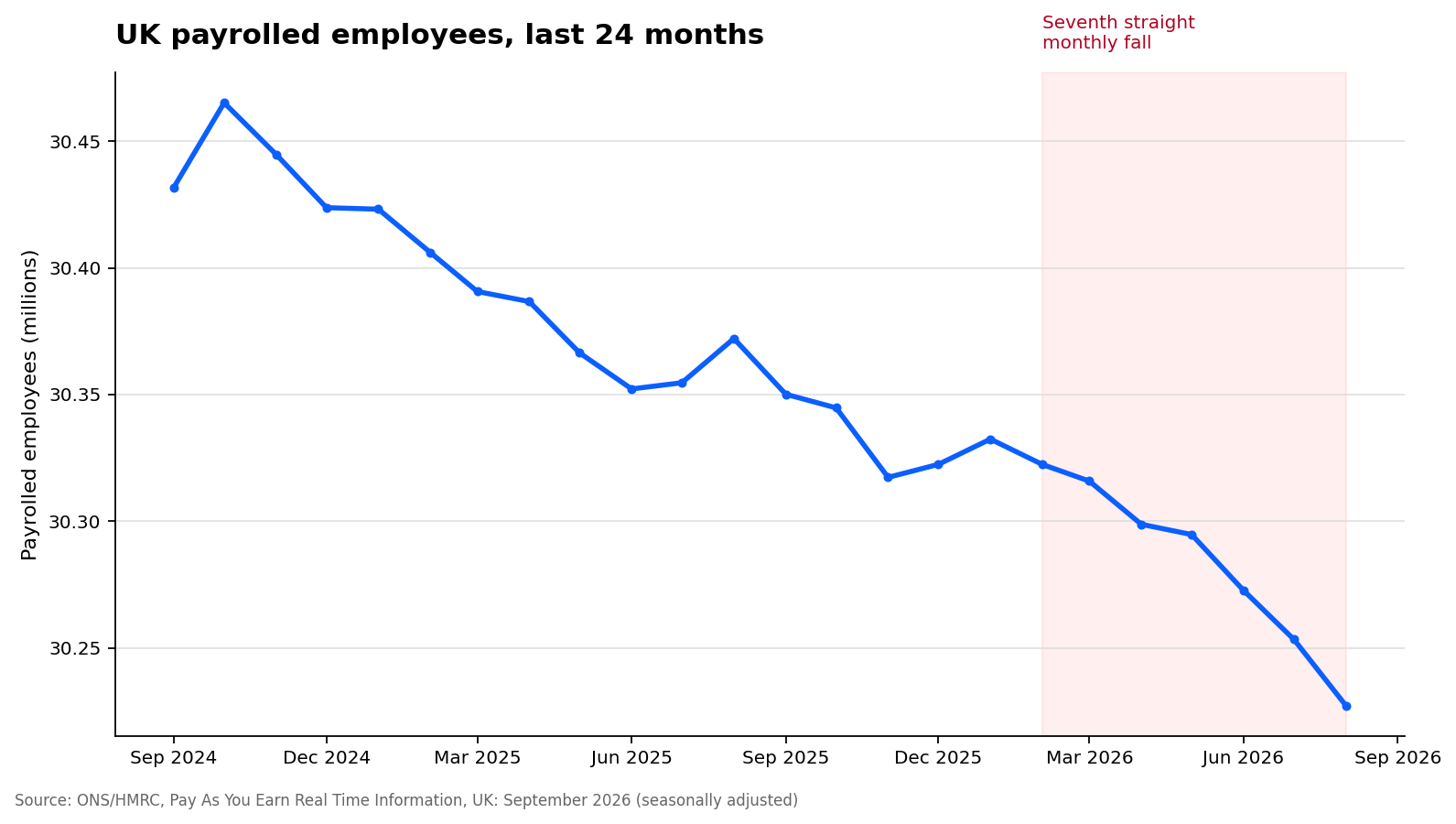
The UK's jobs market has now lost payrolled staff for seven months in a row – but insurance and finance is one of the few corners of the economy still adding people, according to official figures published on 15 September 2026.
Early estimates from the Office for National Statistics (ONS) show the number of payrolled employees across the UK fell by around 26,000 in August, taking the total to roughly 30.2 million. That's the seventh consecutive monthly decline, following falls in every month since February, and leaves the workforce down by approximately 145,000 people (-0.5%) compared with August last year. The figures come from HM Revenue and Customs' Pay As You Earn (PAYE) Real Time Information system, a joint release with the ONS, and August's numbers are early estimates that are likely to be revised as more data comes in.
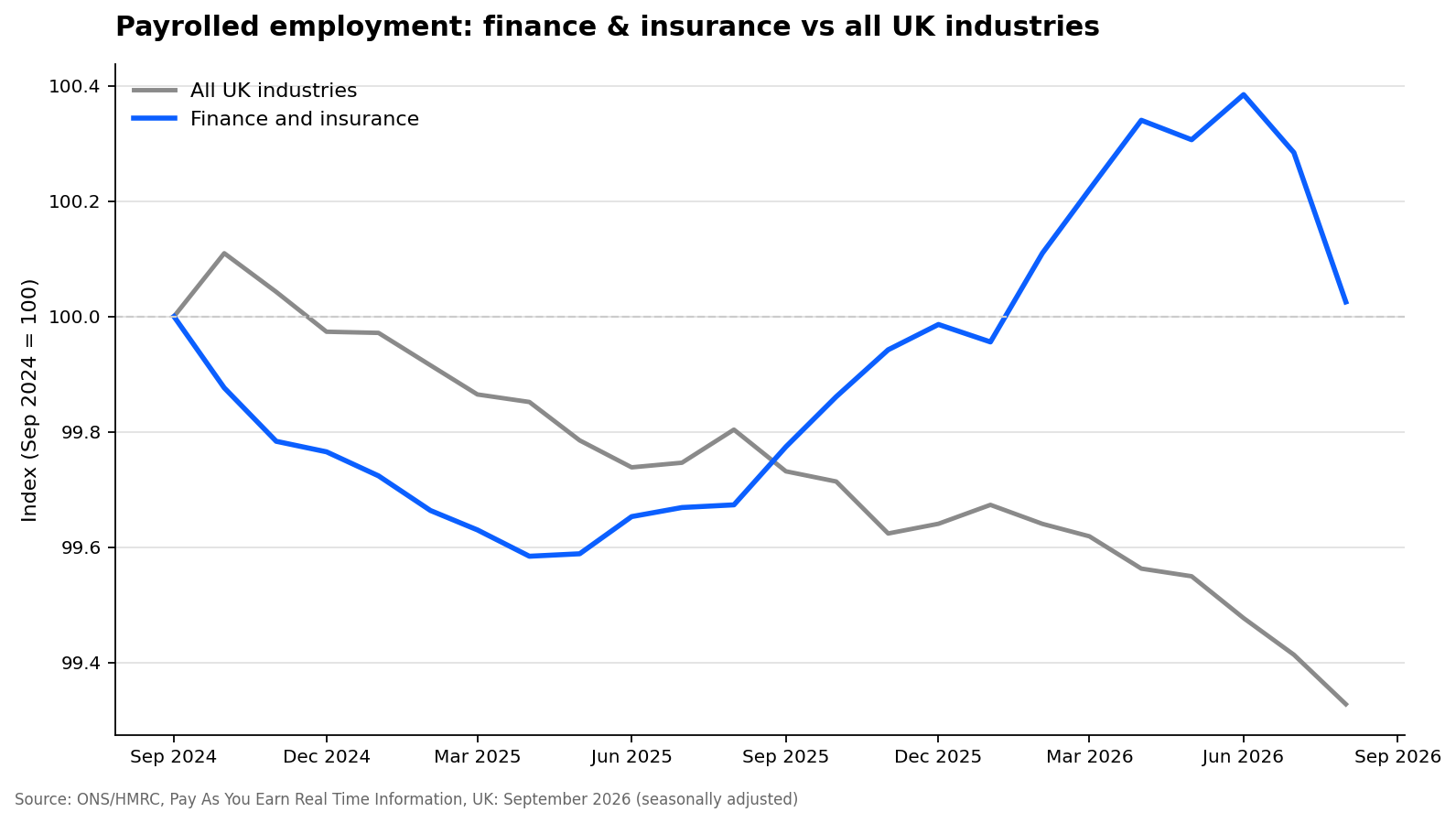
Set against that backdrop, finance and insurance looks like something of an outlier. Payrolled headcount in the sector stood at approximately 1.1 million in August, up by roughly 3,900 people (+0.4%) on the same month a year ago – one of the few major sectors still showing annual growth while the wider jobs market contracts. Month-on-month, the sector did dip slightly, shedding around 2,800 roles compared with July, so it isn't immune to the broader cooling, just less exposed to it than most industries.
Some of that resilience has a geography to it. London remains the world's largest insurance and reinsurance marketplace, but regional hubs such as Glasgow and Edinburgh have built up substantial clusters of their own in recent years, a trend IB has covered in detail. That spread of employment across several UK cities, rather than concentration in one, is one reason the sector has tended to weather downturns a little better than industries more exposed to a single region or a single type of consumer spending.
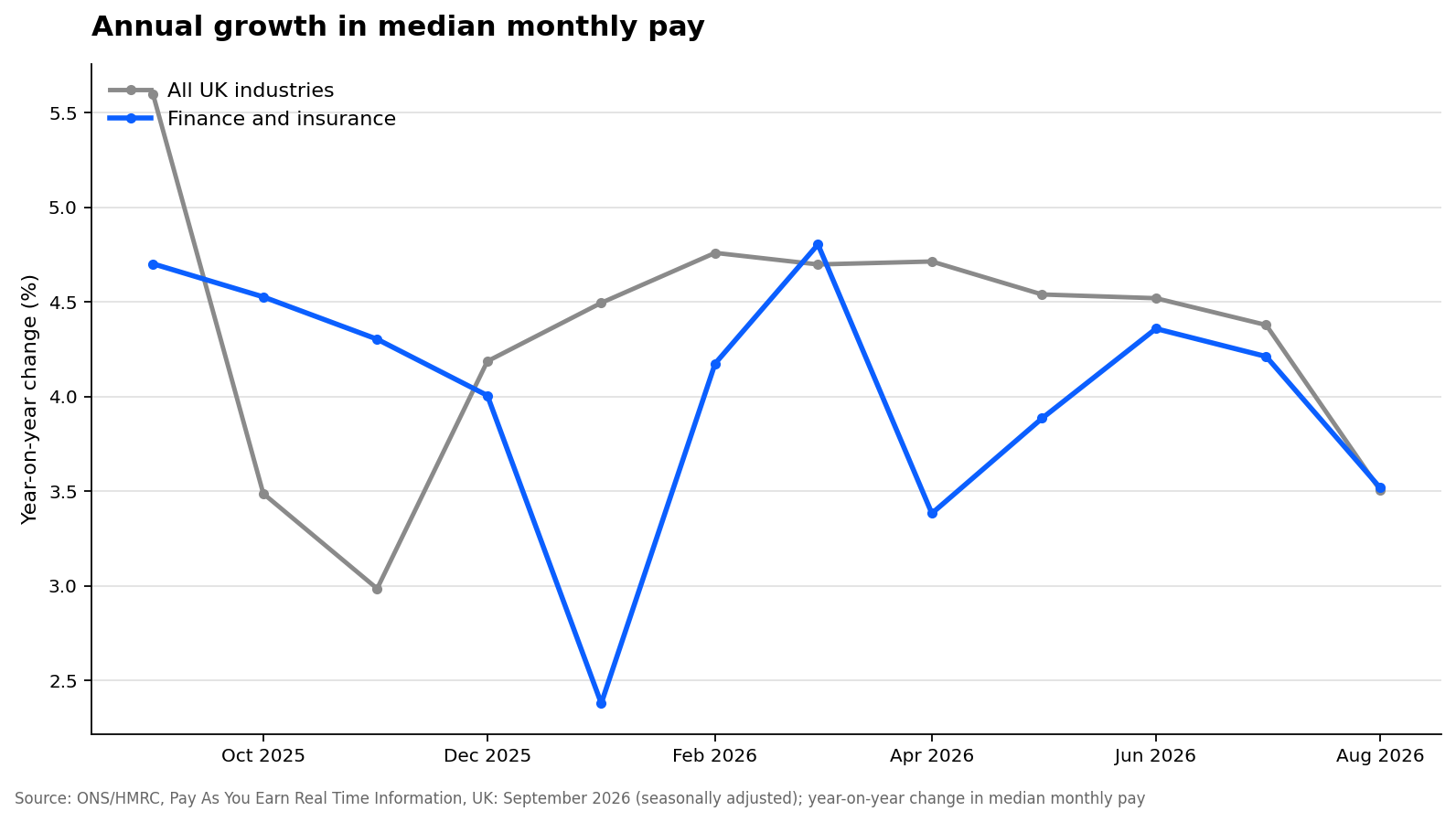
Pay tells a more balanced story than headcount does. Median monthly pay in finance and insurance reached approximately £4,295 in August, up around 3.5% on a year earlier. That's a healthy rise in cash terms, but it's essentially identical to the 3.5% increase in median pay across the whole UK economy over the same period (from roughly £2,567 to £2,657 a month). Insurance and finance pay isn't pulling further ahead of the rest of the country on a percentage basis – it's simply starting from a much higher base and holding its lead rather than extending it.
Look at the full labour market update released alongside the RTI figures, and the picture looks fragile rather than dire. Unemployment held at 4.9% in the three months to July, the employment rate was largely unchanged at 75.1%, and job vacancies fell to around 702,000 – their lowest level since 2021, outside the pandemic period. Regular pay across the whole economy grew by 3.5% annually and total pay (including bonuses) by 3.9%, though once inflation is factored in using the CPIH measure, real growth was a much more modest 0.6% for regular pay and 0.9% for total pay.
Naomi Clayton, chief executive of the Institute for Employment Studies, described the labour market as essentially flat, noting that the steepest job losses over the last quarter had come in retail and hospitality rather than financial or professional services. Jack Kennedy, senior economist at Indeed, pointed to the bind this creates for the Bank of England ahead of its next rate decision, due on Thursday 17 September: a weakening jobs market argues for caution on rates, even as global energy costs keep inflation risks alive. He added that private sector wage growth remaining within the Bank's comfort zone reduces the odds of pay increases feeding back into prices.
For insurers and brokers, headline headcount growth doesn't necessarily mean hiring feels easy on the ground. Gallagher Bassett's 2026 Claims Insights report found that talent attraction and retention had jumped from seventh to first place among UK insurers' top business concerns in a single year, with 72% of respondents reporting greater difficulty finding qualified candidates and roughly half flagging acute shortages in claims handling specifically.
That squares with what IB has heard from the market: a talent shortage looming for brokers as younger recruitment falters and a quarter of the workforce is already over 50. Independent brokers are feeling the squeeze more acutely than most. Speaking at a recent IBTV roundtable of independent brokers, Russell Sessions, managing director at Vision Insurance Brokers, said his firm has "had a relatively high turnover in our corporate team in London, poached by bigger brokers... offered incredibly large pay increases to move. Even if we wanted to keep them, we just couldn't compete." At the same event, Gareth Cotty, chief commercial officer at Thomas Carroll Group, pointed to rising employment costs compounding the problem: "We had it a few years ago with the National Insurance increase, that could have allowed us to employ maybe three or four new people, just the cost of dealing with that bill."
Put together, the numbers point to a sector adding jobs overall while still struggling to fill specific, skilled roles – a mismatch between headline growth and on-the-ground hiring difficulty that recruiters will recognise. Add pay growth that's keeping pace with, rather than beating, the rest of the economy, and the case for insurers to compete harder on career development, flexibility and employer brand – rather than relying on wages alone – looks stronger than the topline figures suggest.
The next update to the PAYE RTI series, along with the full ONS labour market overview, is due in mid-October. Given how much August's early estimates for both employment and pay tend to move once fuller data comes in, insurers watching the numbers for signs of a genuine hiring slowdown – as opposed to a one-month wobble – will want to see whether the trend holds.