Andy Burnham used his first Prime Minister's Questions on Tuesday to refuse, twice, to rule out raising taxes or borrowing more at next month's Budget. It came on the same day UK government borrowing costs hit their highest level since the 2008 financial crisis, with the 10-year gilt yield touching 5.26% and the 30-year yield at 5.89%.
Chancellor John Healey delivers his first Budget on 28 October, and the timing is awkward. A global bond sell-off - tied partly to a fresh flare-up between the US and Iran and rising oil and gas prices - has pushed up borrowing costs across the UK, US, Japan and the eurozone. For the Treasury, that means a bigger bill just to service existing debt, at the exact moment Healey is trying to work out how to pay for defence, the cost of living and everything else Labour has promised since taking office in July.
None of this is just background noise for insurance professionals. Higher gilt yields feed directly into how life insurers price bulk annuities, a stretched Treasury tends to eye up Insurance Premium Tax (IPT), and any move on capital gains tax could affect how brokerages and MGAs get bought and sold. And plenty of it lands closer to home than that - on your own dividends, your pension contributions, and what you'd walk away with if you sold your business.
Budget speculation moves fast. Here's roughly where things stand, based on public reporting so far:
|
Measure |
Status |
|
Budget date: 28 October 2026 |
Confirmed |
|
Dividend tax rates of 10.75% / 35.75% for 2026/27 |
Confirmed - set at the 2025 Budget |
|
Dividend tax-free allowance at £500/year |
Confirmed - already in effect |
|
Business Asset Disposal Relief at 18% |
Confirmed - already in effect |
|
Salary sacrifice pension NI relief capped at first £2,000/year |
Confirmed, but not until April 2029 |
|
Cash ISA limit cut to £12,000 for under-65s |
Confirmed - from April 2027 |
|
NATO 3.5% GDP defence target by 2035 |
Confirmed government position |
|
3% GDP defence target by 2030 (the one Healey resigned over) |
Not committed to - repeatedly declined by Burnham |
|
Headline income tax, employee NI and VAT rate rises |
Ruled out - protected by manifesto pledge |
|
Fiscal headroom shrinking sharply after the bond sell-off |
Widely reported, exact size disputed (estimates range from roughly £13bn to the high-£20bns) |
|
IPT rate change (12%/20%) |
Rumoured - no announcement yet |
|
CGT rates aligned with income tax bands |
Rumoured - reportedly gaining traction with government advisers |
|
Dividend tax brought closer to income tax rates |
Rumoured |
|
Acceleration or extension of the salary sacrifice pension cap |
Rumoured - opposed by the ABI and insurer CEOs |
|
National Insurance extended to savings, property and pension income |
Rumoured - one economist's estimate, disputed by others |
|
Cut or removal of the 25% tax-free pension lump sum |
Rumoured most years, never actioned so far |
None of the rumoured items are locked in, and several tax specialists think some of them - particularly NI on unearned income - are more media speculation than genuine Treasury planning. Treat the table as a live watchlist rather than a forecast.
A gilt is simply a UK government bond - effectively an IOU the Treasury issues to borrow money, promising to pay interest until it matures. When gilt yields rise, it costs the government more to borrow, and the interest bill on the UK's existing debt pile goes up too.
The latest jump has been driven largely by geopolitics. Renewed US strikes on Iran, and Iranian action in the Strait of Hormuz, pushed Brent crude to around $94.67 a barrel this week and sent European natural gas prices to their highest level since 2023, above €75/MWh in Dutch trading. Deutsche Bank analysts described the mood as "a chill" sweeping through markets as inflation and rate-rise fears took hold. UK gilts have been among the hardest hit, alongside sell-offs in US, German and French government debt.
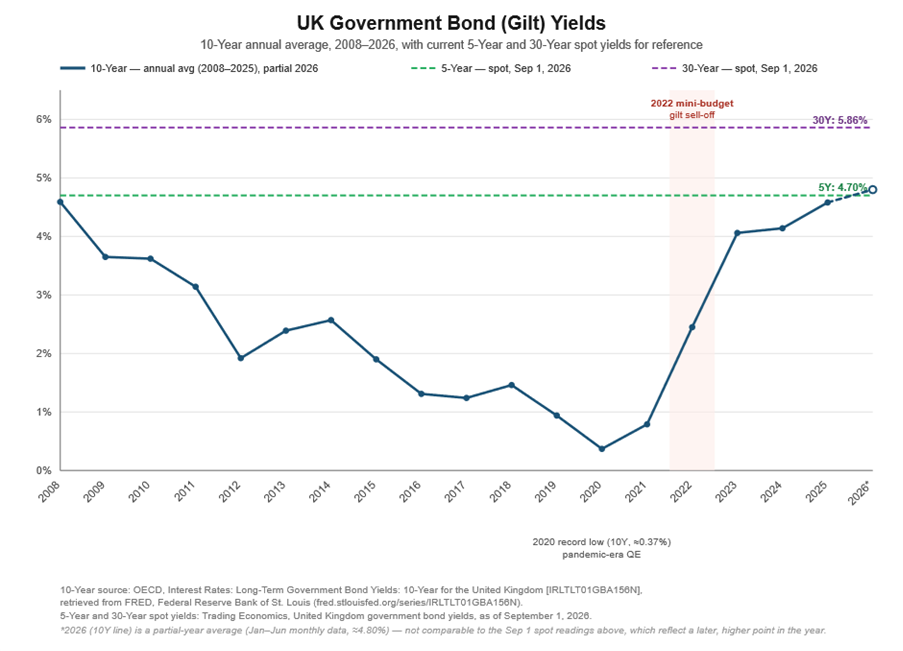
That matters for the Budget because the Office for Budget Responsibility (OBR) will need to revise up its forecast for what the government spends servicing its debt. Fiscal headroom - the buffer Healey has against breaking his own borrowing rules - stood at roughly £23-24bn after the Spring Statement. Economists now believe that buffer has been almost halved by the combination of the Iran conflict and rising borrowing costs, with some estimates putting it as low as £13bn. Whichever figure turns out to be closest, the direction of travel is the same: less room to manoeuvre, and more pressure to raise revenue rather than borrow it.
Whenever the Treasury goes looking for revenue, Insurance Premium Tax tends to come up - and this Budget cycle looks unlikely to be an exception.
IPT receipts have climbed from roughly £8.88bn in 2024/25 to £9.04bn in 2025/26, a new record, with the OBR's Spring Statement forecasts pencilling in £57.8bn of IPT revenue between 2025/26 and 2030/31 - an upgrade on previous projections. It's a tax that's cheap to collect and politically low-profile compared with income tax or VAT, which makes the standard 12% and higher 20% rates an obvious target when the Chancellor is short of money.
Read next: Insurance premium tax hits £5.52 billion amid calls for reform on health cover
Consultancy Broadstone has repeatedly argued that IPT on health insurance works against the government's own goals - taxing products like private medical insurance and health cash plans that are meant to keep people in work and off NHS waiting lists. That case didn't move the needle at last November's Budget, when rates were left unchanged. With the fiscal arithmetic now tighter, brokers advising clients on renewals may want to build in a contingency for change this time round.
One option reportedly gaining traction with government advisers is aligning capital gains tax rates more closely with income tax bands - creating 20%, 40% and 45% rates depending on the taxpayer's income. Analysis from the Centre for the Analysis of Taxation suggests this could raise in the region of £14bn a year for the Treasury.
For an industry that manages large pools of invested premium, and where broker and MGA consolidation has barely slowed in recent years, a higher and more complex CGT regime deserves attention. Lord Jim O'Neill, the former Goldman Sachs chief economist who advises Burnham, has said he expects capital gains tax to rise but warned it risks discouraging investment - telling LBC that risk-takers would likely be "discouraged" from pursuing deals they might otherwise have done. Separately, in comments on Burnham's first Commons speech, O'Neill said the tone of the government's messaging on spending was "the last thing investors want to hear."
Labour's manifesto pledge not to raise headline rates of income tax, employee National Insurance or VAT still stands. But for insurance professionals - broker principals, underwriters, anyone running payroll for a team - there are several routes to a bigger bill that don't touch that pledge at all.
Fiscal drag. Income tax thresholds have been frozen for years and are set to stay that way. That means pay rises quietly push more people into higher tax bands even though the headline rate never changes. It's worth factoring into salary review conversations, since take-home pay can fall in real terms even as gross pay keeps pace with inflation.
Salary sacrifice pensions. A cap limiting National Insurance relief on salary-sacrificed pension contributions to the first £2,000 a year is already legislated for April 2029, and there's speculation the Treasury could look at bringing that forward or going further. The Association of British Insurers and a group of insurer chief executives have already written to the Chancellor warning against tightening the rules further, citing ABI research suggesting two in five savers would cut their pension contributions if the changes went ahead.
Read next: Insurance leaders warn Chancellor against pension salary sacrifice cap
Dividend tax. Many broker principals and MGA owners pay themselves through dividends rather than salary. Rates already rose to 10.75% and 35.75% for 2026/27, and the tax-free dividend allowance is down to £500 a year, from £5,000 a few years ago. Commentary from IFA Magazine suggests dividend rates could be brought closer to income tax bands if the Chancellor needs more revenue.
Selling the business. Business Asset Disposal Relief - the reduced CGT rate available when you sell all or part of a trading business - has already been cut to 18%. Anyone weighing up an exit or succession plan for their brokerage or MGA may want to model the numbers now rather than wait for October, given CGT more broadly is one of the areas under active consideration.
Investment and property income. One idea reportedly floated by Treasury advisers is extending National Insurance to cover income from savings, property and pensions, not just employment. One City economist has put the potential revenue at around £22bn a year; others dispute that figure entirely. If it happened, it would hit anyone in the industry with a buy-to-let property or a sizeable investment portfolio, on top of anything that changes for the business itself.
None of the above is locked in - see the confirmed-versus-rumoured table above - and Treasury watchers have been burned before by speculation that never materialised. Rumours that the 25% tax-free pension lump sum was about to be cut have circulated ahead of several recent Budgets without it actually happening. But with the numbers tighter than they were even a few months ago, it's a reasonable moment to have the dividend, pension and exit-planning conversation with an accountant before 28 October, rather than reacting to the small print on the day.
It isn't all bad news from the bond sell-off. Life insurers that write bulk purchase annuities (BPA) - buying out the pension liabilities of corporate defined benefit schemes - tend to benefit when gilt yields rise, because higher yields reduce the present value of those long-term liabilities and can improve scheme funding positions, making more schemes ready to transact. Insurers with well-matched, hedged balance sheets are typically insulated from the volatility either way; those with unhedged books are more exposed to swings in both directions.
Read next: UK on track for record insurance premium tax year after strong November
Insurers holding long-duration gilts as backing assets for annuity books can also see a boost to solvency positions when yields rise, since the value of matched liabilities falls at the same time. It's one corner of the industry not approaching Budget day with dread.
Away from tax, defence spending remains a live point of tension - and one where reporting has been inconsistent, so it's worth being precise. John Healey resigned as defence secretary under Keir Starmer in June over the government's refusal to commit to spending 3% of GDP on defence by 2030. When Burnham made Healey his Chancellor, many assumed that 3%-by-2030 commitment would follow.
It hasn't. At his first PMQs, pressed again on the target, Burnham declined to confirm it, telling MPs the government would instead "set out a plan to meet our Nato commitments by 2035" - a reference to the separate NATO alliance target of 3.5% of GDP on core defence spending, agreed by member states in 2025. The current UK defence investment plan is reported to put spending at around 2.68% by the end of the decade, short of the 3% figure Healey originally pushed for.
For underwriters, the practical point is the same regardless of which target eventually sticks: sustained growth in UK and NATO defence spending is a tailwind for the specialty and reinsurance markets that write defence contractor, aerospace, cyber and marine war risk, where London market underwriters already play an outsized global role. Budget day and next year's spending review are both worth watching for procurement detail.
Burnham has said his government will be fiscally responsible and will stick to the fiscal rules it inherited from Rachel Reeves, which require day-to-day spending to be funded by tax revenue rather than borrowing. With bond markets making that harder rather than easier, most economists now expect a package of tax measures at the 28 October Budget rather than spending cuts alone.
For the insurance sector, the practical takeaway is to expect movement on IPT, watch how any CGT changes affect deal structuring, and remember that not every consequence of higher borrowing costs cuts one way - insurers with annuity books stand to gain from the same gilt market moves causing the Treasury such difficulty. On a personal level, the sensible move is to have the dividend, pension and exit-planning conversation with an adviser before the Budget, not after it.