Ask a GP receptionist, an A&E nurse, or anyone who's tried to book a same-week scan, and you'll hear the same thing: the NHS is stretched thin. That's also the conclusion of the government's own independent investigation into the health service, led by the surgeon and crossbench peer Lord Darzi, who described it as "in critical condition, but its vital signs are strong."
That review, published in September 2024, found a £37 billion shortfall in NHS capital investment and an A&E system under sustained pressure. Two years on, the metric brokers watch most closely is the elective waiting list. And it shows a service that keeps almost turning a corner, then doesn't quite make it.
NHS England's own monthly figures show the waiting list falling steadily from 7.4 million pathways in October 2025 to a three-year low of 7.11 million in March 2026, real progress. Then April brought the first rise in six months, and the list has climbed every month since, back to 7.33 million by July.
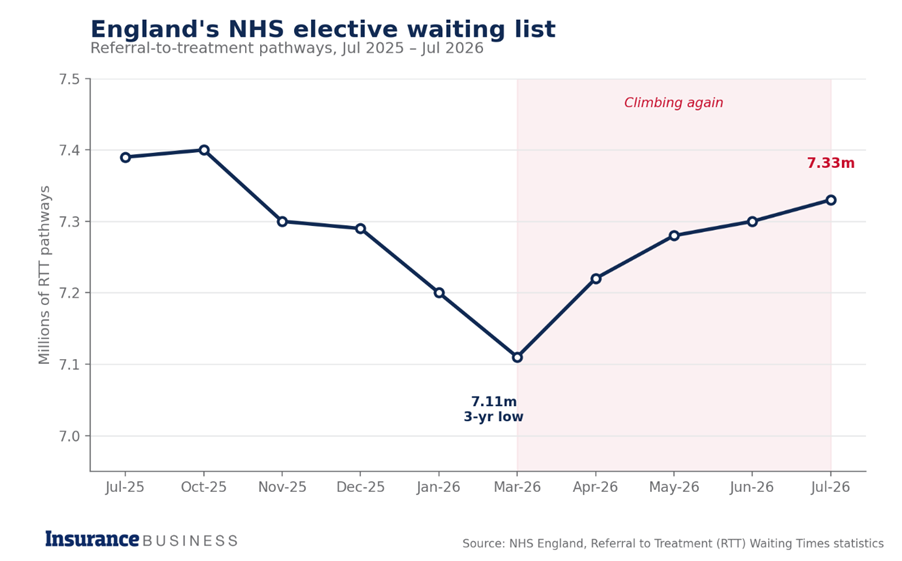
That reversal is the strongest single argument brokers have right now. "The list is still over 7 million" is old news to most finance directors. "It's grown for four straight months" is current, and it's sourced to NHS England's own data.
The headline figure hides sharp differences between specialties. NHS England'sJune 2026 data shows trauma and orthopaedics carrying the largest backlog by far. There are 830,000 people waiting, with just 61% seen within 18 weeks, followed by ophthalmology (621,000) and ENT (594,000, and the specialty furthest off target at 59%). Oral surgery and plastic surgery are smaller lists but worse-performing, both under 60% seen on time.
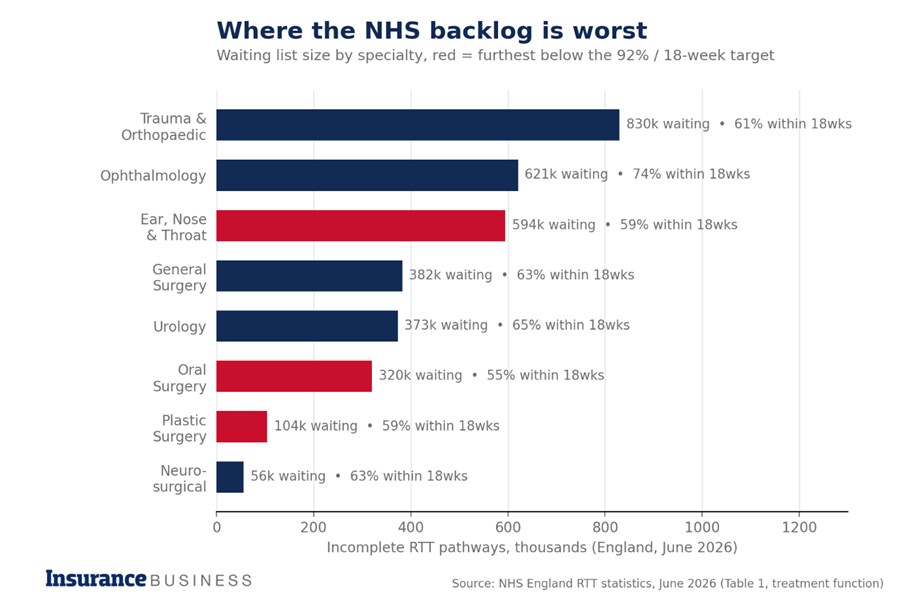
That breakdown matters for how brokers pitch cover. Hip and knee replacements, cataract surgery and ENT procedures — exactly the categories where PMI-funded treatment is cheapest and quickest to arrange — are also where the NHS backlog is heaviest and slowest to clear.
There's also a postcode effect. Analysis by insurance intermediary WeCovr of NHS England's trust-level RTT data found patients at Mid and South Essex facing waits of around 67 weeks for trauma and orthopaedic treatment, against roughly 22 weeks for the same care at Royal Berkshire. That’s a 45-week gap for identical treatment, driven entirely by where the patient lives. For employers with staff spread across multiple sites or regions, that variation is itself a reason to standardise on private cover rather than let outcomes depend on postcode.
Read next: Insurance in the spotlight as private health admissions hit new high
None of this lives in a political vacuum. Andy Burnham, who became prime minister in July after succeeding Keir Starmer, now owns this problem, with Yvette Cooper holding the health brief. Social care reform and an ageing population remain unresolved. Whoever's in No.10, the structural pressure on the NHS isn't dissolving soon.
Businesses aren't waiting for Westminster. The Association of British Insurers reported a record £4 billion paid out in individual and workplace PMI claims in 2024, up 13% year on year. Health insurance coverage reached 6.5 million people, with 4.8 million through employer schemes which is the highest workplace figure in more than three decades of ABI data.
Separate analysis from Broadstone found PMI-funded hospital admissions hit 500,000 in the first nine months of 2025 alone, up 16% on pre-pandemic levels, growth that held even while NHS waiting lists stayed broadly flat, as Insurance Business covered earlier this year.
Read next: PMI-funded private health admissions hit a new high – Broadstone
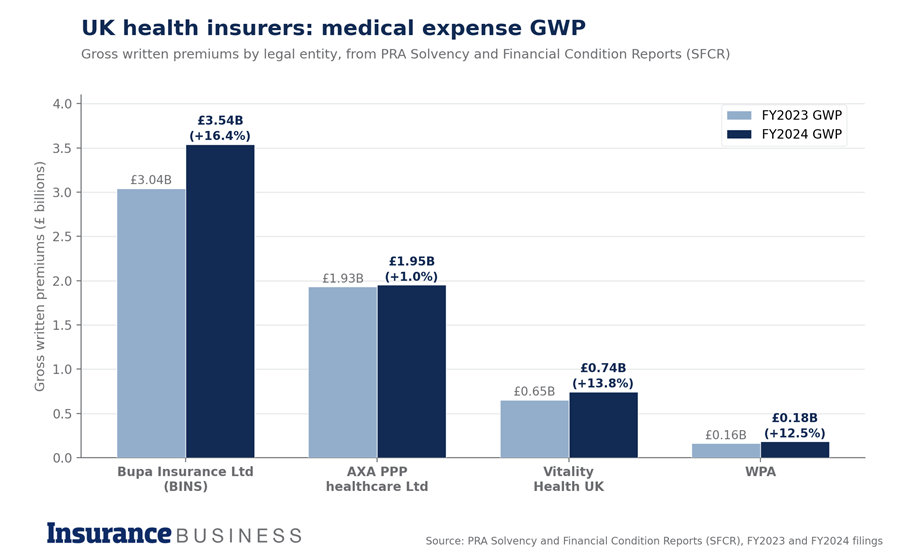
The supply side is concentrated. According to LaingBuisson's Health Cover UK Data Insights report, the "big four" — Bupa, AXA Health, Aviva and VitalityHealth — now capture 95% of the UK private medical cover market, up from 88.3% in 2017. The wider health cover market (which includes dental and cash plans alongside PMI) grew 12.2% year on year to £7.59 billion, with private medical cover alone worth roughly £6.15 billion of that.
Bupa remains the largest player by revenue and membership, though exact market shares between the four aren't published with much precision beyond that. For brokers, the concentration cuts both ways: fewer relationships to manage, but also less room to differentiate on carrier alone. Service, claims speed and how a scheme is structured for a client end up mattering more than which of the big four sits on the policy.
Demand is climbing despite a tax that makes cover more expensive every year. For some crazy reason the government taxes people who want to pay for their own medical treatment with insurance. IPT on health cover sits at 12%, and receipts have gone from £3.29 billion in 2015/16 to a record £9.04 billion in 2025/26 up 174% in a decade, as Insurance Business reported earlier this year.
Industry figures including Broadstone's Ewen Tweedie have pushed for a targeted IPT exemption on health cover, arguing the tax prices smaller employers and lower-income households out of exactly the product that eases NHS pressure.
Read next: Record IPT haul reignites industry push for health cover rethink
Read next: Brokers need to think "outside the box"
The NHS isn't finished, and PMI isn't a substitute for it. It still doesn't touch A&E, maternity or most chronic conditions. But for diagnostics, elective surgery and the specialties where the backlog is worst, employer demand keeps growing, and NHS England's own numbers now give brokers a specific, current story to tell rather than a generic one about a backlog that never moves.