The 12 Clubs of the International Group are, in Tysers' words, "stronger than ever in terms of free reserves". Their combined total is the highest in the broker's figures going back to 2018/19.
According to Tysers' 2026 P&I report, free reserves reached US$6.78bn at 20 February 2026. That is more than US$800m up on a year earlier and about 39% higher than the US$4.87bn recorded in 2022/23. Measured per owned gross ton, reserves have climbed from US$3.52 to US$4.42 over the same period.
So who does that money belong to? In a mutual, the members, and it's the point Tysers keeps returning to in this year's report. The broker argues that mutuality means Clubs should hold enough to stay stable and avoid surprise supplementary calls in bad years, and no more. It adds that 2024, which it describes as the worst claims year ever, showed the Clubs already had enough capital to cope comfortably. They now have a further US$800m on top.
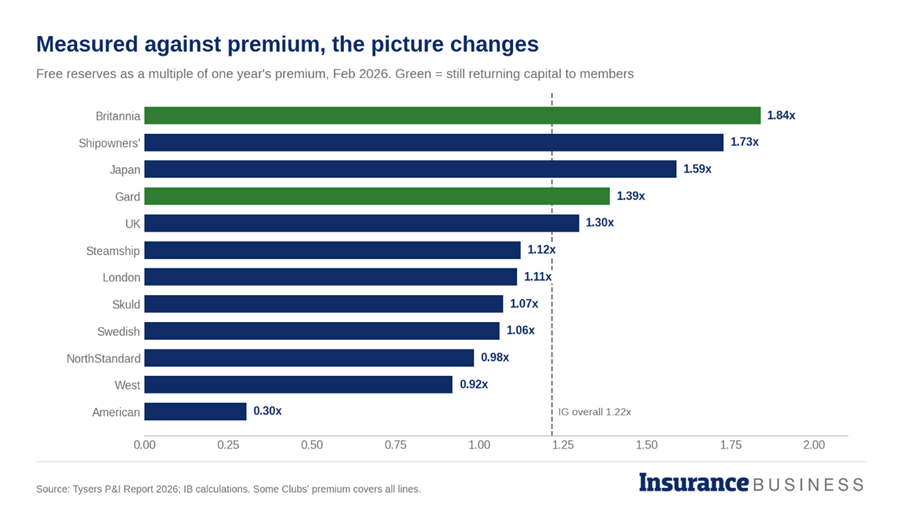
Yet Tysers found only two Clubs still returning money to members, Gard and Britannia. That is down from three a year earlier.
Read next: P&I Clubs post surplus across the board as reserves near US$6.8 billion
Gard continued its 10% owners' general discount for the 2026 policy year, worth about US$56m against P&I premium, according to Tysers. Chief executive Rolf Thore Roppestad said returning excess capital while keeping the balance sheet strong is "fundamental to how we run Gard".
Britannia has returned money two years running. It handed members about US$28.8m after the February 2025 renewal and a further US$15m in February 2026, while still growing free reserves to US$572.2m. It managed that despite a 111% combined ratio, the second highest in the group.
Read next: Britannia Group profit rebounds to US$60.9 million as claims normalise
The Shipowners' Club draws Tysers' sharpest criticism. Its free reserves rose from US$447m to US$531m, or US$15.43 per owned gross ton. That's roughly three and a half times the IG average, although small-vessel Clubs naturally score high on a per-ton basis. Measured against premium, the Club holds about 1.7 years' worth. Only Britannia holds more, and Britannia is still handing money back.
Tysers said it was "somewhat dismayed" that the Club appears to have no intention of returning capital. The Club maintains that its strong capital position leaves it well placed to keep offering "high quality, well priced P&I insurance". It still applied a 5% general increase for 2026.
There is a genuine complication. Tysers pointed out last year that fixed-premium members account for around 30% of the Club's premium, so a straight return to mutual members alone could leave them out. The broker suggested alternatives such as continuity credits.
Steamship Mutual has closed the door for now. A year earlier it distributed US$42.8m to renewing members, taking its returns over nine years to US$156m. This year, according to Tysers, it has ruled out any distribution. Its annual report describes retaining capital as "prudent stewardship".
NorthStandard, whose reserves rose from US$800m to US$923m, told members it needs to keep building its buffer. Its reasoning is that conflict, tariffs and expanding sanctions regimes have made trade and compliance harder to predict, so capital returns are not appropriate.
Read next: West of England P&I builds capital buffer
The Clubs do have a real argument, and Tysers acknowledges most of it. Standard & Poor's rating models, Solvency II capital requirements and the growth of non-mutual products all push boards towards holding more. Across the group, the average solvency capital ratio sits at 222%.
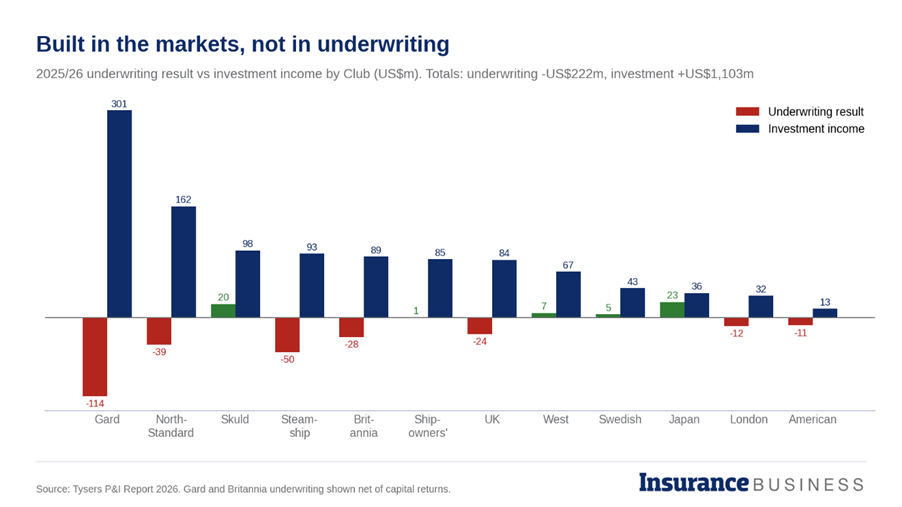
More importantly, the reserves were built in the markets, not in underwriting. The 12 Clubs made a combined technical loss of US$222m in 2025/26, comfortably outweighed by investment income of US$1.1bn. That cushion can shrink just as quickly in a bad year for markets.
Large claims are getting larger, too. The Dali casualty became the first P&I claim ever to reach the IG's overspill layer, after the State of Maryland reached a US$2.25bn final settlement with the vessel's owner and operator. Tysers notes that some overspill reinsurers initially queried Britannia's compliance with a claims cooperation clause before the claim was paid in full.
Read next: MV Dali pushes P&I market into uncharted overspill territory
Tysers expects 2027 general or target increases to land between 0% and 7.5%, similar to last year. It argues that many Clubs are well enough reserved not to need increases at all. If they push for them anyway, it wants the Clubs to be "more generous with capital distributions".
Chief executive Tom Wilson made the same point on 23 September. He told Insurance Business that the stronger Clubs' reserves mean it is "time for them to consider returning excess funds to their members".
For brokers, that gives shipowner clients a clear line of questioning at renewal: what reserve level does each Club actually target, and what happens to anything above it? A Club asking for 5% while sitting on reserves worth more than a year and a half of premium, and returning none of it, may struggle to give a convincing answer.
Read next: Swedish Club sets 5% general increase for 2026/27