Most insurers would expect a pat on the back for breaking even on underwriting and growing reserves by almost a fifth in a year. The Shipowners' Club has been bumped down a place instead.
In its 2026 P&I report, Lloyd's broker Tysers moved the small-vessel specialist from second to third in its ranking of the 12 International Group (IG) Clubs. Its explanation was blunt: it now considers the Club's free reserves "excessive". Skuld takes second place, and Gard keeps top spot for its ability to absorb a difficult year and still hand premium back to members.
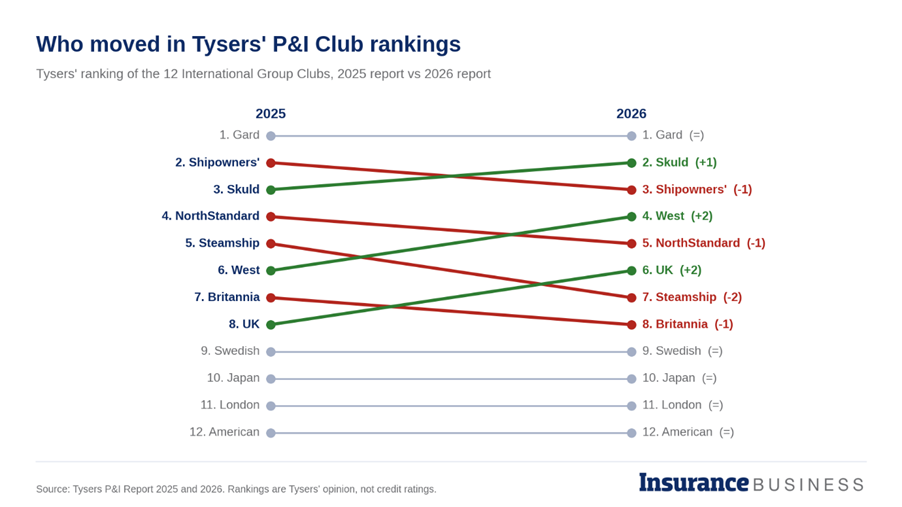
The table is one broker's opinion, not a credit rating. Still, it offers a useful snapshot of how a specialist marine broker sees the Clubs heading into the February 2027 renewal. This year's order also says a fair amount about what Tysers thinks a mutual is for.
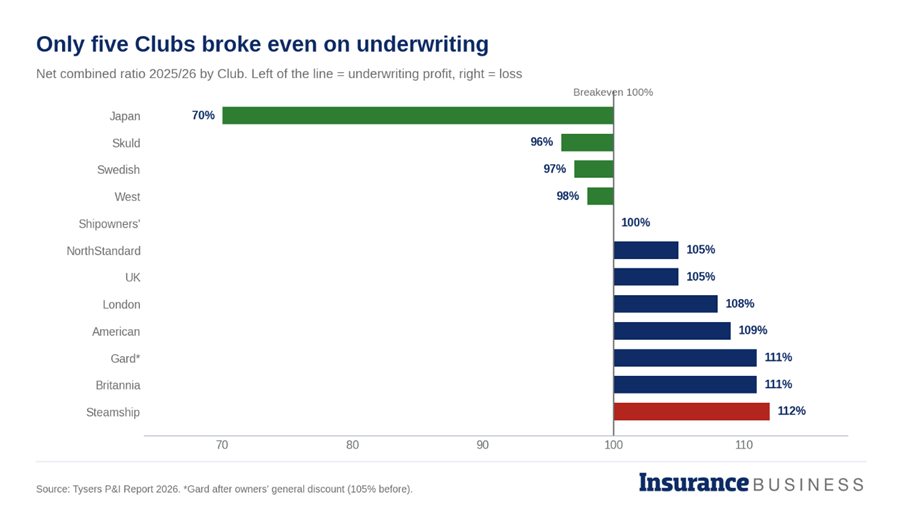
On paper, the Shipowners' Club had another steady year. Its combined ratio came in at around 100%, with a five-year average of 98.6% and a ten-year average of 100.1%. That's close to the textbook definition of a mutual providing cover at cost.
Investment returns of just over 10%, worth about US$85m, lifted free reserves from US$447m to US$531m. That works out at US$15.43 per owned gross ton, roughly three and a half times the IG average of US$4.42, although small-vessel Clubs naturally score high on a per-ton basis.
It's quite a reversal. A year ago, Tysers promoted the Club three places to second, citing its consistent underwriting and growing free reserves. Even then, the broker suggested that US$447m was more than enough.
This year Tysers said it was "somewhat dismayed" that the Club showed no sign of returning any capital. It added that it was struggling to accept that reserves well above US$500m were appropriate for a Club insuring only smaller vessels. The Club's position, set out in its annual report, is that its board reviewed capital levels and judged them appropriate for the risks it carries.
It hasn't held back on price either. The board resolved that a 5% general increase would be applied for 2026, citing inflation and an imbalance between premium and claims.
There is also a new face at the top. Marcus Tarrant joined the Club in 2014 as chief actuary, became CFO in 2023, and took over as chief executive in June 2026. Tysers noted drily that he is the third CEO in under five years.
Read next: P&I Clubs post surplus across the board as reserves near US$6.8 billion
Skuld's promotion from third follows a sharp underwriting turnaround:
Tysers gently teased the Club over the self-congratulatory tone of its annual report. That included a photograph of chief executive Ståle Hansen with King Charles III at Windsor Castle.
The broker still concluded that Skuld had "an excellent year fully in tune and not missing a beat". Hansen's own summary, in the Club's annual report, was that diversification "is not simply a strategy, it's a core source of resilience."
Read next: Skuld bucks P&I market trend with sharp profit jump
The West of England jumps two places, from sixth to fourth, after what Tysers called a run of good results. Its 2025 combined ratio was 98%, and its three-year rolling average sits at 99%, inside its own sub-100% target. Free reserves reached a record US$377m. More than a quarter of the Club's income now comes from non-mutual covers, a notable shift for a Club Tysers describes as having once treated diversification as taboo.
S&P upgraded West to A- with a stable outlook, pointing to improved performance that has seen it outperform many IG peers in recent years. Group CEO Tom Bowsher said the year to 20 February 2026 was the fifth running in which West's combined ratio beat the average of its IG peers. Tysers noted one catch: S&P has signalled that any further upgrade depends on West gaining scale and diversifying further.
Read next: West P&I's S&P gets an upgrade – but who gets the credit?
The heaviest criticism in the report was reserved for Steamship Mutual. It slides two places, from fifth to seventh, and into the bottom half behind the UK P&I Club.
Its 112% combined ratio was the worst in the IG. By Tysers' count, five of the past eight years have come in above 110%, and the Club has made an underwriting profit in only two of those eight. Steamship's conservative investment approach, with equities at around 7% of the portfolio, meant it didn't enjoy the 10%-plus returns seen elsewhere.
Tysers also took aim at the Club's annual report. It called the report "disappointingly loaded with generalisations and little to support them" and questioned what its repeated references to "resilience" meant in practice.
Steamship sees things differently. It points to free reserves of US$578m, an S&P A rating and a 220% Solvency II capital ratio. Chief executive Jonathan Andrews highlighted "record free reserves, our best ever investment return alongside tonnage growth".
Members are paying more either way. Lockton's renewal review found that Steamship and the American Club set the highest general increases in the IG for 2026/27, at 8%.
Read next: Steamship Mutual insured shipowner sued £900 million over fuel and nurdle spill
Tysers themed this year's report around musical instruments. Gard is the grand piano, Steamship the trumpet (for blowing its own) and the American Club gets the gong.
Further down the table, the UK P&I Club climbs two places to sixth, a move Tysers links to its planned merger with the TT Club. NorthStandard slips one place to fifth and Britannia one place to eighth. The bottom four are unchanged: the Swedish Club, the Japan P&I Club, the London P&I Club and the American Club.
The Japan Club posted the best combined ratio in the group, at 70%, but Tysers says it is held back by its lack of geographical spread. The American Club closed a policy year without an unbudgeted supplementary call for the first time in years. It remains the only IG Club rated below investment grade by S&P, at BB+.
Read next: UK P&I and TT Club close in on Thomas Miller takeover bid
Three of Tysers' top four, Gard, Skuld and West, now run diversified books alongside mutual P&I. Steamship pitches itself as a dedicated P&I specialist, and Tysers' response was that the diversified Clubs "happen to be performing rather better". The Shipowners' Club, a pure P&I Club, earned its demotion for hoarding rather than underperforming.
Tysers will revisit the Clubs' renewal strategies in its December update, after the 2026 half-year results.