Ask a chatbot for advice on your pension, your mortgage or your protection cover, and there's now a better-than-even chance you'll be acting on something wrong.
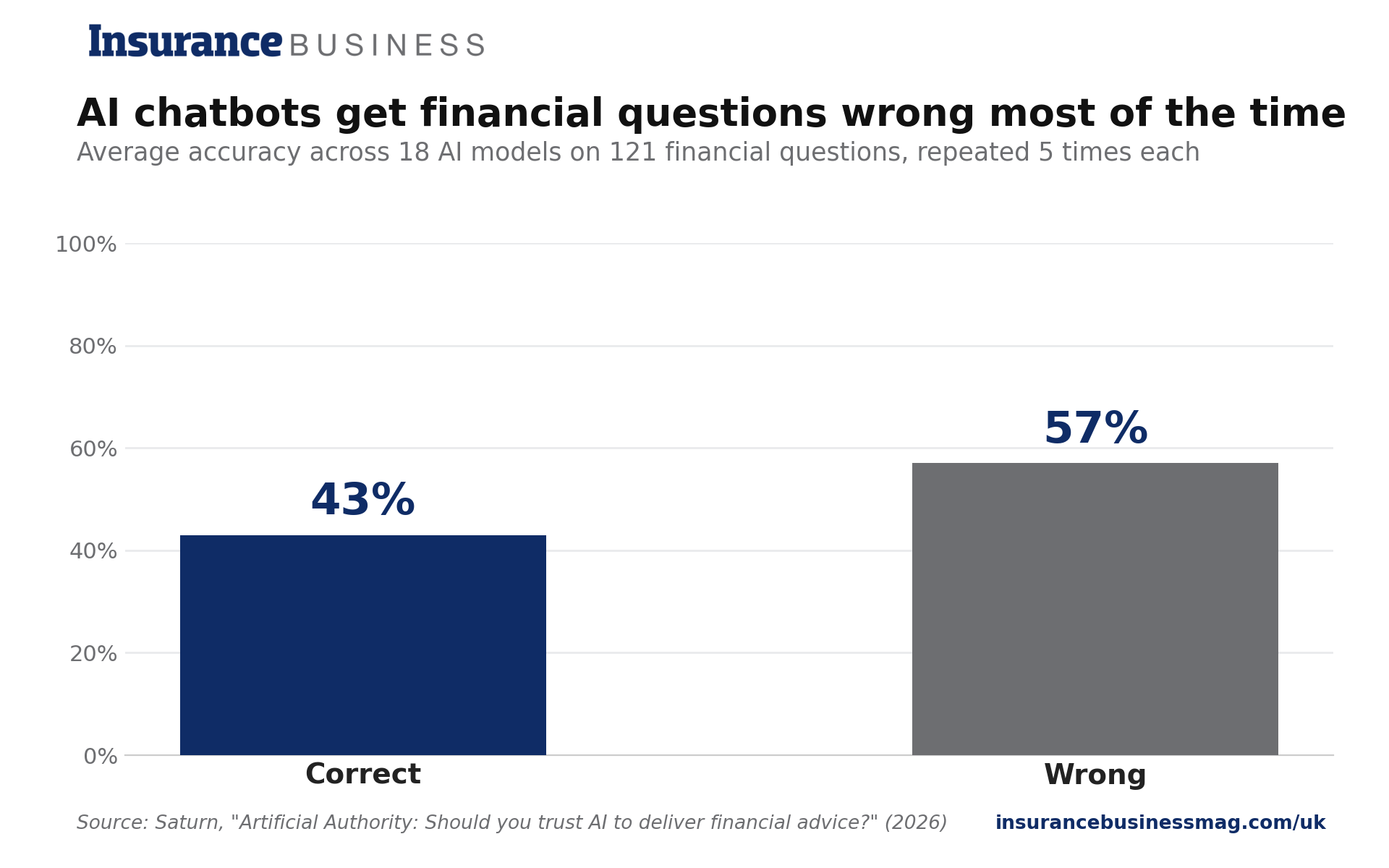
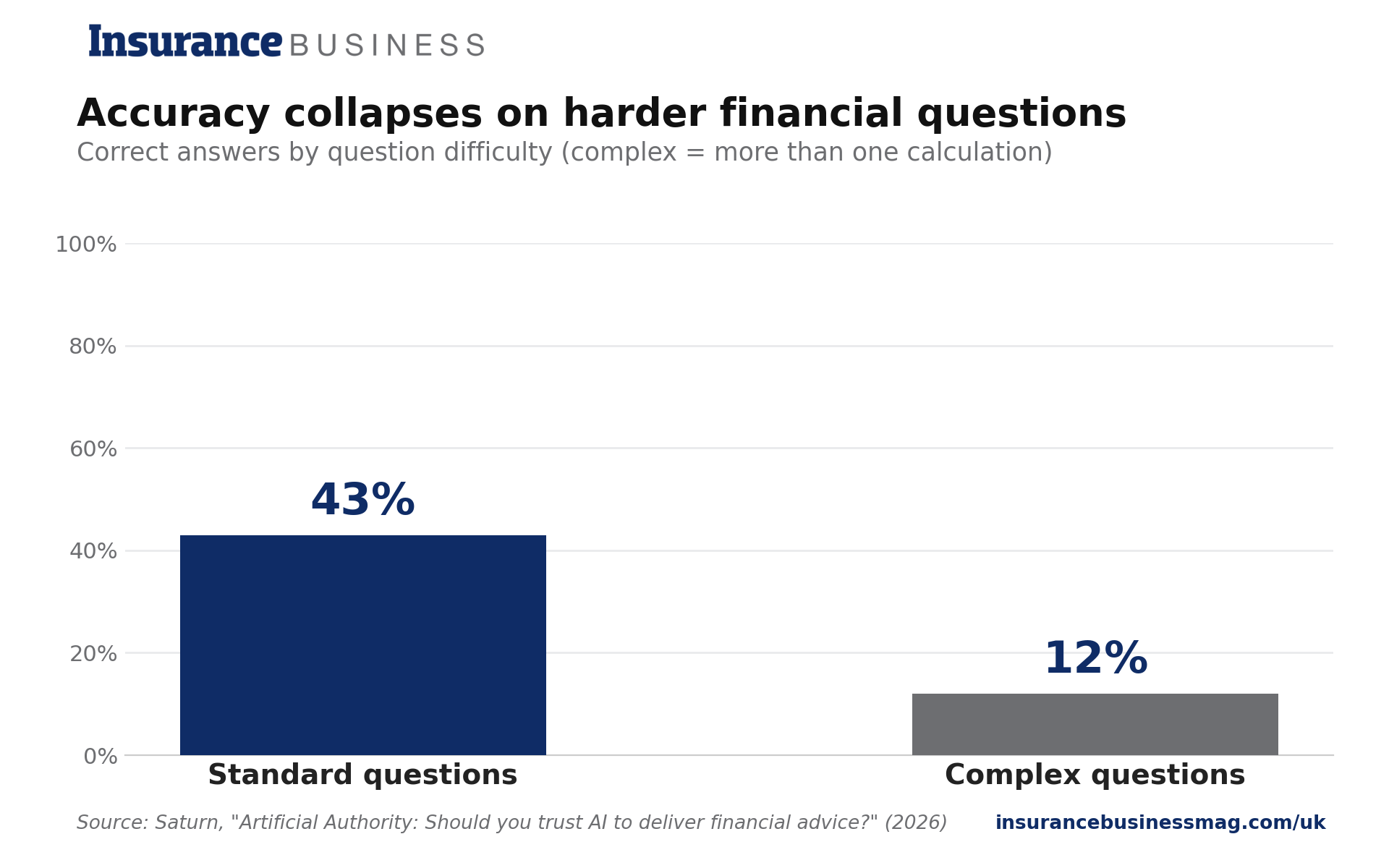
That's the headline finding from new research by fintech firm Saturn, which tested 18 popular AI models, including versions of ChatGPT, Claude, Copilot, Grok and Gemini, against 121 real financial questions. Each question was asked five times to check consistency, producing more than 10,000 answers in total. The models got it wrong 57% of the time. On harder, multi-step questions, the error rate climbed to 88%, with the weakest models failing 99% of the time.
Saturn's report catalogues errors that go well beyond small rounding errors. One free model reportedly invented a pension tax rule that could have exposed a saver to a £17,500 charge from HMRC. Another fabricated a student loan repayment exemption for graduates moving abroad, a rule that doesn't exist anywhere in UK policy. A third wrongly told a borrower that a mortgage payment holiday wouldn't touch their credit score, when in reality it can, making it harder to secure a competitive rate down the line.
Read next: FCA's AI review raises alarm over consumer trust
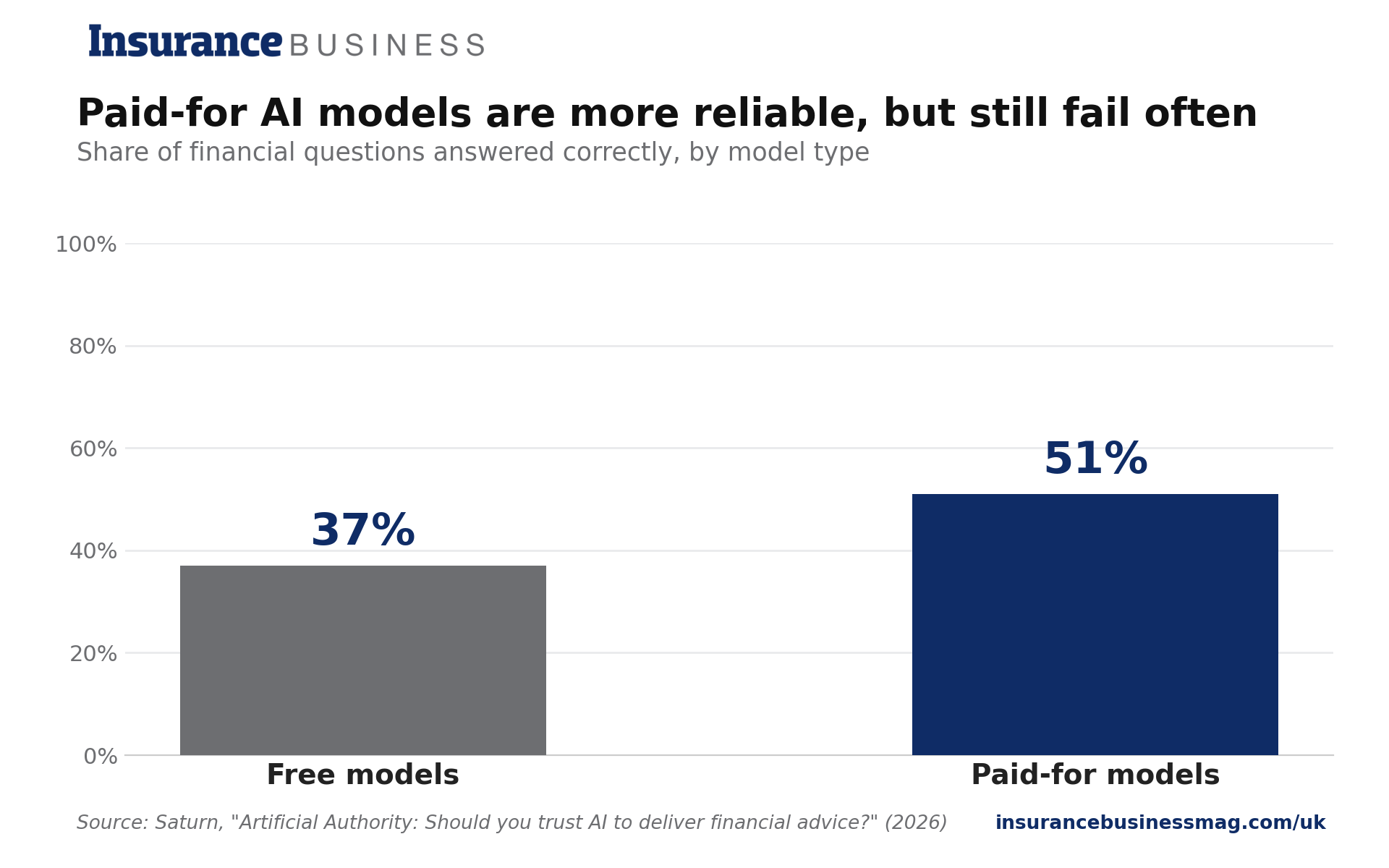
Saturn's chief executive, Amal Jolly gave everyone a warning when she said: "Millions of people are trusting the AI models for money advice, but they are getting wrong answers that can lose them money." Paid-for models did outperform free ones, and newer versions beat older ones, but even the strongest performer in the study, a "reasoning" mode of Claude Opus 5, still got close to four in ten answers wrong. For an insurance and advice sector that lives or dies on getting suitability right, a 39% failure rate wouldn't survive a single file review, let alone a regulator's.
The Financial Conduct Authority's Mills Review, published earlier this year, found that roughly one in five UK adults, around 11 million people, would be comfortable letting AI make financial decisions for them. Appetite was highest for exactly the kind of complex calls this research shows chatbots handle worst: debt, pensions and investments.
Brokers and advisers have good reason to be sceptical of what that trend means in practice. It's one thing for a consumer to ask a chatbot to explain a concept. It's another for them to walk away believing they've had "advice" with none of the safeguards that come with the real thing.
The UK's protection gap is already substantial: according to the Income Protection Task Force, 85% of income protection needs in the UK remain unmet, despite ABI reports that protection insurers paid out £7.84 billion in claims in 2025 alone. That's support that never reaches households who assumed a five-minute chatbot conversation had them covered.
Read next: AI is creating better informed customers but increasing the risk of misinformation
David Brooks, head of policy at Broadstone, has made a similar point about advice, warning that consumers need to treat AI "as a starting point, not a substitute for professional guidance, scheme information or regulated advice," and that trust "should be earned through accuracy and accountability, not assumed because an answer sounds convincing." Saturn's data suggests a lot of that trust is currently handed out on credit the technology hasn't earned.
Sarah Coles, head of personal finance at AJ Bell, said advisers are already fielding calls from clients who've acted on odd AI-generated suggestions and want reassurance nothing has gone wrong. That raises a bigger, uglier question for the insurance market: when a business embeds a chatbot into client-facing work and it hallucinates a rule, who pays?
George Grimshaw, divisional head of cyber and technology at The Clear Group, has pointed out that insurers are usually cautious about emerging risk but have been unusually quick to fold AI exposure into everyday underwriting. Poor AI governance, he's warned, could just as easily trigger compliance-driven claims or regulatory fines as a straightforward professional indemnity dispute.
“Despite the insurance market being somewhat more cautious when it comes to emerging risk, AI seems to be an exception to the rule with many in the market being quick to welcome AI risk as part and parcel of underwriting UK business risk,” he told Insurance Business.
Saturn's error rates make that risk look a lot less theoretical.
Read next: When AI gets it wrong: insurers examine professional liability risk
The regulatory backstop that normally catches a bad outcome doesn't apply here. Anyone who gets poor advice from an authorised adviser can go to the Financial Ombudsman Service and, in the worst case, the Financial Services Compensation Scheme. Someone acting on a free chatbot's confidently wrong answer has no equivalent.
As Jolly put it, AI financial advice is "currently unregulated, leaving consumers with none of the protections... that they would get if they went to a human adviser," and the FCA "needs to act fast to protect people." The Chartered Insurance Institute has raised a related concern closer to home, warning of a widening "fluency gap" between how quickly firms are adopting AI and how well they understand its limitations.
Read next: CII warns of AI 'fluency gap' threatening responsible adoption across insurance
Coles concedes chatbots can still be a reasonable starting point for basic budgeting. But Saturn's research draws a sharp line between what these tools are actually reliable at and what consumers are trusting them to do: insurance, tax, pensions, other protection needs, exactly the products brokers and advisers exist to get right. Regulated advice comes with qualified people, an audit trail, and a compensation scheme standing behind it if it goes wrong.
A chatbot offers none of that, however confident it sounds. Until the FCA works out where these tools sit within the regulatory perimeter, brokers now have a concrete, well-evidenced reason to make the case for a human adviser over a search box, and this research is worth promoting.