
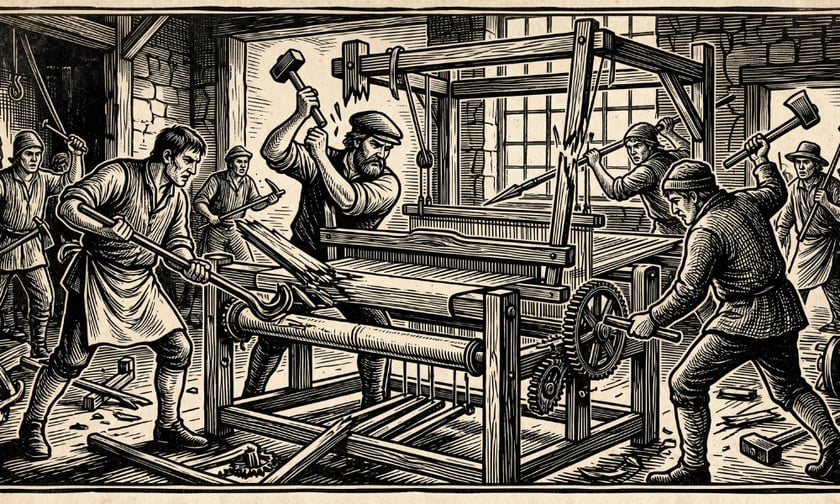
In 1812, a British magistrate named Joseph Radcliffe wrote to London warning that the textile districts of Yorkshire were ungovernable. Skilled weavers were smashing mechanised looms by night, burning mills, and threatening factory owners with death. The British government responded by making loom-breaking a capital offence and deploying more troops to the region than Wellington had taken to the Iberian Peninsula.
The Luddites lost. The looms won. And within two generations, the textile industry employed more people than it ever had before - though not the same people, not in the same places, and not doing the same work.
That is the pattern. It has repeated with the steam engine, the automobile, the mainframe, and the spreadsheet. Each time, the jobs being destroyed were visible and concentrated; the jobs being created were diffuse, delayed, and unimaginable in advance. Each time, the transition was longer and more painful than the boosters promised. Each time, the net outcome was positive - eventually.
Artificial intelligence is the next iteration. For insurance professionals, the question is not whether the pattern will repeat. It is where in the cycle they currently stand, and what that implies about the decisions they should be making now.
The Wall Street Journal published a survey on June 9, 2026 of sixteen leading economists on AI and the labour market - including Daron Acemoglu of MIT, winner of the 2024 Nobel Memorial Prize in Economic Sciences, alongside former White House advisers and senior faculty from Harvard, Stanford, and Yale (Te-Ping Chen and Justin Lahart, The Wall Street Journal, June 9, 2026). The results reveal a profession that is certain about one thing and divided about almost everything else.
All fifteen economists who responded agreed that AI will meaningfully boost labour productivity - a rare consensus in a field that treats disagreement as a professional virtue. On the question of jobs, however, the survey split almost evenly: five expected net job losses, eight expected no significant change, and two expected net growth. On whether AI will widen or narrow inequality, seven predicted it would widen the gap; five thought it would narrow.
The disagreement is itself informative. These are not uninformed observers. It reflects the genuine uncertainty embedded in every historical technology transition: the displacement is legible well before the reinstatement becomes visible.
Michael Strain of the American Enterprise Institute put the historical calibration plainly: "It is true that, over the medium run, new technologies make (basically) everyone in society better off. But the Industrial Revolution left average real wages stagnating and the quality of non-wage amenities declining for four decades." He sees no basis for assuming AI will be different.
The phrase "four decades" deserves to sit with the reader for a moment. An insurance professional entering the workforce today will be in mid-career before the transition, if it follows historical precedent, has fully resolved.
Historical technology waves
How long did each transition take?
Approximate years between major displacement and visible labour market recovery. The AI transition is already underway.
Sources: Historical estimates; Michael Strain / AEI; academic literature. Chart: Insurance Business
The timing of each subsequent technology shock compressed, but the structure remained consistent:
The automobile (1910s–1940s): Horse-drawn transport, carriage makers, and blacksmiths were largely eliminated within a generation. The United States simultaneously created millions of jobs in manufacturing, road construction, petroleum, roadside hospitality, and motor insurance - an entirely new line of business that did not exist in 1900.
Industrial automation and computers (1950s–1970s): Concerns about mass unemployment were serious enough that President Lyndon Johnson assembled a National Commission on Technology, Automation, and Economic Progress. Its conclusion, now famous, was that "technology destroys jobs, but not work." The commission was right. Manufacturing employment contracted, but white-collar knowledge work expanded dramatically - much of it in insurance and financial services.
David Deming, Dean of Harvard College, used the history of telephone switchboard operators to make the same point to the WSJ: those workers were displaced essentially overnight by mechanical switching technology, but the women who would have entered the profession became stenographers, administrative assistants, and other roles instead. His conclusion is worth holding: "People are the ultimate general-purpose technology."
Office automation and the internet (1980s–2000s): Approximately 700,000 manufacturing jobs and 600,000 secretarial roles were eliminated in the United Kingdom alone. Travel agents, bank tellers, and telephone operators saw their professions decimated or restructured. The insurance industry lost its typing pools, its hand-drawn actuarial tables, and its armies of claims processors - and replaced them with underwriters, data analysts, and relationship managers.
In each case, displacement was visible, concentrated, and rapid. Creation was diffuse, gradual, and hard to attribute to any single cause. That asymmetry creates a persistent illusion: the jobs being lost are on the front page; the jobs being created are not yet legible.
Previous technology waves primarily automated physical or clerical tasks: weaving cloth, assembling cars, typing letters, routing telephone calls. Artificial intelligence targets cognitive and analytical tasks that were previously considered immune to automation - reading and summarising documents, assessing risk, detecting fraud patterns, drafting correspondence, analysing medical images, generating legal summaries.
Justin Wolfers of the University of Michigan was blunt: "I think of AI as doing cognitive work, so this is a revolution coming squarely at white-collar workers. I now know what blue-collar workers felt like in the 1970s."
The scale of the projected shift reflects this. The World Economic Forum's Future of Jobs Report 2025, drawing on surveys of more than 1,000 employers representing 14 million workers, projects that 92 million jobs will be displaced globally by 2030, while 170 million new roles will be created - a net gain of 78 million positions. The report also found that 86% of employers expect AI to transform their business within five years, and that 40% of core skills will change within that period (World Economic Forum, Future of Jobs Report 2025, January 2025).
Goldman Sachs has estimated that generative AI could automate tasks equivalent to approximately 300 million full-time jobs worldwide, with two-thirds of current roles exposed to some degree of disruption - framed by the authors themselves as exposure rather than certain replacement (Goldman Sachs Global Investment Research, updated through 2025). Financial services and insurance sit among the highest-exposure sectors in both analyses.
The insurance pincer
Insurance sector leads on AI hiring — by a wide margin
Percentage of employers planning to hire staff skilled in working with AI. Insurance and pension fund employers significantly outpace the global average, even as entry-level roles are being automated away.
Sources: The Institutes Knowledge Group, 2026 Skills Report; US Bureau of Labor Statistics. Chart: Insurance Business
Insurance faces a challenge that is simultaneously an old one and a new one. The industry's core functions - assessing risk, pricing coverage, processing claims, managing relationships - have always involved a high ratio of information processing to genuine judgment. The information-processing component is precisely what AI handles best.
David Autor of MIT was direct: workers in "routine information-processing roles - adjusting insurance claims, translating documents, writing standard ad copy - face genuine displacement risk." He is naming insurance claims adjustment not as an illustration, but as a primary example.
The structural pressure is already measurable. As Insurance Business reported this week, the US Bureau of Labor Statistics projects approximately 400,000 insurance workers will retire by 2026. At the same moment, AI is automating the entry-level roles that historically served as the industry's recruitment pipeline. The 2026 Skills Report from The Institutes Knowledge Group - drawing on data from more than 170,000 course completions and over 10,000 designations earned in 2025 - found that 91% of insurance and pension fund employers now plan to hire staff skilled in working with AI, well above the global employer average of 62%.
The result is a pincer movement: the talent pipeline narrowing from below while the top of the organisation faces a retirement exodus. The skills that automation handles worst - strategic thinking, client relationships, regulatory judgment, complex claim resolution - are precisely the skills the industry is now racing to develop.
Crawford & Company's Chief Technology Officer Joel Raedeke has identified the deeper paradox: AI delivers the greatest value when operated by seasoned professionals rather than inexperienced staff. By removing the entry-level roles where experience is built, the industry risks eliminating the training ground that produces the expert judgment AI cannot replicate. This is not an argument against adoption. It is an argument for intentional workforce strategy alongside it.
Ajay Agrawal of the University of Toronto's Rotman School of Management offered the most pointed strategic observation for insurers. He told the WSJ that the industry's value proposition may shift fundamentally - from "repair and replace" to "predict and prevent." That is not merely a product innovation. It is a redefinition of what insurance professionals are paid to do.
If history is any guide, the industry will not simply lose roles - it will gain roles that do not yet have established names. The WSJ economists' analysis suggests where to look.
The roles that will be most protected - and most generously rewarded - share a common characteristic: they require the kind of judgment that cannot be reduced to historical data. Oversight of AI-driven claims and underwriting processes, where accountability cannot be delegated to a model. Complex and novel risk assessment, where the underwriter who can price climate, autonomous vehicle, or AI liability risk faces no algorithmic competition. Client relationship management at moments of genuine distress, where a policy is being tested rather than sold. And the emerging discipline of AI governance within carriers - bridging actuarial knowledge, model risk, and regulatory compliance in ways that neither actuaries nor data scientists currently do alone.
Acemoglu summarised the direction of travel: interpersonal and social skills will become more important as AI takes on more codifiable knowledge work. Harvard Business School's Rafaella Sadun added a dimension specific to organisations in transition: the ability to build coalitions, manage resistance, and help people adapt will carry a premium precisely because AI creates internal winners and losers as surely as it creates external ones.
Intellectual honesty requires acknowledging what the record consistently shows: the adjustment is real, uneven, and long. Workers in routine roles and those with limited adaptability face significantly greater re-employment challenges than their more flexible peers - a finding confirmed by studies of automation's impact on plant closures in Australia and Belgium, and analyses of mass layoffs in Germany and Sweden (Beer et al., 2019; Goos et al., 2021; Blien et al., 2021, as cited in Industrial and Corporate Change, Oxford Academic, November 2025).
Acemoglu was among the more pessimistic of the WSJ economists: both robot adoption and trade shocks had "fairly negative displacement effects that were long-lasting, because they were sudden and the jobs they impacted were concentrated in certain local labor markets." There is, he said, "a lot of evidence suggesting that those workers will lose out and inequality will increase."
Autor was measured but clear: whether AI's gains are broadly shared "do not depend on the technology. They depend on the societal institutions and policies we build to share the gains and redress the costs." The United States, he observed, is currently unprepared, with prevailing signals from Washington and Silicon Valley amounting to "let it rip and damn the consequences."
The insurance industry has a specific reason to take that dimension seriously. The sector is the primary mechanism through which economic losses are absorbed and shared. An industry that automates its own workforce without adequate transition support generates ethical and reputational exposure - precisely the kind of risk that insurers are supposed to understand better than anyone.
Rebecca Henderson of Harvard Business School offered perhaps the most candid assessment in the WSJ survey: she expects this disruption to be significant enough that affected workers will eventually "get very, very angry and change the politics." She was honest about the limits of historical analogy: "I don't think we've ever really seen anything moving with this scale and speed before. It's going to be a wild ride."
That combination - a well-understood historical pattern operating at unprecedented scale and speed - is exactly what makes this moment both legible and dangerous. The Luddites smashing looms in Yorkshire were not wrong about what was being lost; they simply had no way to see what was being built. Insurance professionals today have an advantage the weavers did not: two centuries of evidence about how these transitions unfold, a clear picture of which skills survive them, and enough lead time to act.
The algorithm is not the enemy of the insurance professional. But the industry that waits for certainty before preparing will find, as every previous generation did, that the certainty arrives too late. The prudent response is the one that good risk management always demands: clear eyes, early action, and an honest accounting of what is at stake.
Sources: Te-Ping Chen and Justin Lahart, "Economists Weigh In on the Future of Work and AI," The Wall Street Journal, June 9, 2026; World Economic Forum, Future of Jobs Report 2025 (January 2025); Goldman Sachs Global Investment Research; The Institutes Knowledge Group, 2026 Skills Report; US Bureau of Labor Statistics; Beer et al. (2019); Goos et al. (2021); Blien et al. (2021) and Olsson & Tåg (2017), as cited in Industrial and Corporate Change, Oxford Academic (November 2025); IMF Finance & Development (December 2025); Deloitte UK (February 2026).




