Nonqualified deferred compensation plans have always lived in executive benefits territory, sold by specialists to a narrow slice of C-suite clients. That's starting to change, and the shift shows up clearly in NFP's newly published 2026 US Executive Benefits Trend Report, which surveyed 273 executive benefits decision-makers nationwide with research firm Empatix.
Buried in the report is a line that matters more to group benefits brokers than it might first appear: as more employees move into higher compensation brackets, many for the first time, demand for tax-efficient deferral tools is expanding "beyond traditional executive populations to include a broader range of key employees." That's a signal that a product category group brokers have historically treated as someone else's specialty is starting to touch their own client base.
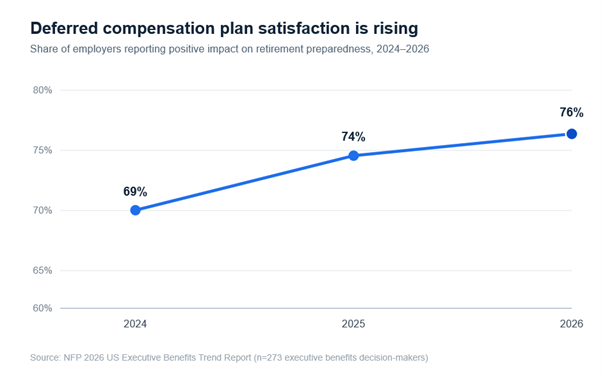
Two forces are pushing deferred comp downstream. First, a SECURE Act 2.0 provision that took effect this year requires employees aged 50 and older earning above roughly $150,000 in prior-year FICA wages to make catch-up retirement contributions on an after-tax Roth basis rather than pre-tax. That threshold catches plenty of people who aren't executives in the traditional sense — senior managers, directors, high-earning specialists, anyone a few years from a title change rather than already in the corner office. It strips away a tax-planning lever many of them were relying on. NQDC arrangements aren't subject to that rule, which is part of why 82% of employers in NFP's survey say deferred comp plans now have a high or moderate impact on overall plan success, and why satisfaction with those plans has climbed from 69% in 2024 to 76% this year (see chart below).
Second, and more directly relevant to group brokers: compensation growth itself is pulling a wider swath of the workforce into the income band where these tools start to make financial sense. That's a population group benefits brokers already serve. It's not a hypothetical cross-sell — it's an existing book of clients whose second- and third-tier leadership are becoming candidates for a product most brokers aren't positioned to discuss on their own.
Read next: Employers chase cost cuts, leaving benefits brokers at a crossroads
NFP's data points to a second, related opening. Only 28% of key employees say they fully understand the executive benefits available to them; the rest are either muddling through with unanswered questions or outright confused. In response, 23% of employers plan to increase participant education around deferred compensation plans over the next 12 to 18 months, and others are expanding access to financial planning and advisory support.
That's an advisory gap, not a product gap — and advisory gaps are where brokers earn their retainer. Specific, defensible plan-design conversations tend to do more for a broker's standing with a client than a general wellness pitch, a dynamic that holds whether the plan in question is a health plan or a deferred comp arrangement.
Read next: Employers think their benefits show care. Workers disagree
None of this requires a group benefits broker to start designing NQDC plans. A workable model looks more like a division of labor: the executive benefits specialist handles plan structure, funding vehicles like BOLI/COLI, and compliance; the group broker owns the communication layer — helping HR explain eligibility, tax treatment, and distribution timing to a newly eligible cohort of key employees who've never had to think about deferred comp before. That's a natural extension of the total-rewards conversations most group brokers are already having with HR and finance leaders, not a new specialty to build from scratch. Formalizing a referral relationship with an executive benefits team — rather than staying silent when a client's compensation structure changes — is the more concrete version of that pitch.
Where this connects to retention pressure clients already feel
The timing helps the case. Eighty-one percent of employers in NFP's survey say they cannot afford to lose top talent, and 99% report their executive benefits have been successful in retention. Those numbers sit inside a broader anxiety about the economy — 94% of employers are at least somewhat concerned, and 95% say they don't know what to expect next — that is pushing companies toward tools they can control, like compensation structure, rather than ones they can't, like the economy itself.
Read next: AI in benefits is a trust problem, not a technology problem
For group benefits brokers already fielding questions about how to keep clients' second-tier leadership engaged, deferred compensation education is a logical extension of ground they're already standing on — not a new specialty, just a wider lens on the same client relationships.