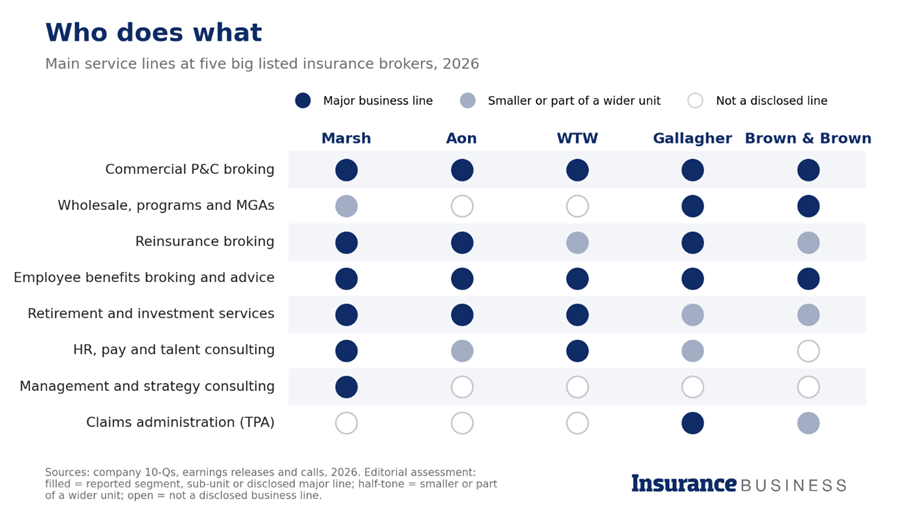
Aon. Marsh. WTW. They all have short catchy names now, and none of the three leads with the word "broker" any more. Marsh sponsors Formula1 now and calls itself "a global professional services firm" in its latest quarterly filing. WTW's sponsors Italian club Juventus and its results describe it as "a leading global advisory, broking and solutions company." Aon sponsors Ferrari’s F1 team and splits its business into Risk Capital and Human Capital rather than broking and consulting, maybe because it’s descriptive, maybe because it sounds cooler to the marketing consultants they doubtlessly employed.
The labels, do however, reflect real individual businesses (with bountiful cross-sell opportunities). Each firm runs a large arm advising employers on health benefits, pensions, investments and pay, and Marsh also owns a management consultancy, the former Oliver Wyman. Last Thursday, Marsh chief executive John Doyle went further. "We believe we can be the most impactful professional services firm in the world," he told analysts.
The segment figures in the three firms' filings give a clearer answer than the branding, and it differs from firm to firm.
In 2025, Marsh earned 36% of its segment revenue from Consulting and 64% from Risk and Insurance Services, according to its full-year results. Aon took 34% from Human Capital and 66% from Risk Capital, according to its 2025 annual report. WTW was the outlier: 55% of its segment revenue came from Health, Wealth & Career and 45% from Risk & Broking, according to its full-year release.
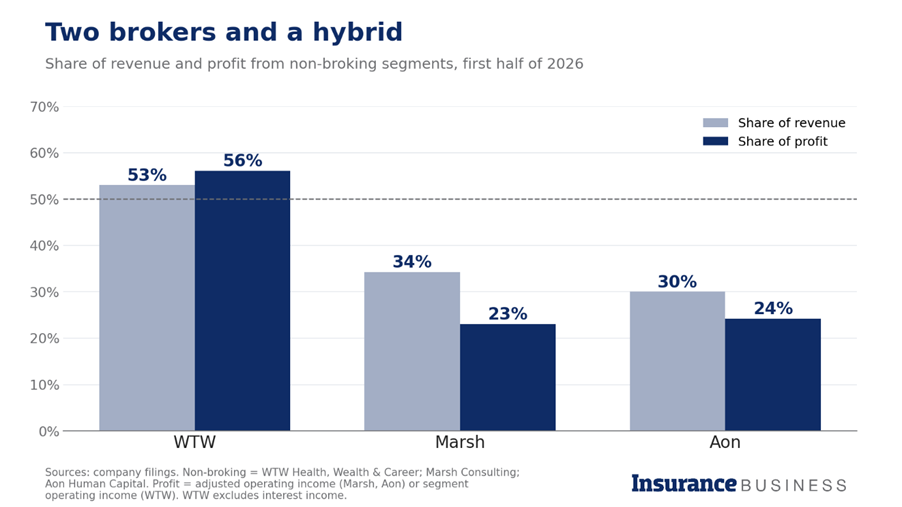
Profits largely follow the same directions. In the first half of 2026, Marsh's Consulting segment produced 23% of its segment adjusted operating income, and Aon's Human Capital segment produced 24%. At WTW, Health, Wealth & Career produced 56% of segment operating income.
On those numbers, Marsh and Aon are brokers with large advisory businesses attached. WTW earns most of its revenue and most of its profit outside broking.
Read next: WTW revenue climbs 8% but organic growth trails broking rivals
Those splits overstate how much consulting each firm does, because every "non-broking" segment contains a sizeable benefits brokerage. Aon's annual report credits growth at Health Solutions, its biggest Human Capital unit at $3.8 billion of 2025 revenue, to "core health and benefits brokerage." Marsh's Health and Benefits business, which sits inside People and Investments, brought in $1.85 billion in the first nine months of 2026. WTW's Health business sits inside Health, Wealth & Career.
Only Marsh reports a stand-alone management consulting unit. Marsh Management Consulting generated $3.6 billion in 2025, about 13% of Marsh's segment revenue.
Gallagher, the other big listed broker with a large benefits business, reports differently. Its employee benefits brokerage and consulting sit inside its Brokerage segment, so they count as broking. Its only separately reported non-broking business is Gallagher Bassett, its claims management arm, which accounted for about 10% of first-half revenue. Brown & Brown reports only distribution segments.
The share of business that consulting contributes has shifted over the past two years, but mostly because of what each firm bought or sold.
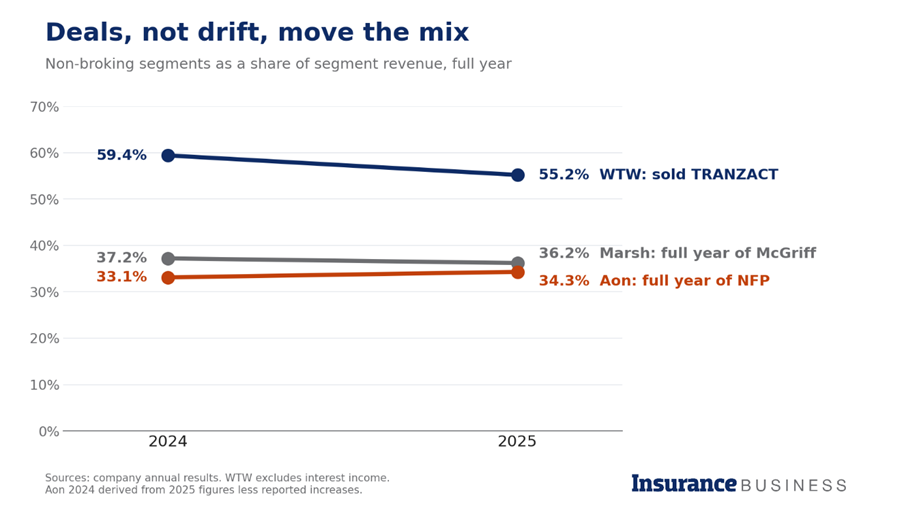
Marsh's consulting share fell from 37.2% in 2024 to 36.2% in 2025 after it absorbed McGriff, a broker and its largest acquisition. It has edged back up this year as Management Consulting outgrew the rest of the firm, reaching 34.3% of first-half revenue against 33.3% a year earlier.
Aon went the other way, then reversed. Buying NFP lifted Human Capital to 34.3% of revenue in 2025, from 33.1% in 2024. Selling the NFP Wealth business has since cut it to 30.0% in the first half of 2026, from 31.9% a year earlier.
At WTW, Health, Wealth & Career fell from 59.4% of segment revenue in 2024 to 55.2% in 2025, after the sale of TRANZACT, a business that sat in that segment.
Read next: Marsh delivers strong 2025 performance as revenue climbs 10%
Each firm leans toward its more profitable side. At Marsh, Risk and Insurance Services earned a 33.2% adjusted operating margin in the first nine months of 2026, against 21.4% in Consulting. At Aon, Risk Capital earned 38.4% in the first half, against 28.6% for Human Capital. WTW is the reverse: Health, Wealth & Career earned a 25.7% segment margin in the first half, against 22.4% for Risk & Broking.
Growth isn’t following a single pattern. In Marsh's third quarter, Consulting grew 8% on an underlying basis against 3% for risk and insurance, as soft pricing weighed on broking. At WTW in the second quarter, it was the other way round: Risk & Broking grew 7% organically against 4% for Health, Wealth & Career. Aon's four main units all grew 5% organically in the second quarter.
Read next: Marsh revenue climbs 8% as consulting growth offsets reinsurance decline
Aon and Marsh are still brokerages by any financial measure, with roughly two-thirds of revenue and three-quarters of profit coming from broking. WTW is a genuine hybrid, and has been since Willis merged with Towers Watson in 2016.
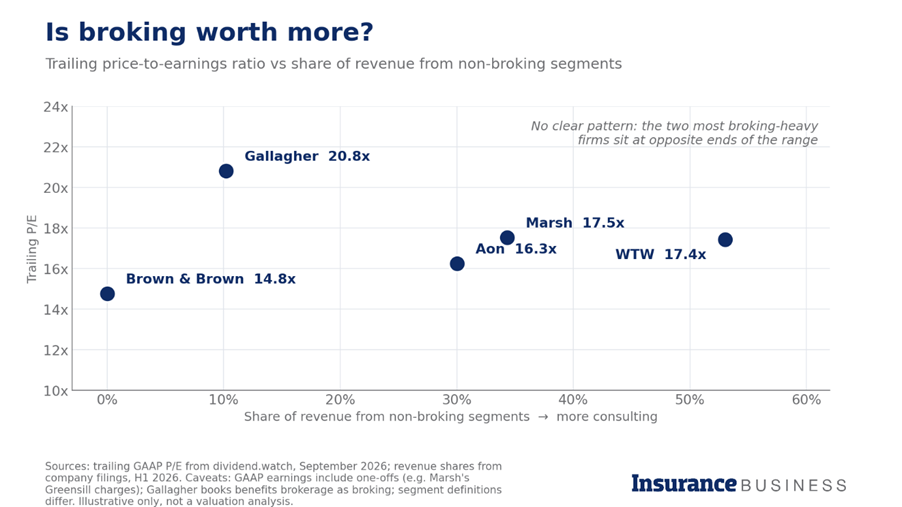
Whether a broking-led or hybrid model affects how the firms are valued comes down to who is doing the valuing. “The answer depends on whether the investors and acquirers are equity or credit-focused,” said Nir Kossovsky, chief executive of Philadelphia-based Steel City Re. “An equity lens prefers to look at pure plays - focus, faster growth, more generous earnings multiples. A credit lens prefers diversified cash flow.”
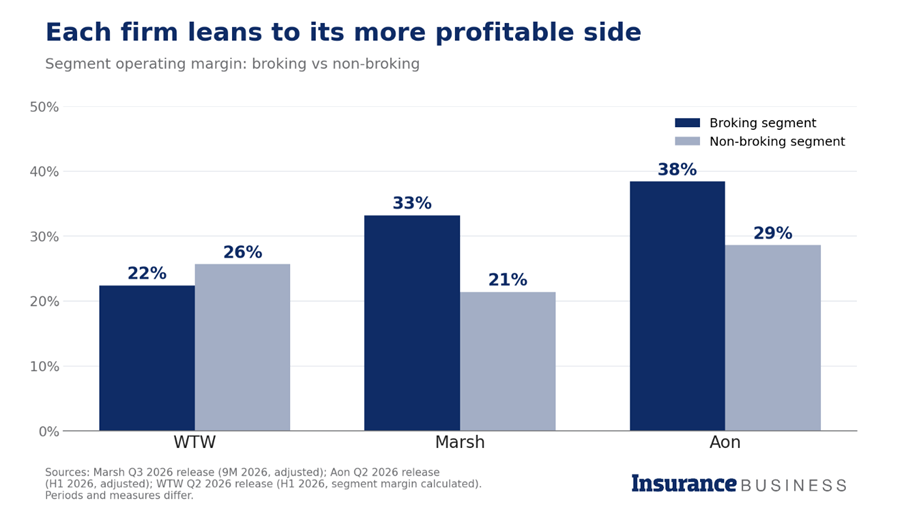
The next data points that may update these charts arrive within two weeks. Aon reports third-quarter results on October 28 and WTW on October 29.
WTW is the only one of the three that earns most of its revenue and profit outside broking. Its share is 53% of revenue in H1 2026, against 34% at Marsh and 30% at Aon. Each company draws its segment lines differently, and every non-broking segment includes some benefits brokerage, so treat these as a guide to mix rather than a precise consulting measure.