
29.8%Brown & Brown 5-Year Avg. EBIT Margin 2021–2025, never below 27% |
5/5MMC, AJG & BRO Consecutive Positive EPS Years vs. 3/5 for Allstate; 4/5 for AIG |
23.9%Marsh & McLennan 5-Year Avg. EBIT Margin vs. 10.2% for Progressive |
The insurance industry rarely provokes envy on Wall Street. Its profits are lumpy, its capital requirements substantial, and a single catastrophic hurricane season can erase years of carefully built underwriting gains. Yet buried within the same sector are businesses that behave nothing like the carriers that dominate the headlines - and over the five years from 2021 through 2025, those businesses compounded quietly, almost invisibly, while their underwriting counterparts lurched through losses and recoveries.
The distinction is structural, not stylistic. A carrier - Progressive, Travelers, AIG, Allstate - takes on risk. It collects premiums, invests the float, and pays claims. When losses exceed expectations, earnings collapse. A broker or intermediary - Marsh & McLennan, Arthur J. Gallagher, Brown & Brown - arranges coverage but bears none of the underwriting risk itself. Its revenue comes from commissions and fees that grow with premium volume but are never impaired by claims. Erie Indemnity is the purest illustration: it earns a management fee from the Erie Exchange, bearing no underwriting risk whatsoever - a model that produced uninterrupted EPS growth from $5.69 in 2021 to $11.48 in 2024, the last full year for which EBIT data is available.
Five years of reported financials from the US insurance industry's largest publicly traded companies makes the contrast unusually legible. Fee-based intermediaries delivered EBIT margins that traditional carriers rarely matched - and sustained those margins across years in which catastrophic weather events, rising reinsurance costs, and macroeconomic pressures battered the underwriting model severely. The gap is not subtle, and it is not a single-year anomaly.
Brown & Brown delivered EBIT margins of 27.2%, 28.7%, 32.0%, 32.0%, and 29.1% in the five consecutive years from 2021 to 2025 - a five-year average of 29.8%, never once dipping below 27%. Marsh & McLennan averaged 23.9% over the same period, ranging from 22.0% in 2022 to 25.3% in 2024 - a remarkably tight band for any financial business operating through a cycle that included a global pandemic recovery, a hard-market pricing surge, and two consecutive catastrophe years. Arthur J. Gallagher averaged 17.1%.
Erie Indemnity, for its four available years, averaged 16.1% - ranging from 13.3% in 2022 to 19.6% in 2024, a clear upward trajectory that reflects management fee income growing as the Erie Exchange expanded its premium base. Its four-year EPS CAGR of 26.4% is the highest of any fee-based entity in the dataset.
Now set those figures against a cross-section of carriers. Progressive posted EBIT margins of 9.3%, 2.4%, 8.3%, 14.6%, and 16.5% over the five years - a five-year average of 10.2%, less than half of Brown & Brown's. Allstate's EBIT swung from +13.4% in 2021, to -2.9% in 2022, to essentially zero in 2023, recovering to 9.6% in 2024 and 20.2% in 2025. The five-year average lands at just 8.1% - dragged down by two consecutive loss years that no broker experienced.
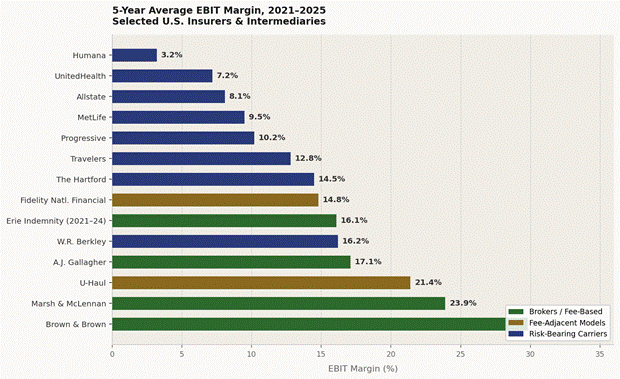
Source: Company 10-K filings. Erie Indemnity: 4-year average (2021–2024). Bars sized to 5-yr average.
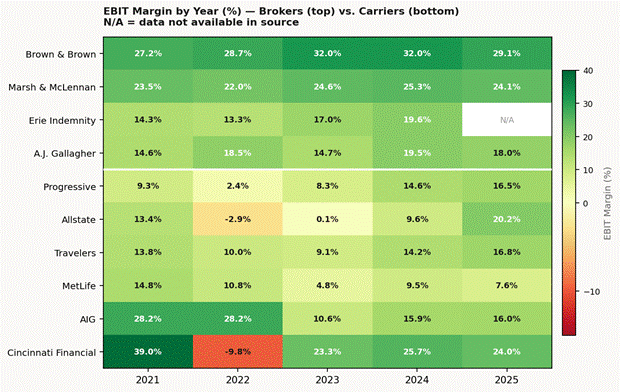
Green = high margin; Red = negative EBIT. White line separates brokers (top 4) from carriers (bottom 6).
Carriers are entirely capable of spectacular EPS growth. Allstate's diluted EPS surged from $4.96 in 2021 to $38.06 in 2025, a compound annual growth rate of 66.4%. The Hartford compounded from $1.47 to $13.32, a CAGR of 73.5% - the highest among carriers in the dataset. Progressive moved from $5.66 to $19.23, a 35.8% CAGR. These are genuinely exceptional trajectories.
The problem, for investors who weight earnings quality and predictability, is the path. Allstate's EPS was negative in both 2022 (-$5.14) and 2023 (-$1.20). AIG posted negative EPS in 2024 after years of apparent stability. Cincinnati Financial swung from $18.10 in 2021 to -$3.06 in 2022, driven by investment losses on its equity portfolio. MetLife's EPS declined from $7.70 in 2021 to $1.81 by 2023 - a 76% drop - before partial recovery.
The brokers' journey was far less dramatic - in the best possible sense. Marsh & McLennan compounded diluted EPS from $6.13 in 2021 to $8.43 in 2025, a CAGR of 8.3%, with positive earnings in every single year. A.J. Gallagher moved from $4.37 to $5.74, a 7.1% CAGR, also uninterrupted. Brown & Brown grew at an 11.2% CAGR. Erie Indemnity, over its four available years, compounded at 26.4% annually without a single negative EPS year - the strongest earnings growth trajectory among the fee-based group.
Table 1 - Diluted EPS by Year, 2021–2025 | Selected US Insurers & Intermediaries
|
Company |
Model |
2021 |
2022 |
2023 |
2024 |
2025 |
CAGR |
Pos.Yrs |
|---|---|---|---|---|---|---|---|---|
|
Marsh & McLennan [BROKER] |
Fee / Intermediary |
$6.13 |
$6.04 |
$7.53 |
$8.18 |
$8.43 |
+8.3% |
5/5 |
|
A.J. Gallagher [BROKER] |
Fee / Intermediary |
$4.37 |
$5.19 |
$4.42 |
$6.50 |
$5.74 |
+7.1% |
5/5 |
|
Brown & Brown [BROKER] |
Fee / Intermediary |
$2.07 |
$2.37 |
$3.05 |
$3.46 |
$3.16 |
+11.2% |
5/5 |
|
Erie Indemnity [BROKER] |
Mgmt. Fee Model |
$5.69 |
$5.71 |
$8.53 |
$11.48 |
N/A |
+26.4%* |
4/4 |
|
Fidelity Natl. Fin. [TITLE] |
Fee/Title Ins. |
$8.44 |
$4.10 |
$1.91 |
- |
- |
N/A |
3/3 |
|
U-Haul [SERVICE] |
Storage/Logistics |
$5.37 |
$7.08 |
$5.54 |
$3.04 |
$1.69 |
-25.1% |
5/5 |
|
Travelers [CARRIER] |
P&C Underwriter |
$14.49 |
$11.77 |
$12.79 |
$21.47 |
$27.43 |
+17.3% |
5/5 |
|
Progressive [CARRIER] |
P&C Underwriter |
$5.66 |
$1.18 |
$6.58 |
$14.40 |
$19.23 |
+35.8% |
5/5 |
|
Allstate [CARRIER] |
P&C Underwriter |
$4.96 |
(-$5.14) |
(-$1.20) |
$16.99 |
$38.06 |
+66.4% |
3/5 |
|
The Hartford [CARRIER] |
P&C/Group Ben. |
$1.47 |
$5.44 |
$7.97 |
$10.35 |
$13.32 |
+73.5% |
5/5 |
|
MetLife [CARRIER] |
Life/Annuities |
$7.70 |
$2.91 |
$1.81 |
$5.94 |
$4.84 |
-11.0% |
5/5 |
|
AIG [CARRIER] |
Multi-line Carrier |
$11.95 |
$12.94 |
$4.98 |
(-$2.17) |
$5.43 |
-17.9% |
4/5 |
|
UnitedHealth [CARRIER] |
Managed Care |
$18.08 |
$21.18 |
$23.86 |
$15.51 |
$13.23 |
-7.5% |
5/5 |
|
Cincinnati Fin. [CARRIER] |
P&C / Life |
$18.10 |
(-$3.06) |
$11.66 |
$14.53 |
$15.17 |
-4.3% |
4/5 |
|
Centene [CARRIER] |
Managed Care |
$2.28 |
$2.07 |
$4.95 |
$6.31 |
(-$13.53) |
N/A |
4/5 |
* Erie Indemnity CAGR is 3-year (2021–2024); 2025 EBIT not in source data. Loss years shown in red. Green rows = brokers/fee-based. Source: Company 10-K filings, 2021–2025.
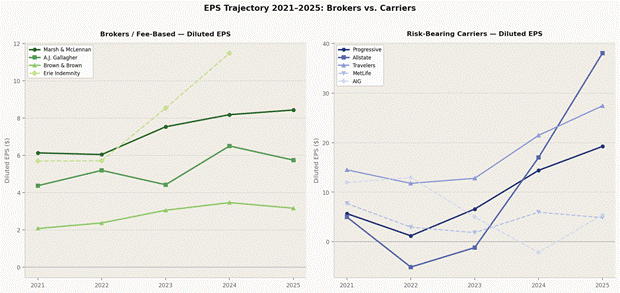
Erie Indemnity plotted through 2024 only (dashed line). Solid lines = 5-year series. Left panel = brokers; right = carriers.
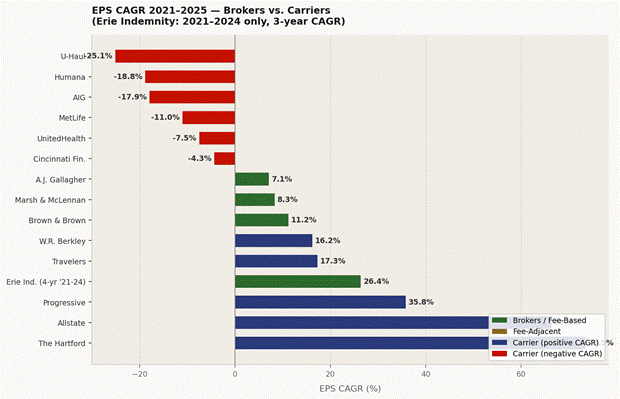
Negative CAGRs in red. Erie Indemnity: 3-year CAGR (2021–2024). Brokers in green; carriers in blue or red.
Not all fee-oriented businesses performed equally well, and that distinction matters for the thesis. Fidelity National Financial's revenue collapsed from $15.1 billion in 2021 to $11.5 billion in 2022 as the mortgage market froze. Its five-year average EBIT margin of 14.8% reflects this cyclicality - better than Allstate's 8.1%, but considerably more volatile than MMC's 23.9%. U-Haul's EBIT margins were impressive in 2021 (21.0%) and 2022 (28.5%), reflecting the post-pandemic surge in moving and storage demand, but compressed to 13.2% by 2025 as that tailwind normalized. U-Haul EPS fell at a 25.1% annual rate over the full five years.
The lesson is that fee-adjacent is necessary but not sufficient for quality earnings - the nature and stability of the fee stream matters enormously. The insurance brokers benefited from a specific and durable tailwind: hardening commercial and personal-lines premium rates from 2021 through 2024, which mechanically expanded the commission base on which broker fees are calculated. Erie Indemnity is the clearest illustration: its management fee income is directly tied to the premiums written by the Erie Exchange, which grew from approximately $2.7 billion in 2021 to $3.9 billion in 2024. No underwriting risk was assumed. Every dollar of premium growth translated directly into higher fee revenue.
Table 2 - Average & 2025 EBIT Margins | Full Dataset
|
Company |
Segment |
Avg EBIT Margin 21-25 |
2025 EBIT Margin |
|---|---|---|---|
|
Brown & Brown |
Broker |
29.8% |
29.1% |
|
Marsh & McLennan |
Broker |
23.9% |
24.1% |
|
Erie Indemnity |
Broker |
16.1% (4yr) |
N/A |
|
A.J. Gallagher |
Broker |
17.1% |
18.0% |
|
U-Haul |
Service |
21.4% |
13.2% |
|
Cincinnati Financial |
P&C Carrier |
20.4% |
24.0% |
|
AIG |
Multi-line |
19.8% |
16.0% |
|
W.R. Berkley |
P&C Carrier |
16.2% |
16.4% |
|
Fidelity Natl. Fin. |
Title |
14.8% |
11.6% |
|
The Hartford |
P&C Carrier |
14.5% |
17.7% |
|
Travelers |
P&C Carrier |
12.8% |
16.8% |
|
Progressive |
P&C Carrier |
10.2% |
16.5% |
|
MetLife |
Life/Annuities |
9.5% |
7.6% |
|
Allstate |
P&C Carrier |
8.1% |
20.2% |
|
UnitedHealth |
Managed Care |
7.2% |
4.2% |
|
Humana |
Managed Care |
3.2% |
1.7% |
|
Centene |
Managed Care |
1.3% |
-3.1% |
Erie Indemnity average is 2021–2024 only; 2025 EBIT not available. Source: Company 10-K filings, 2021–2025. Green rows = brokers/fee-based.
The honest version of the counter-argument is about absolute return. Hartford's cumulative EPS growth from 2021 to 2025 was 807%. Allstate's was 667%. Progressive's was 240%. No broker in the dataset approaches those absolute multiples. For investors with a five-year horizon and the willingness to hold through two loss years, the carrier recovery was one of the best trades in financial services during the period.
The managed-care segment offers a further complication. UnitedHealth, Humana, and Centene operate more fee-for-service than traditional underwriting models, yet delivered among the worst five-year earnings trajectories in the dataset. UnitedHealth's EBIT margin fell from 8.3% in 2021 to 4.2% in 2025. Humana fell from 4.4% to 1.7%. Centene turned deeply negative in 2025, with EPS collapsing to -$13.53. The lesson: the quality of fee income - its structural durability and growth mechanism - matters as much as its existence.
What the five-year window ultimately shows is a sorting of the insurance universe into two distinct risk-return profiles. The pure-play insurance brokers - MMC, AJG, BRO, and Erie Indemnity - delivered consistent, positive, compounding earnings of 7–26% annually without interruption. The P&C carriers that repriced aggressively delivered deep losses followed by extraordinary gains, producing headline CAGRs that look spectacular in retrospect but required investors to absorb two or more years of negative earnings to capture them. For most institutional mandates - pension funds, endowments, liability-matched portfolios - smooth compounding is not a consolation prize. It is the objective. And over five years of hard data, it is exactly what the fee-based side of insurance delivered.
All financial data sourced from company 10-K annual filings, 2021–2025. EBIT margin = EBIT / total revenue; five-year averages are simple arithmetic means. EPS CAGRs calculated as (EPS2025 / EPS2021)^(1/4) - 1 where both terminal years are positive. Erie Indemnity CAGR is 3-year (2021–2024). Market capitalization data as of March 18, 2026. This article is for informational purposes only and does not constitute investment advice.