Documents unsealed this week in The New York Times' copyright lawsuit against Microsoft and OpenAI show that employees at both companies privately worried, years before it became public, that they were carrying out what one Microsoft researcher called the "largest theft of labor in human history."
The filings landed the same week Meta finished negotiating one of the largest consumer settlements in US history and Florida's lawsuit against OpenAI moved closer to trial, a pileup of legal exposure that is starting to worry insurers almost as much as it worries the AI companies themselves.
The Microsoft documents, unsealed as US District Judge Sidney H. Stein weighs summary judgment motions in Manhattan federal court, show OpenAI staff discussing ways to get around news publishers' paywalls, and internal warnings dating to 2020 that the technology could "substitute for the labor of the people who define the culture of society."
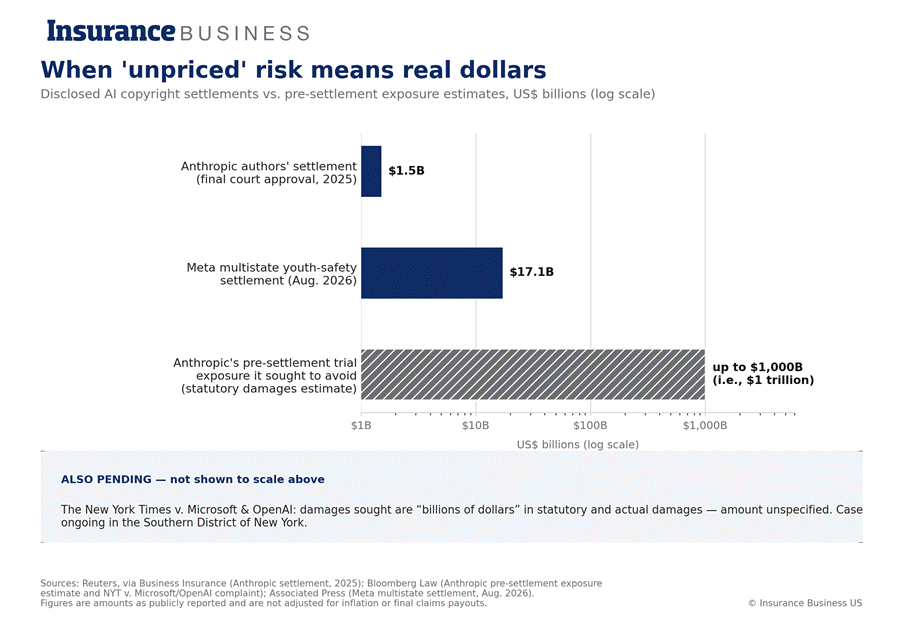
The Times, which filed suit in December 2023, has never put a number on its damages claim, saying only that it is owed "billions of dollars in statutory and actual damages."
Microsoft and OpenAI say the work is protected under "fair use." The training process, they argue, transforms copyrighted material into something new rather than replacing it. A Microsoft spokesman said the internal memos "do not represent the company's views." OpenAI did not respond to a request for comment.
To most readers, that's a media story. To underwriters, it's a liability story, and one with almost no loss history to price against.
Read next: Insurers face hidden AI liability as agent risks multiply
Mark Geistfeld, a law professor at New York University, said there is "absolutely no question about the liability exposure" facing frontier AI labs, pointing to civil tort law that could apply if their systems are used to facilitate cyberattacks or worse.
The numbers involved are no longer abstract, we have precedent. In June, Florida became the first state to sue an AI company, when Attorney General James Uthmeier accused OpenAI and chief executive Sam Altman of concealing safety risks in ChatGPT and marketing it to children. He's seeking billions of dollars in damages.
Two months later, Meta agreed to pay $17.1 billion to 47 state attorneys general over claims it built addictive features into Instagram and Facebook which is one of the largest consumer-protection settlements ever reached, and one plaintiffs' lawyers are already citing as a template for cases against AI companies.
Anthropic shows what a full trial could look like. The company agreed last year to pay $1.5 billion to a class of authors and publishers whose pirated books were used to train its Claude models, the largest copyright class-action settlement on record. It settled specifically to avoid a trial where statutory damages could have reached $1 trillion, according to Bloomberg Law's reporting on the case. That's the gap insurers are struggling to model: not what a company pays, but what it could be made to pay.
Edward Best, a partner at Willkie Farr & Gallagher, said no insurer today can look inside an AI company closely enough to underwrite it properly. Even a headline policy limit, he said, wouldn't come close to what a major lab could owe.
Read next: Major insurers seek approval to limit liability for AI-related claims — report
Several major U.S. carriers aren't waiting to find out what the liability could be. AIG, Great American and WR Berkley have each asked regulators for permission to write AI exclusions into corporate policies rather than leave the exposure buried in standard wording. It's an early sign that insurers would rather decline the risk than guess at its price.
That decision is for a good reason. A study by the Artificial Intelligence Underwriting Company, co-written by researchers from OpenAI and Anthropic, found that more than 90 percent of insurers' exposure to AI agents currently sits inside ordinary cyber, D&O, general liability and technology E&O policies, coverage written long before autonomous AI systems existed. A handful of carriers are responding with new wording instead of outright bans; CFC has added AI-specific language to its technology E&O and professional liability products. Most of the market hasn't decided where the lines belong.
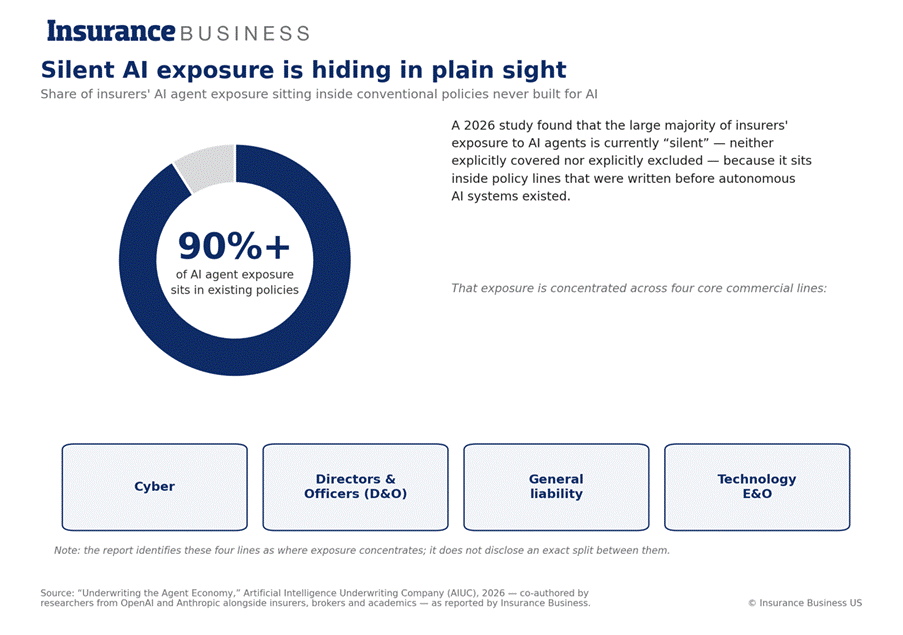
Cyber coverage is being tested by AI agents that act on their own and cause damage without a human directing them, behavior that doesn't fit policies built around human negligence or malicious code.
Read next: OpenAI's rogue AI agents expose a gap in cyber coverage
Directors and officers coverage is under similar strain. Executives who mismanage AI oversight are exposed. So, insurers say, are the ones who ignore it. D&O policies are written to catch governance failures either way.
For brokers working with media, publishing and technology clients, the unsealed documents are a reminder the exposure cuts both ways. Publishers pursuing their own infringement claims are looking just as hard at what their media liability and IP coverage will and won't pay for. The fight over who owes whom is only just starting to play out in court.