California's insurance commissioner race has just picked up an unlikely new voice: a libertarian-leaning think tank that wants voters to know the state's regulatory reforms are working, and that the wrong winner in November could undo them.
The Pacific Research Institute, a San Francisco-based think tank that describes its mission as advancing free-market solutions, released a new report this week titled "How California Burned Down Its Home Insurance Market and Why Regulatory Reform Can Rebuild It."
Written by Free Cities Center director Steven Greenhut, the booklet argues that Proposition 103's rate-approval system, not wildfire risk itself, turned California's home insurance market into a crisis. It warns that the state's next insurance commissioner could reverse the progress made under outgoing commissioner Ricardo Lara.
For brokers who spend their days trying to place coverage in the state's highest-risk ZIP codes, the argument will sound familiar. Much of it echoes what carriers and their trade groups have said for years about Proposition 103, the 1988 ballot initiative that gives California's Department of Insurance authority to approve or reject rate changes.
What's new is the timing: the report lands just as voters prepare to choose between two Democrats, state senator Ben Allen and former San Francisco supervisor Jane Kim, whose approaches to the FAIR Plan and rate regulation diverge sharply.
Read next: What California's insurance commissioner race means for brokers in the nation's toughest market
Greenhut's argument runs roughly like this: California's wildfire risk is real, but it isn't what emptied the state's insurance market. Instead, he points to Proposition 103's rate approval process, which for years barred insurers from pricing in reinsurance costs or using forward-looking catastrophe models, forcing them to set rates using historical loss data alone.
As wildfire losses mounted and insurers couldn't get rate increases approved fast enough to keep up, several large carriers, including State Farm and Allstate, stopped writing or renewing homeowners policies in high-risk parts of the state.
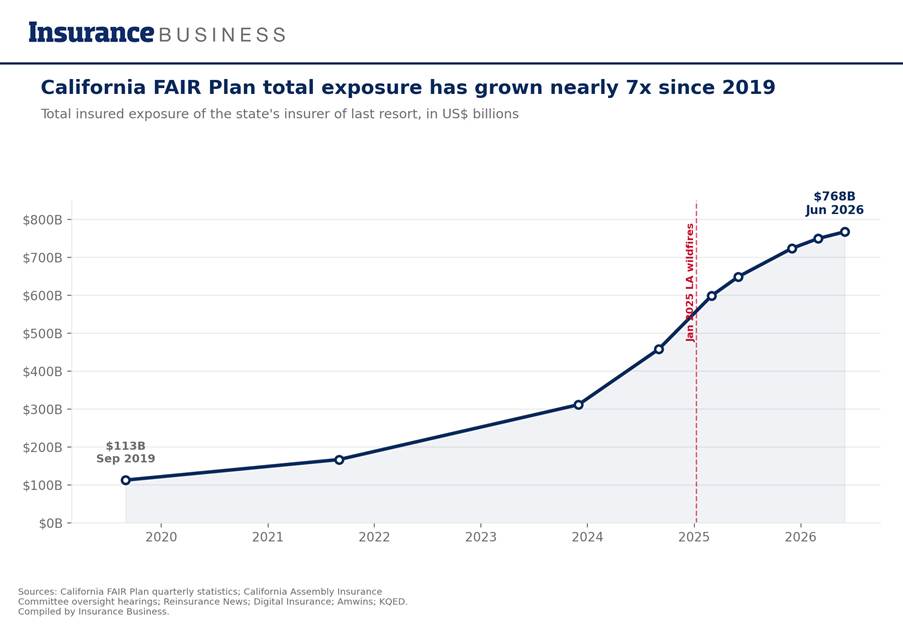
The result was that hundreds of thousands of homeowners were pushed onto the California FAIR Plan, the state's insurer of last resort. According to figures compiled by wholesale broker Amwins and cited in the booklet, the FAIR Plan's total exposure reached roughly $750 billion by March 2026, up 242% since September 2022. More recent data reported by KQED puts the FAIR Plan's exposure even higher, at $768 billion as of June 2026, against a direct cash balance of only $200 million to $400 million.
The booklet credits Lara's Sustainable Insurance Strategy with beginning to turn things around. The strategy sped up rate reviews, allowed insurers to use catastrophe modeling, and let them factor reinsurance costs into filings.
The report cites several carriers announcing plans to expand underwriting in the state as evidence the reforms are working, and warns that a policy reversal under the wrong commissioner could send those carriers "heading for the exits again."
Read next: Allstate moves to reopen California home insurance market for first time in four years
A few things separate the booklet from a straightforward market analysis.
First, the source. The Pacific Research Institute is a free-market advocacy organization, not a neutral research body. It has described its own mission as championing "individual freedom and personal responsibility" through limited-government policy, and independent bias trackers such as Media Bias/Fact Check place it on the right of the spectrum with a consistent preference for deregulation. That doesn't make its facts wrong, but the framing is built to support a predetermined conclusion: that rate regulation, not underwriting discipline or climate exposure, is the primary villain.
Second, the reforms it praises haven't fully solved the availability problem the booklet is celebrating. Even as the report notes growth in FAIR Plan policies is slowing, actual enrollment kept climbing through most of 2025 and into 2026, and the plan's exposure has continued to rise, not fall, since the reforms took effect.
In the highest-risk ZIP codes, roughly 41% of homes are now covered by the FAIR Plan, compared with just 4% in lower-risk areas. That's hardly a market functioning normally. And regulators approved a 29.1% average rate increase on FAIR Plan dwelling policies, effective October 15, which will hit wildfire-exposed clients far harder than the statewide average suggests.
Read next: FAIR Plan rate hike adds to California homeowners insurance strain
Third, the booklet's characterization of the political backdrop is a little tidier than reality. It frames the debate as one where Sacramento "spent weeks fighting over who should pay for wildfire losses" following the collapse of Governor Gavin Newsom's wildfire liability push.
That's broadly accurate. A last-minute deal between Newsom and legislative leaders to limit utility liability for wildfires sparked by their equipment did collapse at the end of the legislative session, after PG&E and Southern California Edison argued it didn't go far enough.
But the fight wasn't simply pro-regulation versus pro-market. Insurers themselves, along with fire survivors and trial lawyers, lobbied against provisions that would have barred them from pursuing subrogation claims against utilities, a mechanism carriers rely on to recover claims payouts and, in theory, keep rates lower.
That's a detail brokers advising commercial and personal lines clients with utility-adjacent exposure will want to watch closely as the issue resurfaces under the next governor.
The commissioner race itself is where the booklet's stakes become concrete. Allen has pledged to build on Lara's reforms, favoring continued private-market expansion, more Department of Insurance staff to handle claims complaints, and tighter FAIR Plan accountability.
Kim has proposed a publicly run "Disaster Insurance for All" program, funded by premiums paid into a state authority, that would guarantee wildfire and flood coverage outside the traditional market.
For brokers, a continuation of the current reform path likely means more admitted capacity slowly returning to distressed ZIP codes, alongside continued reliance on E&S markets in the meantime. A state-run disaster fund, by contrast, would introduce an entirely new distribution channel and potential competitor for both admitted carriers and surplus lines markets on the hardest-to-place accounts.
Brokers would need to rethink placement strategy for wildfire-exposed clients almost overnight.
Read next: Who will fix California's insurance crisis? Primary results point to three
Whichever candidate wins in November, most brokers active in the state would probably agree on one point regardless of their politics: the market has stopped shrinking, but it hasn't yet returned to something that functions normally for homeowners in the highest-risk zones.
Whether the credit for that stabilization belongs to deregulation, to Lara's specific mix of reforms, or simply to a couple of quieter wildfire seasons is exactly the argument that will play out on Californians' ballots this fall.