The United Nations has taken out insurance against a really bad year. The UN Office for the Coordination of Humanitarian Affairs (OCHA) has launched what it calls a first-of-its-kind insurance programme, able to release up to US$40m in extra funding when several disasters loom at the same time. The money pays for “anticipatory action”: getting cash and supplies to people in the hours or days before a forecast flood, storm or drought arrives, rather than after the damage is done.
Gallagher Re structured and placed the cover, and Liberty Mutual is lead insurer. The Centre for Disaster Protection gave independent technical advice. That centre is a UK creation: it was launched by the UK Prime Minister in July 2017 and is funded with UK aid, and it is based in London and funded by the FCDO.
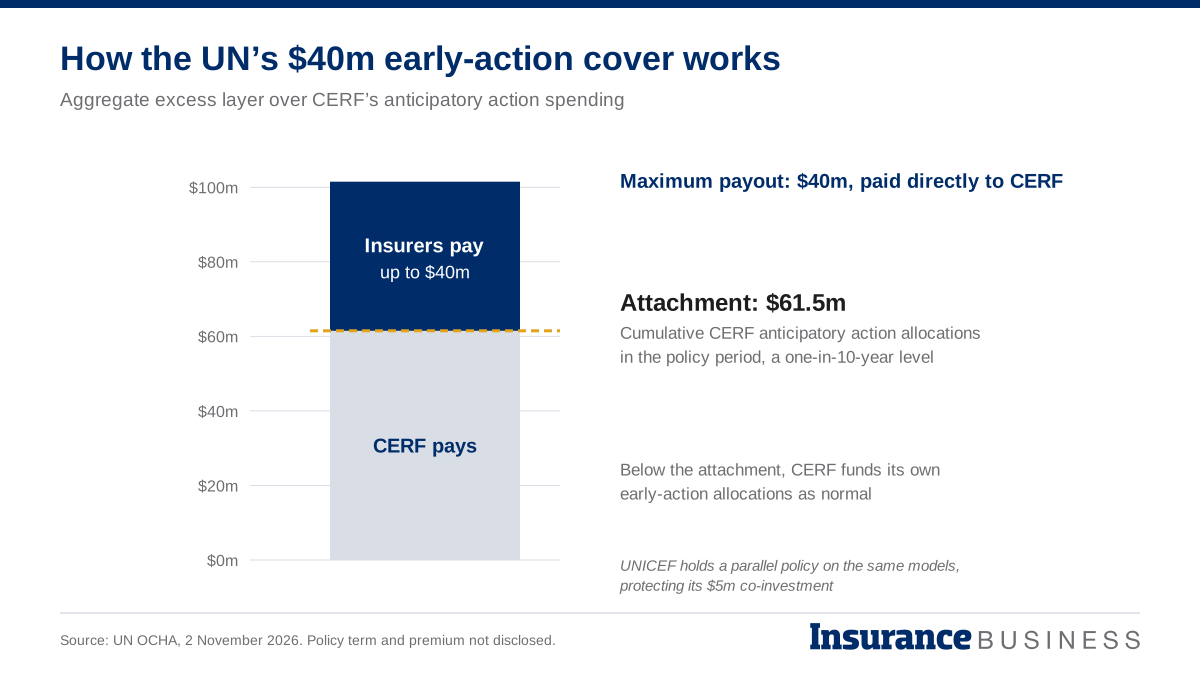
The policy sits over the anticipatory action spending of the UN’s Central Emergency Response Fund (CERF). It responds once CERF’s cumulative anticipatory action allocations go past $61.5m in the policy period, a level OCHA equates to a one-in-10-year event, and pays up to $40m directly into CERF.
It’s been built as an aggregate excess layer sitting on a humanitarian fund. Below the attachment point, CERF pays its own way. Above it, insurers pick up the bill. OCHA says capping what it must set aside for exceptionally difficult years should also let it stretch early help to more communities.
UNICEF has bought a sister policy. It runs on the same risk data, parameters and models and protects UNICEF’s $5m co-investment across 10 inter-agency anticipatory action frameworks. The programme has been built so that other agencies and partners can join later.
How this is different from cat cover
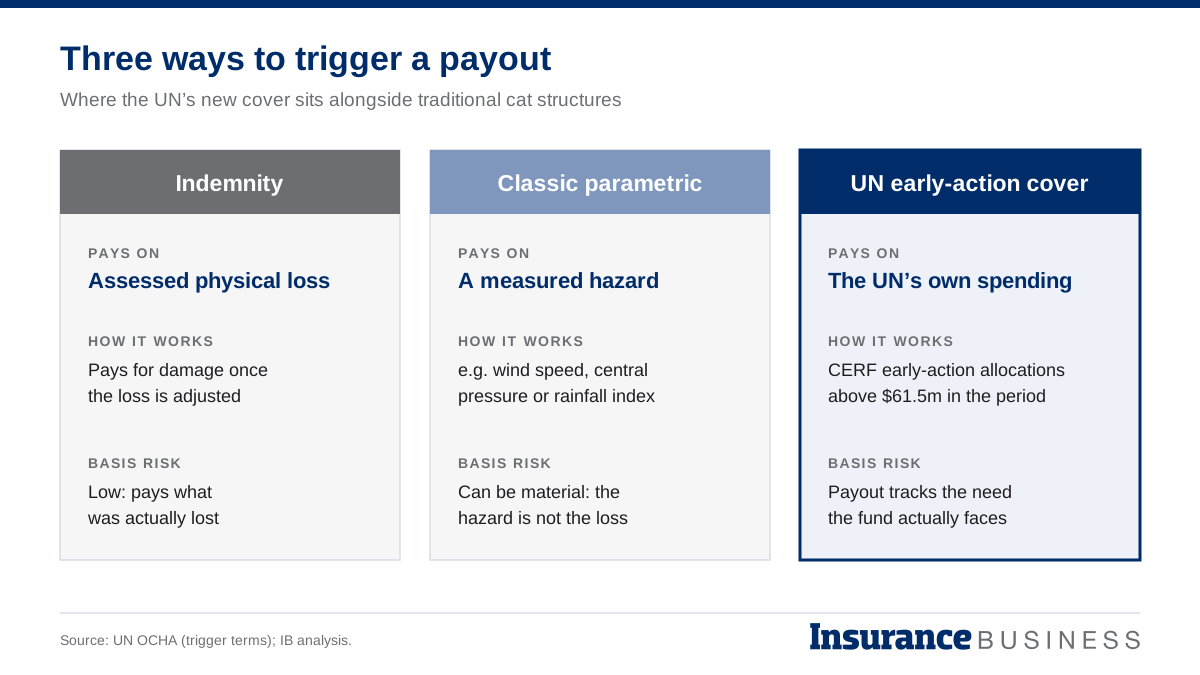
Indemnity: pays for assessed physical loss after the event.
Classic parametric: pays when a measured hazard (wind speed, central pressure, rainfall) crosses a threshold.
This deal: pays when the UN’s own forecast-triggered spending crosses a threshold. The insured risk is too many early-warning frameworks firing in one period, not damage.
Read next: Gallagher Re on how parametric protection survived a reinsurance market recovery
OCHA earlier ran a formal procurement inviting brokers to design it. The request sought risk management and transfer solutions to protect and grow CERF’s capacity to pre-arrange anticipatory action financing, and asked interested (re)insurance brokers to submit expressions of interest.
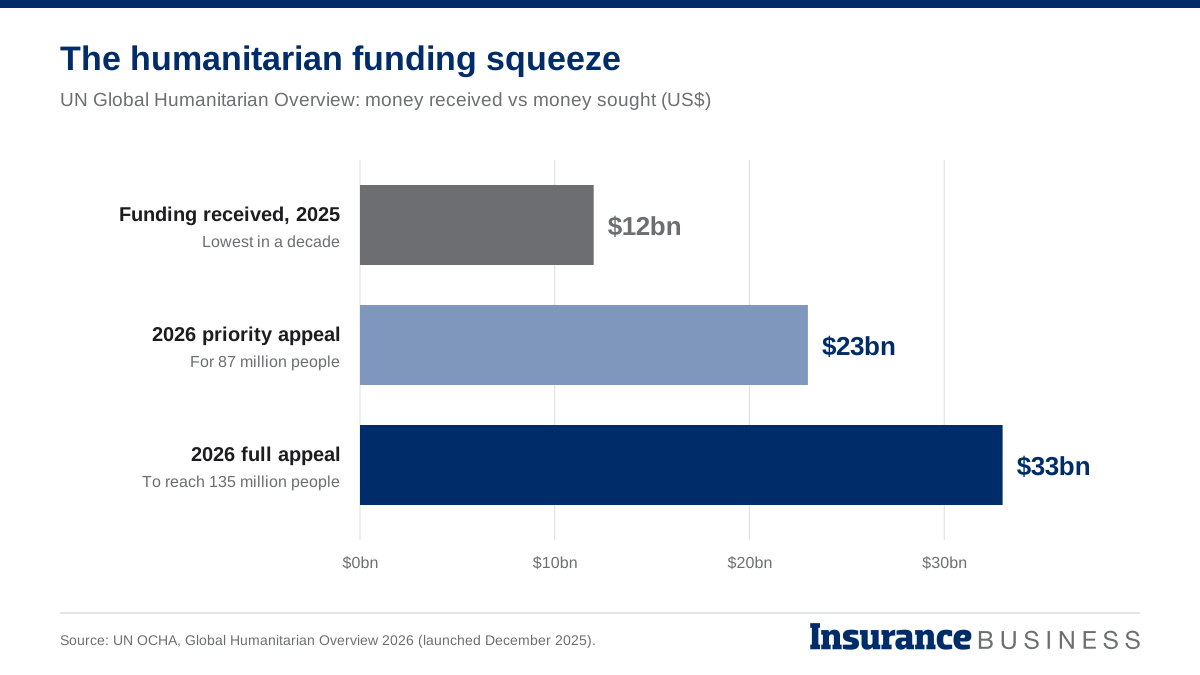
Tom Fletcher, the UN’s emergency relief chief, said funding against the previous humanitarian overview came to only US$12bn, the lowest in a decade. The Global Humanitarian Overview 2026 was scaled back to match. It aims to raise US$33bn over the year, with an initial US$23bn for 87 million people in the most urgent need.
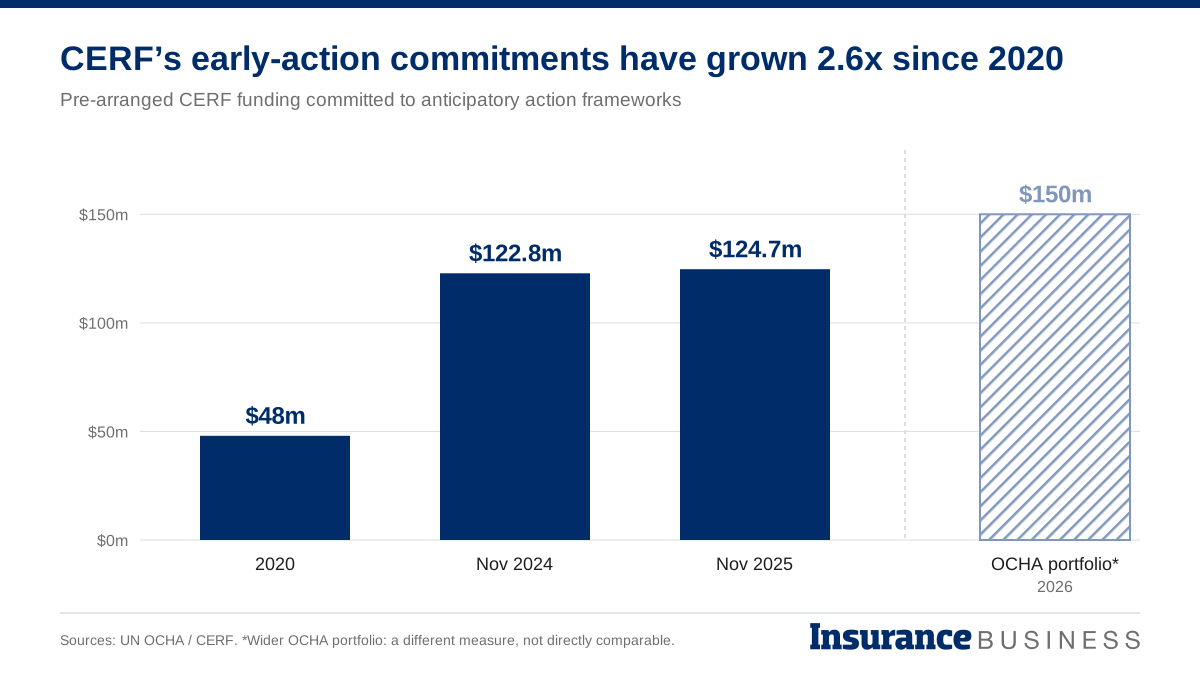
At the same time, the early-action side of the business has grown. CERF’s pre-committed funding for anticipatory action frameworks reached $124.7m in November 2025, compared with $48m in 2020. CERF also supplied roughly half of all pre-arranged anticipatory action funding worldwide in 2024. OCHA now puts its wider anticipatory action portfolio at $150m, covering more than five million people.
That growth creates a concentration problem. Each framework triggers on its own forecast, but a strong El Niño or a busy cyclone season could set off several at once and empty the pot. “Disasters don’t wait for us to get our act together,” Fletcher said at the launch. He described the cover as an extra line of defence that would let the UN protect more people before conditions deteriorate.
The UN already has examples of the human case for this cover with real examples. In Bangladesh, a woman named Salma received WFP cash, funded by CERF, a day before the 2024 floods. She used it to buy food that would keep, candles and firewood, and to lift her bed and livestock pens clear of the water.
Read next: World Bank says Melissa may cause full payout of Jamaica cat bond
Parametric reinsurance allocations has hit record levels in 2026, even as the traditional market has gone through through its softest patch in a decade. Sovereign deals have shown they can pay. Jamaica received its full US$150m cat bond payout after Hurricane Melissa, one of the largest sovereign cat bond redemptions in recent years. That payout also revived arguments about basis risk, the gap between what a trigger pays and what a disaster actually costs.
The UN structure handles basis risk differently. Because the trigger is the UN’s own forecast-driven spending, the payout tracks the need the fund is actually facing. The trade-off is that insurers are underwriting the reliability of OCHA’s frameworks and models, which is why independent technical review mattered.
There is also the protection gap to consider. Aon’s latest catastrophe recap puts global insured natural disaster losses at $91bn for the first nine months of 2026, with the protection gap at 55%. Much of that uninsured burden falls on countries where commercial cover barely exists. Aon’s leadership has argued that private capital will be central to closing coverage gaps, and deals like this one give that capital a route in.
The UK’s fingerprints are on the funding as well as the design - financial and technical support reportedly came from the FCDO, Sweden’s development agency Sida and the Global Shield Financing Facility. The facility is a World Bank-hosted multi-donor trust fund, financed by Canada, Germany, Japan, Luxembourg and the UK.
Read next: Generali in United Nations insurance tie-up
Premium, policy term, whether the risk is shared with following markets or reinsured, and which Liberty entity is on risk have not been disclosed.
If the cover works as intended, a humanitarian fund will have shown it can buy aggregate protection from commercial insurers, and the London market should expect more agencies, and their donors, to come asking.
Read next: Parametric moves beyond weather as Howden Re builds dedicated practice