Pinion Insurance has picked the executive who will try to turn its US plan into written premium.
Gary S. Maier took over as US chief executive on Tuesday, the London-based carrier said in an announcement. He comes from Ledger Investing, the New York casualty insurance-linked securities firm, where he was chief revenue officer and ran Ledger Risk Markets, the company's reinsurance intermediary arm.
Maier's career covers most of the steps a program has to pass through before it reaches the market. He spent more than 17 years at Chubb, starting as a trainee and leaving as a zone executive underwriting officer. From 2005 to 2013 he was chief underwriting officer at Tower Group, where he also oversaw US marketing, distribution and corporate development. He later became managing principal at the Capacity Group of New Jersey, a Mahwah brokerage whose retail operations EPIC Insurance Brokers & Consultants acquired in 2017.
At Ledger he helped build a market for a risk class many people thought could not be securitized. He found MGAs and carriers willing to cede casualty risk and matched them with institutional investors. Pinion says the marketplace placed more than $2.5 billion in premium in its first several years, up from the roughly $2 billion Ledger was approaching when it named a dedicated reinsurance chief in 2024.
Read next: Barings backs Pinion Insurance launch as MGA premiums surge
In a statement, Maier said Pinion aims to make the relationship between MGAs and their capacity providers "more transparent, efficient, and responsive." Co-founder Laura Baird, the group's chief technology officer, said his background matches the company's focus on underwriting and on working closely with MGAs.
Pinion launched in February with a preferred equity commitment of up to $180 million from Barings. It is incorporated in Bermuda and run from London. Group CEO Neil McConachie helped found Fidelis, Lancashire and Montpelier Re, and before Pinion he was chief risk and capital officer at fronting carrier Accredited.
Co-founder Philip Vandoninck previously ran Fidelis' Bermuda operation. Baird's firm, Pinion Risk Consulting, built the technology the carrier runs on.
Since then the company has hired Fortegra's Kyle Selvig as US chief underwriting officer and Aspen's former UK finance chief Chris Jones as group CFO. In July it launched Sarrus, a data platform that pulls information directly from MGAs' source systems. Sarrus gives Pinion and its reinsurers a daily view of each portfolio and builds the month-end bordereau so MGAs don't have to.
The start date for underwriting has moved back. Pinion plans to get nationwide excess and surplus licenses by buying an existing shell insurer, which requires approval from that company's home-state regulator.
It has also said it will not formally begin operations until it has an AM Best rating. In February the company was aiming to bind US business in the second quarter. By July that target had become the third quarter, which ends Wednesday. Tuesday's announcement did not update the timeline.
Read next: US MGA market swells to $128 billion as specialization reshapes distribution
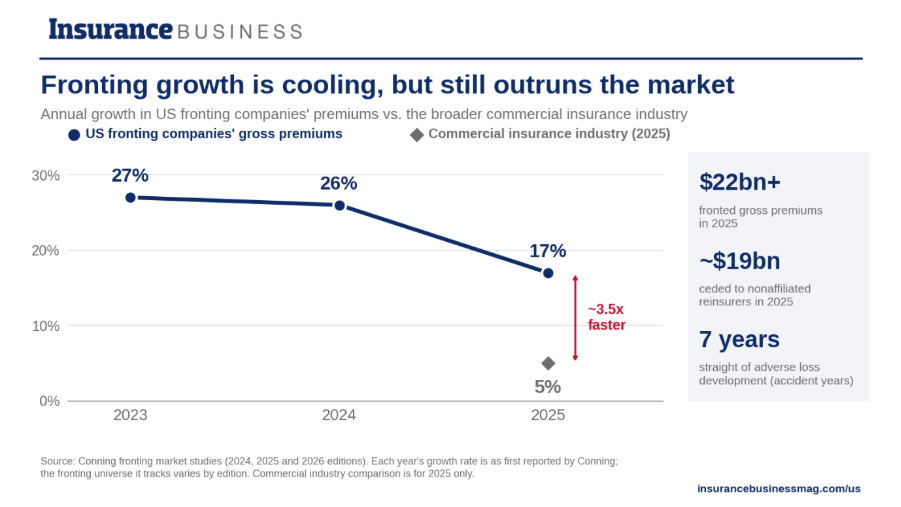
Maier is arriving as the fronting business moves into a harder phase. Conning estimates US MGA premium reached about $128 billion last year. The research firm also found that fronted premium grew 17% in 2025 to more than $22 billion, down from 26% growth the year before. Other liability was the fastest-growing line, and together with commercial auto it made up nearly half of all fronted premium.
Loss results have not kept up with that growth. Conning's analysis shows initial accident-year loss ratios have worsened in each of the past seven years, and five companies have exited or scaled back fronting, a trend it describes as the end of the sector's easy growth phase.
The 10 biggest fronts already write about 69% of MGA-dedicated premium, according to Morningstar DBRS, which has also warned about the counterparty exposure that concentration creates.
That consolidation is showing up in agency offices. When Federated Mutual bought trucking MGA HDVI, the fronting arrangement behind policies placed by more than 100 agencies changed. Carriers are also looking harder at their delegated authority partners, so access to capacity increasingly depends on the individual MGA's track record.
Read next: MGA consolidation reaches trucking insurtech HDVI
Large carriers see the same opportunity. Earlier this month Aviva launched a hybrid fronting unit aimed at programs of £20 million or more. Its executives said they expect reinsurers to value AA-rated paper while some specialist fronts are under scrutiny. Hybrid fronting means the carrier keeps a meaningful share of the risk instead of passing nearly all of it to reinsurers.
This is where Maier's time at Ledger could help. Fronts pass most of their risk to reinsurers, and Conning found US fronting companies ceded almost $19 billion to unaffiliated reinsurers last year.
A new carrier without a long track record needs those capital providers to have confidence in it. Ledger has reported that investors are starting to set aside separate allocations for casualty instead of treating ILS as mainly a property-cat investment. That makes a US chief with ILS relationships more valuable than he would have been a few years ago.
Read next: Fidelis Partnership files for NYSE listing - its prospectus shows how much still rides on Pelagos
Vandoninck, the group's chief underwriting officer, called Maier "a proven market maker."
Brokers and MGAs will want to see Pinion's rating and its first signed programs before they judge whether the company can deliver.