President Donald Trump's approval rating has fallen to 31%, the lowest the Reuters/Ipsos poll has recorded in either of his terms. With two weeks to go before the Nov. 3 midterms, registered voters favor Democrats over Republicans for Congress by 12 points. For the insurance industry, the more useful question is not who wins, but what happens next – in a lame-duck Congress with hard deadlines, and in state races where insurance costs are now on the ballot.
The survey, which closed on Oct. 19, put the generic-ballot split at 47% to 35%, up from a 7-point gap two weeks earlier. Respondents pointed to high gasoline prices, which have climbed since the US and Israel began strikes on Iran in February, and 68% disapproved of the president's handling of the economy.
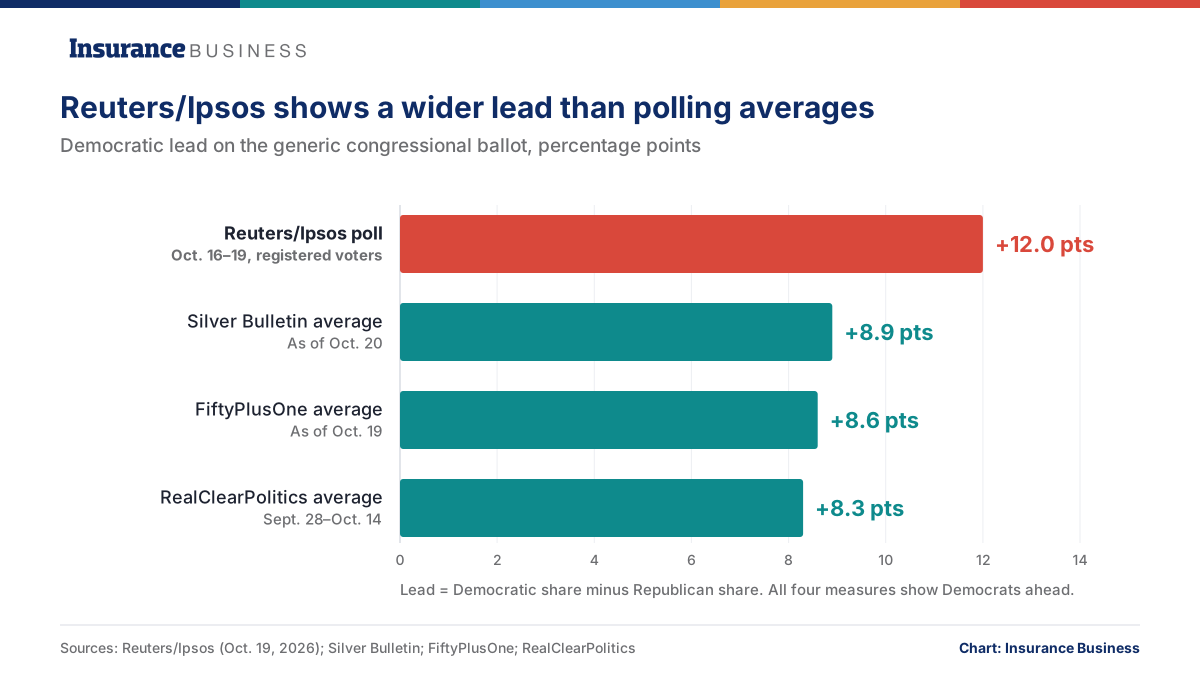
That poll sits at the gloomier end of the range for Republicans. Polling averages show a narrower but still clear Democratic lead: about 8 points in the RealClearPolitics average for late September to mid-October, and just under 9 points in the Silver Bulletin tracker as of Oct. 20. Reuters itself cautioned that national ballot questions do not capture individual House and Senate races, where Republicans hold some structural advantages.
What that means for insurance comes down to three things: unfinished business that the outgoing Congress must handle in its lame-duck session, whoever runs the committees that write federal insurance law next year, and a cost-of-living debate in which premiums now sit alongside gasoline and groceries.
The same cost-of-living frustration behind the poll numbers has pulled insurance into the campaign. The New York Times reported this month that home insurance and property taxes have joined gasoline, diesel and groceries as a top voter concern, noting that home premiums have climbed 46% since 2021 – nearly triple the rate of inflation, in syndicated coverage of the piece. The paper linked rising premiums to tighter races in states including Kansas, Florida and North Carolina.
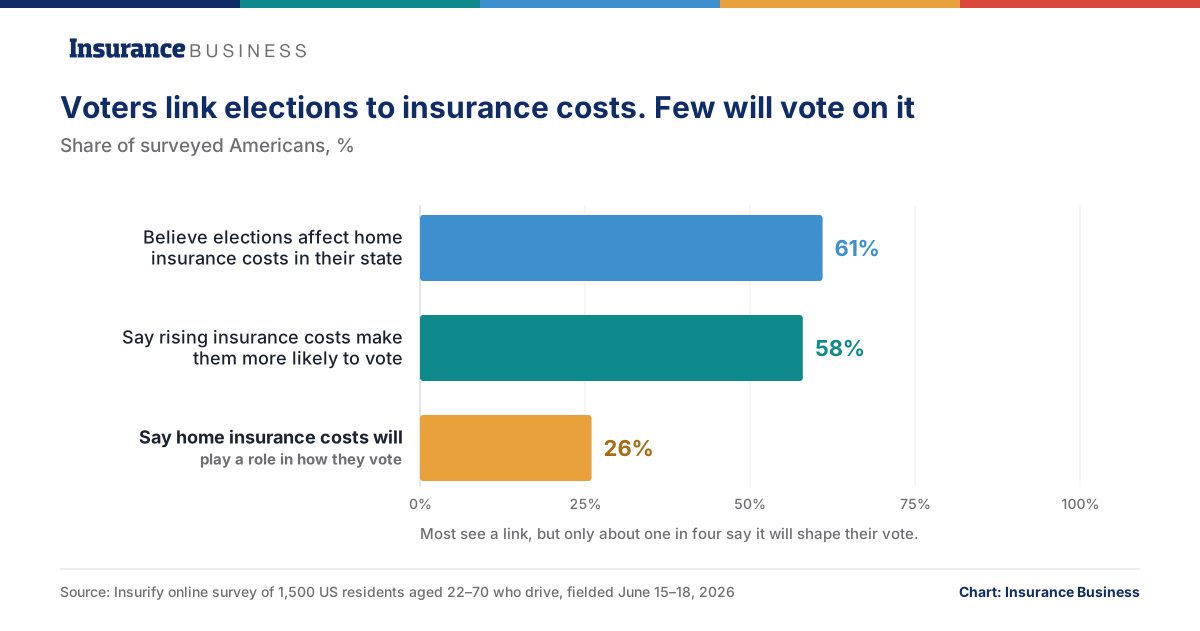
How much it moves votes is less clear. In an Insurify survey of 1,500 Americans, 61% said elections affect insurance costs in their state, but only 26% said home insurance costs would play a role in how they vote this year.
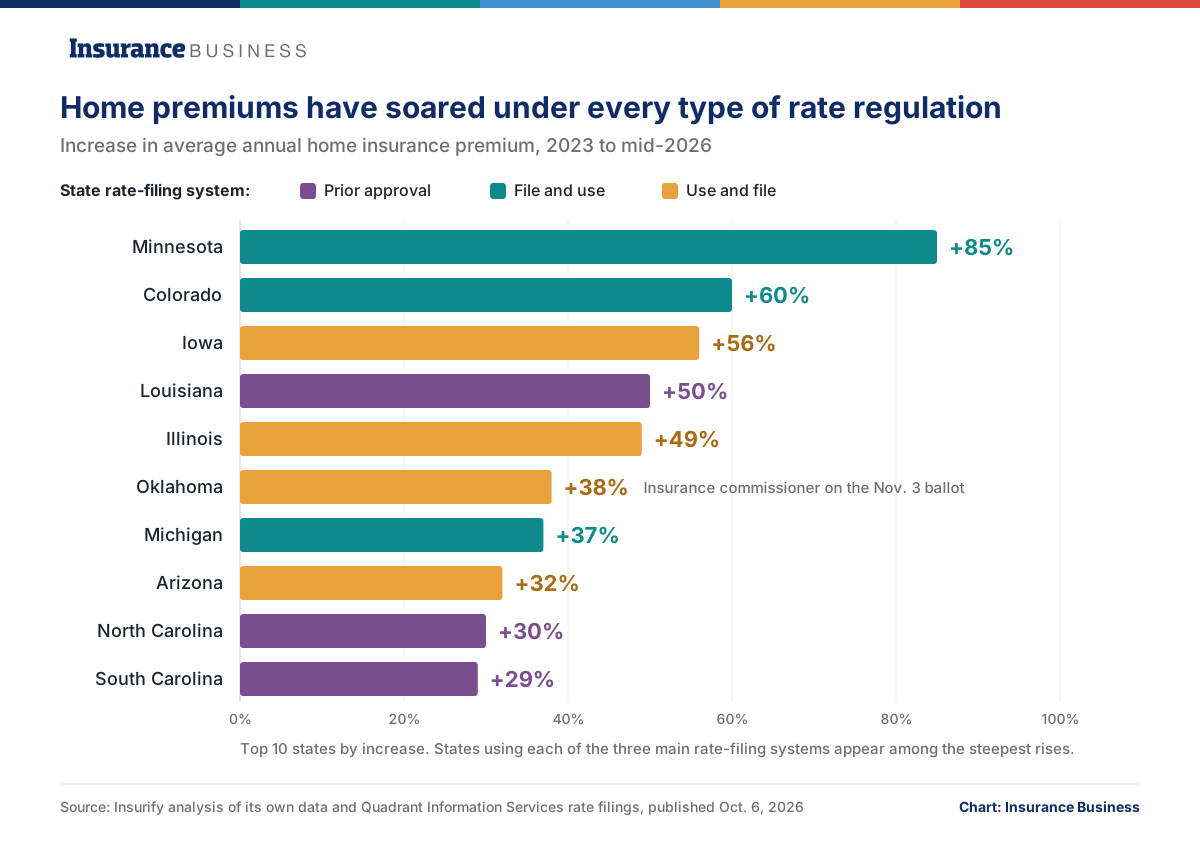
The pressure is sharpest in the states, where rates are actually regulated. In Florida, affordability has featured in both the Senate and governor's races, while Texas Governor Greg Abbott has directed regulators to examine property insurance costs, as covered in reporting on how insurance affordability became a 2026 election issue. In Oklahoma, where average home premiums top $5,500 a year, both the Republican and Democratic candidates for insurance commissioner have called lowering rates their top priority.
For agents, the practical risk is expectation management. Clients who hear candidates promise relief may arrive at renewal expecting cuts that rate filings have not produced – or that apply to a different line or territory than their own.
Read next: As insurance affordability becomes a 2026 election issue, agents must deal with the fallout
The federal Terrorism Risk Insurance Program is not due to expire until Dec. 31, 2027, but the industry wants it settled this year. Both chambers have voted for a seven-year extension to 2034, and by wide bipartisan margins. The House passed H.R. 7128 by 373-15 in June. The Senate followed on Sept. 28, clearing S. 4395 by unanimous consent after a 24-0 committee vote.
The bills are not identical, though the gap is narrow, according to the Congressional Research Service. One chamber has to accept the other's version, or the two must agree a compromise, before anything reaches the president.
|
House bill (H.R. 7128) |
Senate bill (S. 4395) |
|
|
Extends program to |
Dec. 31, 2034 |
Dec. 31, 2034 |
|
Certification threshold |
Rises from $5M to $10M from 2029 |
Unchanged at $5M |
|
Treasury notice during certification |
Required |
Not included |
|
Vote |
373-15 (June) |
Unanimous consent (Sept. 28) |
The industry wants the gap closed this year. Sam Whitfield, APCIA's senior vice president of federal government relations, urged lawmakers to "quickly reconcile any differences between the bills" and get a long-term extension to the president before year-end, as covered in reporting on insurers pressing Congress to settle TRIA differences. NAMIC made the case in terms of construction lending, arguing that new development depends on terrorism cover being available to secure financing.
The policyholder side is pushing the same way. The Coalition to Insure Against Terrorism has said it wants the extension enacted in 2026 and has called for it to ride on a "must pass" bill this year. The December spending package is the most obvious candidate.
The worry is practical. Insurers and policyholders are already negotiating terms that run past the end of 2027, and the National Association of Realtors has warned that past delays led insurers to add conditional terrorism exclusions – leaving some property owners at risk of technical default on loans that require the cover.
Read next: Senate committee clears TRIA extension as insurers flag market uncertainty
TRIA has cross-party sponsorship – the Senate bill was introduced by Republicans Dave McCormick and Thom Tillis with Democrats Tina Smith and Ruben Gallego – so a change in which party controls either chamber next year would not obviously threaten it. The risk is calendar, not ideology. If the lame duck runs out of time, the job passes to a new Congress whose committee leadership, and possibly majority, will have changed.
The most immediate deadline belongs to the National Flood Insurance Program. The stopgap spending bill Congress passed in September funds the government at current levels and extends the NFIP's authority only to Dec. 11, according to the National Association of Home Builders. That puts flood insurance on the same clock as the fight over full-year federal funding.
The program has lived on short-term patches since its last long-term reauthorization ran out in 2017. The September measure was the 36th such extension, according to the Congressional Research Service, and the NFIP has already lapsed twice in the past 13 months – for 43 days from Oct. 1, 2025 during the government shutdown, and again for three days in February. When authority lapses, FEMA cannot write new policies or renew expiring ones, and its Treasury borrowing authority falls from $30.425 billion to $1 billion. FEMA says it would still pay valid claims on existing policies with available funds.
The stakes are concentrated but large: nearly 4.5 million policies and more than $1.3 trillion in coverage, according to a Legis1 summary of CRS data. The program also owes $22.525 billion to the Treasury. Because federally backed mortgages in high-risk flood zones require coverage, a lapse can freeze home sales in coastal and river communities. Private flood policies are unaffected, which has made private carriers a fallback each time the program has stalled.
Agents want more than another patch. The Independent Insurance Agents & Brokers of America (the Big "I") backs a long-term reauthorization of a modernized program, and says that at the very least Congress must avoid a lapse. It has also said it will oppose cuts to Write-Your-Own reimbursements. But a long-term fix looks unlikely before Dec. 11: CRS identifies no pending long-term reauthorization bill, so the realistic choice in the lame duck is between another short extension and a lapse.
The issue the Reuters/Ipsos poll ties most closely to voter frustration – gasoline – has a less obvious effect on insurance. Higher fuel costs tend to cut driving, which can mean fewer accidents.
Michel Léonard, chief economist at the Insurance Information Institute, told the price-comparison site Insurify that when gas prices are higher, "people drive less," and that personal auto claim frequency should be expected to fall. Insurify estimated that if pump prices stayed elevated, Americans' miles driven could drop 10% to 12% by the end of 2026, enough to pull average premiums slightly below its pre-war forecast. Before the conflict it had projected a 0.7% rise to $2,236 for full coverage.
Read next: Hormuz war risk claims could exceed $3 billion as US-Iran fighting resumes
Any relief would be modest against a premium base Insurify says is up 42% since the end of 2021. For the industry, the war's bigger effects are being felt in specialty lines, as covered in analysis of how the Iran conflict is reshaping airline insurance pricing.
Read next: War is now the risk every boardroom fears most, and insurers are hiring accordingly
The election result will shape the agenda for 2027, but the lame duck decides the near-term picture. Three questions matter most for the industry. Will Congress pass full-year funding or another stopgap by Dec. 11, and does it carry the NFIP for longer than a few weeks? Will the House and Senate settle on a single TRIA bill – possibly by attaching it to that spending package – or hand an almost-finished job to the next Congress? And if control of either chamber changes, who takes over the committees that write insurance law? The House Financial Services Committee is currently chaired by Rep. French Hill (R-Ark.), and the Senate Banking Committee by Sen. Tim Scott (R-S.C.), with Sen. Elizabeth Warren (D-Mass.) as ranking member.
|
Date |
What happens |
|
Nov. 3, 2026 |
Midterm elections |
|
Dec. 11, 2026, 11:59 p.m. |
Stopgap government funding and NFIP authority expire |
|
Jan. 3, 2027 |
New Congress convenes; unfinished bills must restart |
|
Dec. 31, 2027 |
Current TRIA authorization expires |
|
2029 |
House bill's $10M certification threshold would take effect, if enacted |
For agents with flood clients, the practical advice from past lapses still applies: bind or renew NFIP policies before Dec. 11 where possible, and line up private flood options as a backstop. For commercial brokers, it is worth checking now whether renewals running past 2027 carry any conditional terrorism language.