The insurance industry already has insurers, reinsurers, insurtechs, MGAs, MGUs, fronting carriers and the occasional "program administrator," a title nobody has ever fully explained at a dinner party.
This week, California agents can add one more label to the list: the neo-insurer.
That's what MGT calls itself. The company, which describes itself as an "AI-native neo-insurer," said Tuesday that it has started offering small commercial property and casualty coverage in California through appointed agents. It announced the move from San Francisco, though its main carrier, MGT Insurance Company, is based in Greenwood Village, Colorado. MGT says the launch brings its footprint to 43 states plus Washington, DC.
So what is a neo-insurer? The prefix borrows a little glamour from the "neobanks" that turned checking accounts into phone apps. In MGT's case, the more useful answer is structural.
Many insurtechs operate as MGAs and rent another carrier's balance sheet. MGT holds its own paper, and it got that paper the old-fashioned way, by acquisition: the company completed its purchase of CM Select Insurance Company from Church Mutual Holding Company in 2023.
In AM Best's most recent public rating action on the group, in March 2025, the agency assigned an A- (Excellent) financial strength rating to MGT Specialty Insurance Company and affirmed the same rating for MGT Insurance Company, both with a stable outlook. The ratings release also noted that the group was in its infancy, writing only a modest amount of premium, with plans to expand across several states in the near term.
Stripped of the branding, then, a neo-insurer seems to be a technology-first company that is also, reassuringly, an insurer.
MGT's timing may be opportune. California's property market has spent several years in retreat, and the state's insurer of last resort has absorbed the fallout. According to the California FAIR Plan's statistics, the plan had 696,562 policies in force as of June 2026, up 157% since September 2022, and total exposure of $768 billion, up 250%. Its written premium has reached $2.04 billion.
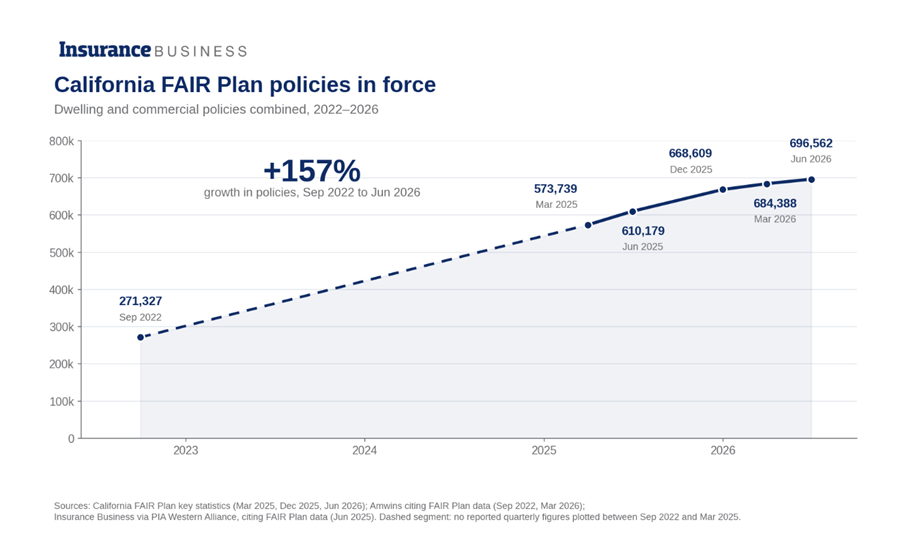
Most of that load is residential, but the commercial book is growing faster. At the end of September 2025, residential exposure had climbed 50% to $645.23 billion statewide, while commercial exposure jumped 82% to $49.5 billion.
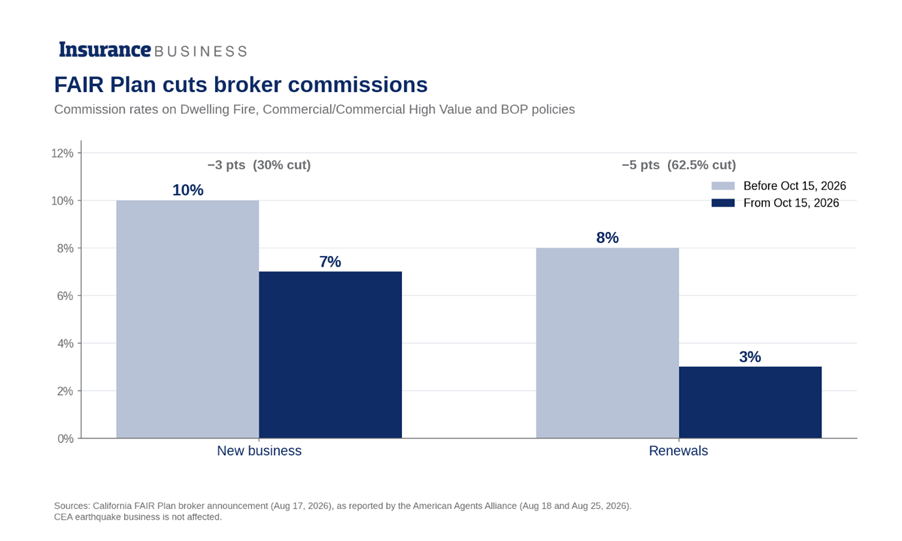
The plan has also just made itself less attractive to the agents who place those businesses. From October 15, 2026, it cuts commissions on new business from 10% to 7%, and renewal commissions fall 62.5%, from 8% to 3%, for certain dwelling fire, commercial, commercial high-value and businessowners policies.
The same date brings a 29.1% average FAIR Plan rate increase, less than the 35.8% the plan had sought. Agents looking for somewhere else to put a restaurant or a contractor's shop now have more reason to take calls from newcomers.
Read next: Bloomberg calls to cut broker insurance commissions
MGT argues that incumbents pulled back from whole regions because their systems couldn't tell one risk from the next. The company says it prices each location using property, geospatial and wildfire data, so it can pick individual accounts rather than draw red lines around counties.
Graham Topol, MGT's co-founder and co-CEO, said the combination of proprietary AI, admitted paper and the A- rating lets the company act as a "reliable partner where legacy carriers won't or can't provide coverage." He also said California makes up 14% of the domestic market. The company didn't say which market it meant.
Jack Ramsey, MGT's vice president of revenue, pitched the move directly to agents, saying the company was "flipping the script" on slow, cumbersome underwriting. Ramsey came to MGT from NEXT Insurance, where he led agent distribution. NEXT is a useful reminder of where digital small commercial can end up: it is now ERGO NEXT Insurance, after ERGO Group completed its $2.6 billion acquisition of the company in 2025 as part of Munich Re's primary insurance arm.
For all the talk of proprietary AI, the filings behind MGT's newest California product read like standard industry practice. The company's application for a new commercial umbrella and excess liability program was submitted June 9 and approved by the Department of Insurance on August 26, according to SERFF Filing Access (tracking number REGU-134914044).
The filing states that MGT had no loss experience of its own to build rates on, so it benchmarked them against approved competitor programs. Thirteen of its 15 proprietary forms were adopted from a program previously approved in California for ACE Insurance Group, and the rest of the program follows ISO's standard umbrella rules.
The approved rating plan is decidedly analog. It prices the first $1 million of cover as a fixed percentage of the underlying policy's premium: 25% for general liability, 45% for products and up to 30% for heavy trucks. Limits run as high as $200 million, a surprising ceiling for a company pitching itself on Main Street.
None of this is unusual for a new program, and regulators still had questions. In an objection letter, the department asked MGT to justify a flat 50% pricing factor for every $5 million layer of coverage, noting that such factors generally decline as limits rise. It also told the company to cap each schedule-rating category at 10% and to explain how it would judge criteria as loose as a "quality control policy." The approved plan steps the layer factor down from 50% to 44%, caps each category at 10%, and now requires evidence such as a written quality-control manual or ISO 9001 certification.
The underwriting guidelines add a small irony. MGT will write its umbrella over other carriers' policies only if they are rated "A" or better by AM Best. That's a notch above MGT's own A-, though its own policies qualify explicitly.
The umbrella filing says nothing about the property and businessowners coverage at the heart of this week's announcement, and that's where the AI and wildfire-data claims would have to prove themselves.
Every insurtech in the last decade has promised to write what the dinosaurs won't, and some of them now belong to the dinosaurs. It's also worth remembering why carriers pulled back in the first place. Outdated technology was one factor. Wildfire losses, reinsurance costs and a rate-approval regime that insurers have long called too slow were bigger ones.
Admitted paper in California comes with Proposition 103 attached: many lines are subject to prior-approval rate review, and MGT's own 78-day umbrella review, complete with objection letter and four rating-plan revisions, shows that no algorithm gets a filing through Sacramento any faster.
Regulators say the market is slowly thawing. Under Commissioner Ricardo Lara's Sustainable Insurance Strategy, the department keeps a list of distressed ZIP codes and requires participating carriers to write more business there. Farmers has pledged to market to 300,000 consumers in high-risk zones from 2026, and Mercury General aims to grow its book in high-risk areas by 15%. "We are not out of the woods," Lara has said, calling a structurally healthier market a three-to-five-year project.
MGT will be competing with the returning incumbents as well as filling the gap they left behind.
Read next: California's FAIR Plan carries growing load as insurers retreat beyond wildfire zones
Whatever you call it, MGT has been busy. The company launched MGT Specialty, its excess and surplus lines arm, and hired former Hiscox executive Chad Nitschke to run it. In October 2025 it closed a $21.6 million Series B round led by Mubadala Capital, with participation from Clocktower Ventures, Tacora Capital and existing investors. At the time, MGT said it served nearly 30,000 customers, had quadrupled its growth and had turned profitable before its second anniversary.
In February it announced a partnership with Amwins, which the companies describe as the largest independent wholesale distributor of specialty insurance products in the US, to bring MGT's AI underwriting and pricing platform to selected E&S risks. That collaboration started with lessor's risk only, MGT's first E&S product. In January, the company also rolled out an artisan contractor BOP that it says agents can quote and bind in under three minutes.
Amwins has been working the California problem from another direction too. It partnered with Vivere on a FAIR Plan wrap designed to fill the coverage gaps left by the plan's bare-bones fire policies.
Read next: 'You cannot depopulate the FAIR Plan if it's cheaper'
For California producers, the practical questions are the same ones they'd put to any new market. Which classes are in appetite? MGT's filed umbrella guidelines don't list any. How far into the wildland-urban interface will the property model actually go? Who handles claims, and how fast? MGT says it will run weekly webinars and publish guidance for agents and business owners, which gives agents an early chance to find out.
So, what is a neo-insurer? On the evidence of its California paperwork, it's a carrier with an AM Best rating, an approved rate filing, a regulator's objection letter and a stack of forms borrowed from ACE, plus a lot of software and a new prefix.
In California right now, a carrier willing to write small commercial risks is newsworthy on its own.