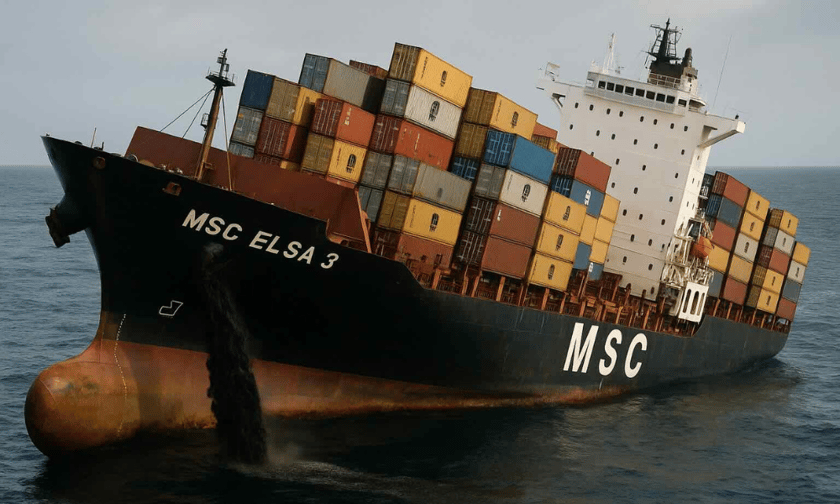
The sinking of the MSC ELSA 3, a Liberian-flagged container ship, off the southern coast of India has triggered a multi-layered crisis involving environmental damage, disrupted coastal economies, and complex insurance liabilities. Now, the Kerala state government is pursuing ₹9,531 crore (approximately $1.1 billion) in damages from Mediterranean Shipping Company (MSC), one of the world's largest shipping operators.
The claim, filed in the Kerala High Court, seeks compensation for ecological destruction, remediation expenses, and economic losses borne by local fishing communities. The lawsuit follows the vessel's capsizing in late May, which resulted in hundreds of containers – including some carrying hazardous chemicals and plastic nurdles – spilling into the Arabian Sea.
The accident occurred on May 25 as the MSC ELSA 3 sailed from Vizhinjam to Kochi. The vessel developed a severe list and eventually sank approximately 13 nautical miles off the coast of Alappuzha during rough monsoon conditions. The ship was carrying approximately 643 containers, among them 72 filled with plastic pellets (nurdles) and at least 13 containing calcium carbide, a water-reactive chemical.
Authorities estimate that only a fraction of the cargo has been recovered. Over 600 tons of nurdles have been collected along the coasts of Kerala and Tamil Nadu, while much of the remaining cargo remains unaccounted for. The state’s preliminary loss estimate includes ₹86.26 billion for ecological damage, ₹3.78 billion for cleanup and remediation, and ₹5.27 billion to compensate the fishing community for income losses and gear damage.
The sinking prompted the Kerala government to formally designate the incident as a “State-Specific Disaster” and establish a multi-tiered response system, including scientific advisory and legal teams. Shoreline clean-up operations are ongoing, and environmental surveillance continues in affected areas.
Insurance responsibilities for the vessel are distributed across several entities. The ship itself was covered under a Hull and Machinery (H&M) policy for physical damage or total loss. Meanwhile, liability for environmental damage and third-party harm falls under the Protection and Indemnity (P&I) cover provided by the Steamship Mutual Underwriting Association, a member of the UK P&I Club.
Under maritime law, individual cargo owners bear the responsibility for insuring their own goods. Losses not covered by insurance may require proof of carrier negligence for recovery. Additionally, a declaration of General Average remains a possibility – triggering shared loss obligations between MSC and cargo owners.
The Kerala government’s claims are expected to proceed through the vessel’s insurers. However, in the absence of attachable assets within India, the Kerala High Court has ordered the arrest of two MSC-linked vessels – MSC Manasa F and MSC Akiteta II – currently docked at Vizhinjam Port, until appropriate security is furnished.
Efforts to recover the remaining containers and stabilize the site are ongoing. The Directorate General of Shipping (DGS) reported that the salvage support vessel Canara Megh has maintained 24/7 caretaking duties. Dutch firm SMIT Salvage is scheduled to initiate diving operations in early August, pending visa and customs clearance for its team and equipment.
Aerial and water quality surveillance has thus far not revealed fresh oil sheens or new environmental hazards, though officials have noted the presence of lingering plastic nurdles and some disruption to local fishing operations.
The DGS has also requested a legal and technical review of cargo documentation, including bills of lading and packaging declarations, to assess potential misdeclarations regarding hazardous cargo. Meanwhile, routine water sampling and a broadcast exclusion zone remain in force around the wreck site.
The MSC ELSA 3 incident underscores the potential scale of modern marine environmental losses – and the complexity of allocating responsibility. While legal proceedings continue in India, insurers and reinsurers may face protracted negotiations over the scale and attribution of liability.
The case may also become a precedent in Indian admiralty law under the Admiralty Act of 2017, particularly in its application to third-party environmental claims and vessel arrest proceedings.
For the insurance industry, the spill poses broader questions about underwriting standards, environmental risk modeling, and exposure to cargo misclassification.
As the Kerala High Court prepares to revisit the matter on July 10, and as clean-up efforts persist along hundreds of miles of coastline, a collision of environmental vulnerability and global logistics liability continues to unfold – one that could reshape marine insurance in the region for years to come.
Fires and machinery breakdowns are eclipsing all other risks in modern marine insurance, according to new data released by the Nordic Association of Marine Insurers. The group’s 2024 Ocean and Coastal Hull reports, based on analysis of tens of thousands of claims, reveal a striking shift in the anatomy of maritime losses: large vessels are aging, systems are failing, and fires at sea are now alarmingly common.
Once considered rare and containable, shipboard fires have become a persistent source of major claims. So, too, have machinery failures – many of which escalate into collisions, groundings, or blackouts in heavy weather. The findings, drawn from the Nordic Marine Insurance Statistics (NoMIS) database, underscore the increasingly interconnected nature of modern shipping risks – and the rising cost of getting it wrong.
The years following the 2008 financial crisis saw a wave of shipbuilding that flooded the world’s ports with vessels. Now, 13 to 17 years later, many of those ships are reaching critical maintenance thresholds. According to the data, vessels in this age group accounted for the majority of machinery-related losses in 2024 – 56 percent of machinery claims by value – compared with 35 percent for newer ships. MSC Elsa 3 was launched in 1997 – making the ship 28 years old.
The cost of machinery claims has soared. In 2024, the average machinery claim per vessel was 50 percent higher than the average between 2015 and 2021. Eleven machinery claims exceeded $5 million in 2024, a rise from seven such cases the previous year.
Many of those incidents involved main engine failures. Others included malfunctions in auxiliary engines and propeller shafts. But these failures rarely occur in isolation. In numerous cases, machinery problems were linked to more complex incidents: a blackout in heavy seas, for example, that leaves a ship unable to steer and ultimately grounded – or worse, involved in a collision.
In the past, major fires on container vessels were infrequent. That began to change in 2019 and has worsened since. According to Cefor, 2023 and 2024 each saw multiple fire-related claims exceeding $10 million. In 2024 alone, four of the nine largest claims stemmed from fire; in 2023, fires accounted for half of the major losses above $10 million – including the two largest, each topping $50 million.
While some fires originate in cargo holds – often due to undeclared or misdeclared hazardous goods – others start in engine rooms, blurring the line between technical malfunction and structural risk. For underwriters, it’s an increasingly vexing problem: fires are hard to predict, harder to contain, and often devastating in cost.
The marine sector had experienced a relatively quiet decade in terms of major nautical claims. That ended in 2023. Collisions returned to the top of insurers’ ledgers in 2024, with the two largest losses over $30 million both involving vessel collisions.
Machinery is often a contributing factor, either as a direct cause or as a secondary failure. The case of the Dali, which lost power and collided with the Francis Scott Key Bridge in Baltimore, is a case in point. Though categorized as a collision, the underlying issue was mechanical – an engine blackout.
“The total cost of claims tied to machinery and equipment malfunction,” the Cefor report noted, “is materially higher than machinery claims alone would suggest.”
Another rising trend: weather-related losses. Cefor reported an uptick in such claims beginning in the fourth quarter of 2023, likely linked to vessel rerouting around the Cape of Good Hope – a longer, more exposed route used increasingly as a detour from the Red Sea due to geopolitical instability.
Heavy seas can amplify the effects of technical failure. One blackout in a storm can put a ship – and its crew – at significant risk. The interaction of weather and machinery is now a key concern for insurers.
The report also examined vessels that were laid up during the early months of the COVID-19 pandemic. Ships that were idled in 2020 had a consistently worse claims record, both before and after their lay-up. Some were scrapped; others remain in circulation with elevated maintenance risks.
Cefor analysts call this a “survival of the fittest” effect: the ships most likely to be taken out of service were also those most prone to failure.
Though the rate of claims cost inflation has slowed since its 2022 peak, costs remain high. Spare parts, dry dock availability, salvage and firefighting logistics – all are increasingly expensive.
The challenge for insurers is not merely the frequency of incidents, but their compound nature. A malfunctioning valve or engine component may trigger a blackout, which in turn causes a grounding or fire. When these links form a chain reaction, the result can be catastrophic – and financially ruinous.
For marine insurers and reinsurers, the message is clear: future losses won’t come neatly labeled. They will arrive as entangled events, spanning machinery, weather, human error, and supply chain complexity. And the policy lines separating them will matter less than how quickly they can be understood – and priced.
2. Deepwater Horizon Oil Spill (2010)
3. Costa Concordia Disaster (2012)
4. Prestige Oil Spill (2002)
5. MOL Comfort Sinking (2013)
6. ONE Apus Container Loss (2020)