Catastrophe modelers and actuaries at some insurers are being pressed to shave their climate projections so business keeps moving. That claim comes from a group of current and recently departed senior executives from across the UK and European property-casualty, reinsurance and broking markets.
Their memo, Sounding the Alarm, by Inside Track, a UK nonprofit that gives senior staff an anonymous channel to raise concerns about their industries. It says modelers in some firms have been asked to give forward-looking estimates a “haircut,” or to “manage down the numbers” so as not to cause alarm. Where higher physical-risk estimates could hurt profitability or market share, the authors write, model adjustments are often constrained by commercial considerations.
It would be easy to regard this as a purely European story, but that would miss how the US property market is financed. Much of the reinsurance capacity behind US carriers comes from European groups. Munich Re and Swiss Re alone accounted for around a quarter of the reinsurance premiums written by the world’s 50 largest reinsurance groups in 2022, according to AM Best. European ownership also reaches the primary market. Farmers Group, which manages the policyholder-owned Farmers Exchanges, is a wholly owned subsidiary of Switzerland’s Zurich Insurance Group.
When models are trimmed, capital is allocated or exposure is cut in Munich, Zurich or London, the effects can reach US reinsurance pricing, carrier appetite and, eventually, renewal notices. The memo does not single out the US. It does name North America, alongside Europe and Japan, among the regions where the impact will be felt.
Read next: Revealed – who are the world’s leading reinsurers?
The memo sets out what it calls the industry’s default response to rising physical risk, in three stages.
The first is price. Premiums rise to reflect higher risk and greater uncertainty, pricing out lower-income households and pushing up costs for sectors such as farming and shipping.
The second is narrower cover. The authors’ example is wildfire being stripped out of property policies. Because most cover renews annually, they note, insurers can make that change with little friction.
The third is withdrawal. Where premiums and claims can’t be balanced, insurers leave certain regions and sectors altogether. The memo names coastal, mountain and flood-prone communities as the most exposed.
The authors stress there is no malice in any of this. In their view, it is simply what short-term incentives reward. The process “has already begun and will now accelerate,” they write. The result will be more uninsured losses landing on households, businesses and taxpayers.
Read next: Triple-I, Munich Re flag $424 billion protection gap in sweeping risk survey
Repricing. The National Association of Insurance Commissioners published its first national analysis of state-collected homeowners data this summer. It found inflation-adjusted average premiums rose between roughly 18% and 43% across the four NAIC regions from 2018 to 2024, with the biggest increases in 2023 and 2024.
Restriction. This stage is the hardest to see in the data, because coverage can shrink while the premium stays flat. The NAIC authors acknowledge the blind spot. Some policyholders, they note, may have moved from standard deductibles to percent-of-value deductibles, which would show up in premium data as no change or even a decrease.
Retreat. Insurers initiated just over 2 million non-renewals in 2024, about 61% more than the year before. Between 2018 and 2024, company-initiated non-renewal rates rose in every NAIC region, by between 96% and 216%. The Southeast saw the sharpest increase. In the West, the rate more than tripled in just two years.
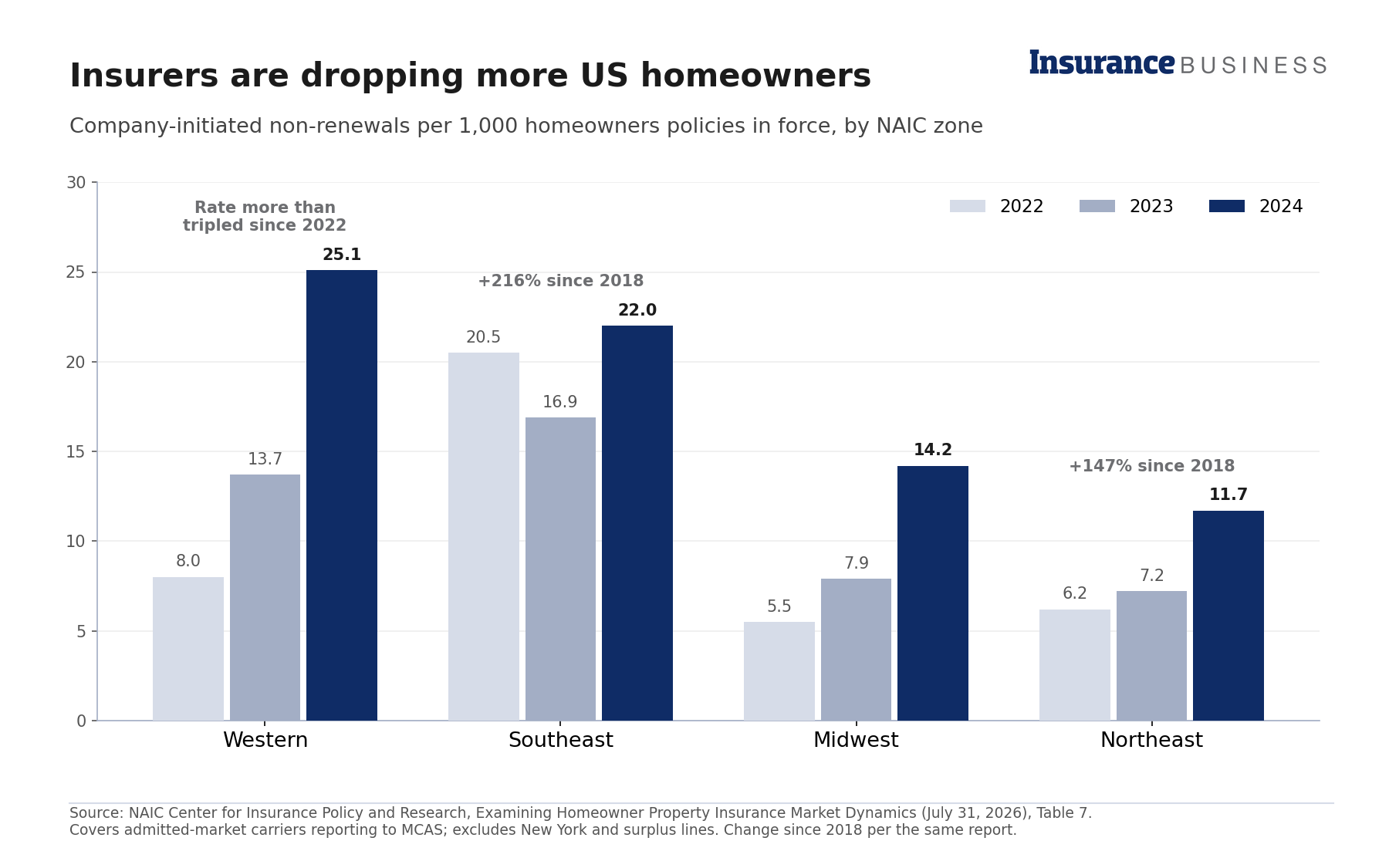
The Midwest is a reminder that this is not only a coastal or wildfire story. The NAIC found it was the only region where operating profits declined almost every year from 2018. Severe convective storms have played an outsized role in the Midwest’s losses since 2021.
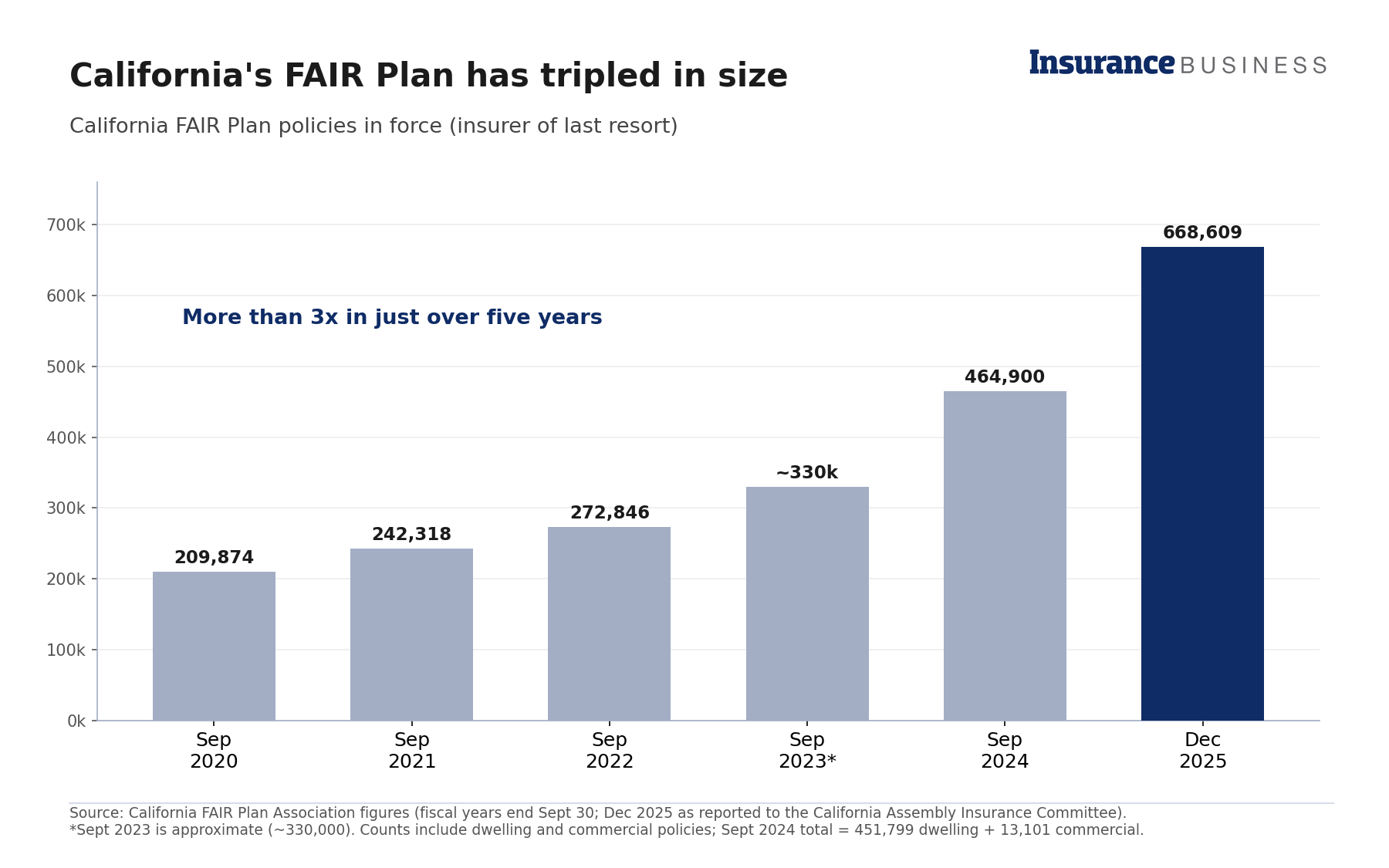
California shows where retreat leads. Enrollment in the state’s FAIR Plan, its insurer of last resort, jumped 43% between September 2024 and December 2025, following the Los Angeles fires that destroyed around 12,000 homes. An analysis of plan data also found that around 14% of FAIR policies now sit in largely urban, lower-wildfire-risk areas.
Read next: California’s FAIR Plan carries growing load as insurers retreat beyond wildfire zones
The pattern extends well beyond California. Between 2018 and 2023, the state insurers of last resort in California, Florida and Louisiana roughly doubled their policy counts as private carriers pulled back. Only about 4% of US homeowners carry flood insurance.
Read next: Flood-prone US counties lose residents at nearly twice last year’s rate
The memo’s central allegation is about catastrophe models, and it is arriving at a sensitive moment in the US. In December 2024, California approved a regulation allowing insurers to use forward-looking wildfire catastrophe models in ratemaking. Most other states already allowed the practice. In return, insurers must commit to writing more policies in wildfire-distressed areas, and the models must account for mitigation by homeowners and communities.
The rules also provide for public review of the models used in rate filings, and the first wildfire model cleared that review in 2025. Model assumptions are now a regulated, contested input to the premiums Californians pay. Consumer advocates have already argued that the rules don’t give the public enough oversight. Any pressure to nudge model outputs, in either direction, therefore matters to regulators as much as to boards.
The memo also argues that modeling capability is uneven across the industry. Some insurers still rely on inadequate or outdated cat models, and the market as a whole leans on a small number of vendor base-case models. Some carriers, it says, can’t properly measure aggregated risk across the firm. Systemic and concentration risk tends to fall between the silos most organizations are built around.
Read next: As climate losses mount, insurers grapple with a volatile new normal in California
The memo’s sharpest warning is about mortgages. If cover is restricted or withdrawn at scale, the authors see an economic shock that could precede a financial crash, much as sub-prime lending did before 2008. In the US, mortgage contracts generally require hazard insurance, so losing coverage can put homeowners at risk of losing their homes.
Recent US research suggests the transmission mechanism could be a real problem for the property market. In a study highlighted by NYU Stern, professors Mary Billings and Stephen Ryan and co-author Han Yan analyzed county-level data from 2018 to 2023. They found that a one-percentage-point rise in non-renewals was associated with:
Lord Stern, who chairs the Grantham Research Institute on Climate Change and the Environment at the London School of Economics, issued a statement alongside the memo. He said a report from insurance insiders identifying a mortgage crisis as a significant concern came as no surprise to him.
The authors say executive pay is increasingly tied to short-term share price performance. In their words, the industry is “jeopardising longer-term shareholder value in favour of quarterly growth.” They urge pension funds and other long-term investors to scrutinize their exposure to insurers. They also question whether carriers can reliably time their exit from deteriorating risks in a less predictable world.
The memo closes on self-interest rather than morality. Even setting aside any wider responsibility, the authors argue, insurers have a stake in helping to reduce risk, not just pricing it and timing their way around it. Otherwise many of today’s policyholders “may suddenly find that they are not our customers tomorrow.”
Read next: Homeowners insurance sector slammed by climate impacts