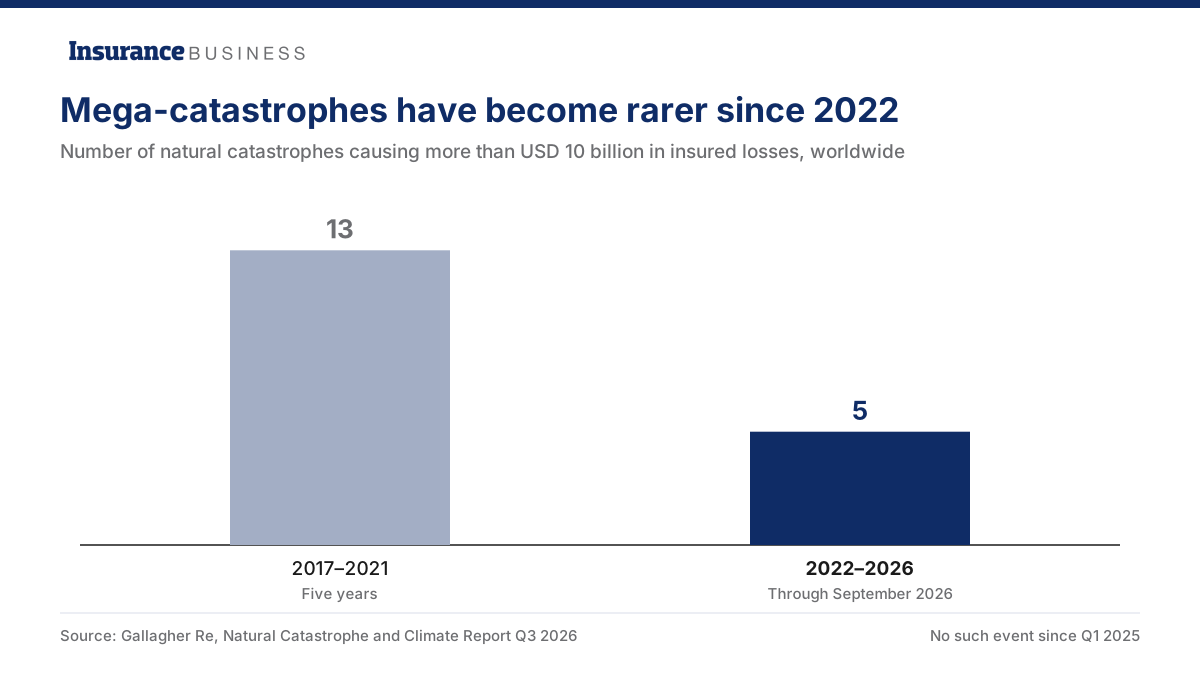
No natural catastrophe anywhere in the world has caused more than $10 billion in insured losses since the first quarter of 2025.
Gallagher Re counts six straight quarters without such a peak-loss event in its Natural Catastrophe and Climate Report: Q3 2026, published this week, and calls it the longest such run in decades.
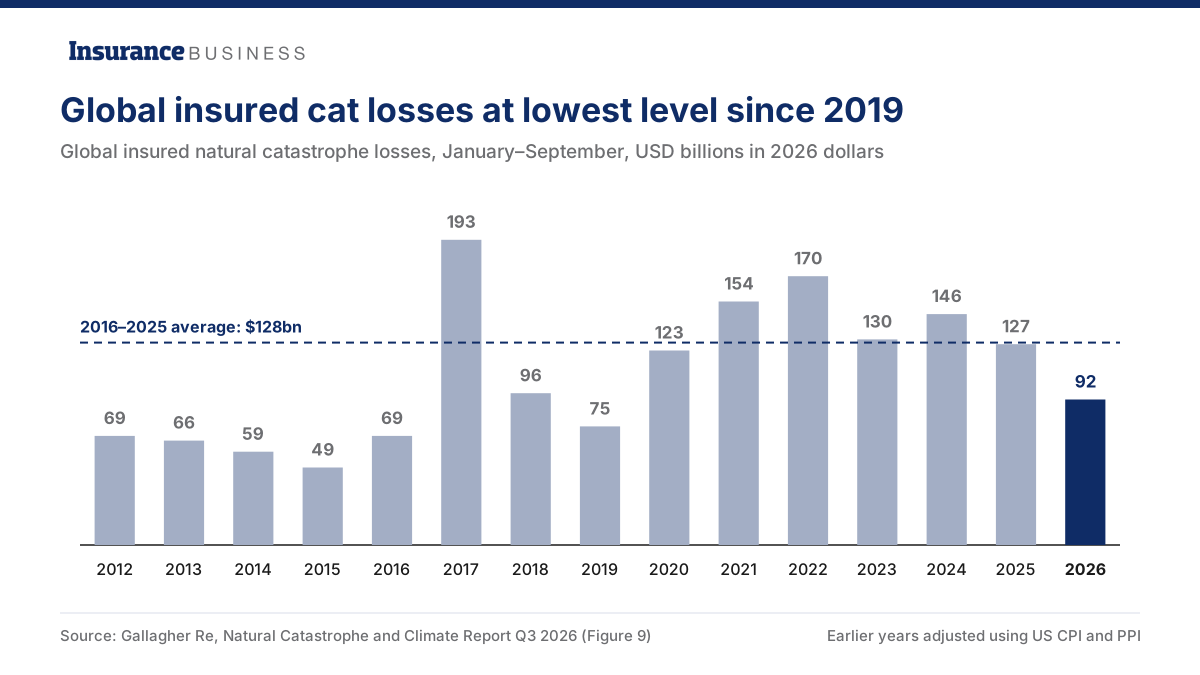
Global insured losses for the first nine months of 2026 came to about $92 billion. That is 29% below the 2016–2025 average for the period and the lowest January-to-September total since 2019. It also helps explain why reinsurers go into the January 1 renewals with record capital and a strong appetite for business.
The number of events was close to normal. Gallagher Re counted 24 billion-dollar insured events through September, in line with the 10-year average. Only 13 exceeded $2 billion, and none reached $10 billion.
Steve Bowen, Gallagher Re's chief science officer, said in a statement accompanying the report that "catastrophe activity and catastrophe losses are not necessarily the same thing." Many serious disasters struck in 2026, he said, but few hit places or unfolded in ways that produced large insured losses.
Since 2022, five catastrophes worldwide have topped $10 billion in insured losses, according to Gallagher Re. There were 13 between 2017 and 2021.
The costliest insured event so far this year was a severe weather outbreak across the central US from April 22 to May 1, at about $6 billion. Three of the five costliest insured events were in North America.
Total economic losses reached about $242 billion, the lowest nine-month figure since 2015, and about 62% of that was uninsured. The US accounted for about 62% of insured losses. The two costliest disasters of the year, earthquakes in Venezuela and Colombia, caused more than $38 billion in combined damage but only about $3 billion in insured losses.
Gallagher Re still expects full-year insured losses to exceed $100 billion. Adjusted for inflation, 2026 would be the 10th consecutive year above that level.
Low catastrophe losses have lifted reinsurer results. Gallagher Re's composite of major reinsurers reported a 19.9% return on equity and a record-low 85.8% combined ratio in the first half, and dedicated reinsurance capital rose to a record of about $688 billion.
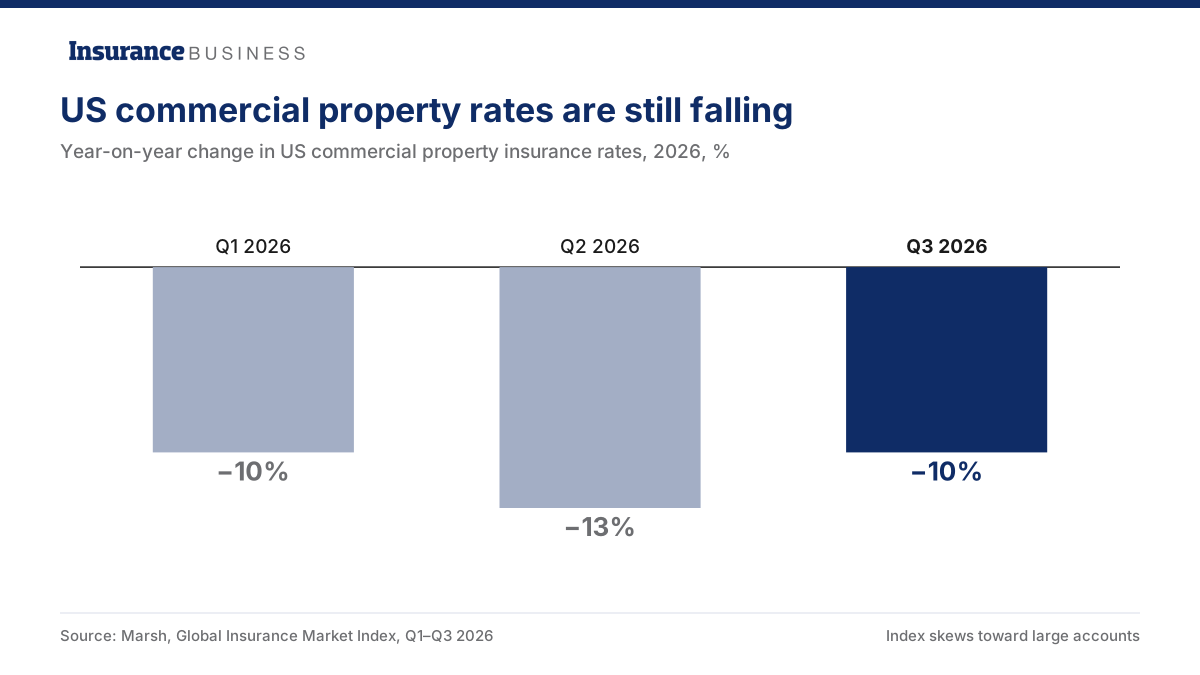
Primary pricing has followed. US commercial property rates fell 10% in the third quarter after a 13% decline in the second, according to Marsh's latest Global Insurance Market Index, released October 21. Marsh said a benign US hurricane season was "contributing to favorable underwriting results for insurers."
August's Midwest derecho did not change the direction of the market, and brokers said at the time that one storm on its own was unlikely to turn the property market. Cedents can expect strong competition among reinsurers at January 1, and the low-loss run is already shaping 2027 renewal discussions.
Read next: Reinsurers enter 2027 renewals with record capital
The report cautions that 18 months without a major event should not be taken as a sign that such events have stopped. Inflation, exposure growth and other non-weather factors continue to push loss costs higher. Gallagher Re says the industry is well placed to absorb a large loss if one occurs.
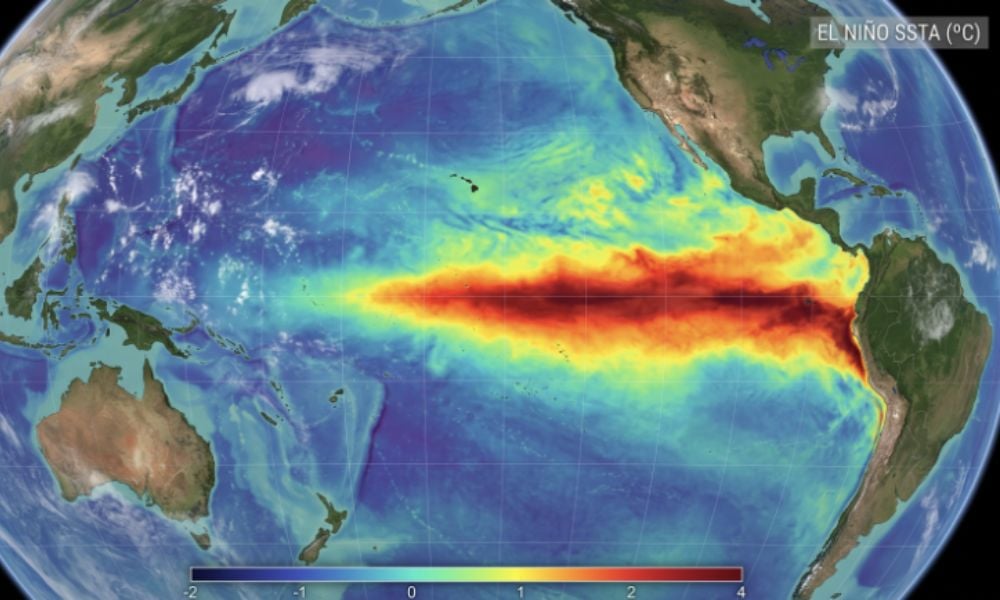
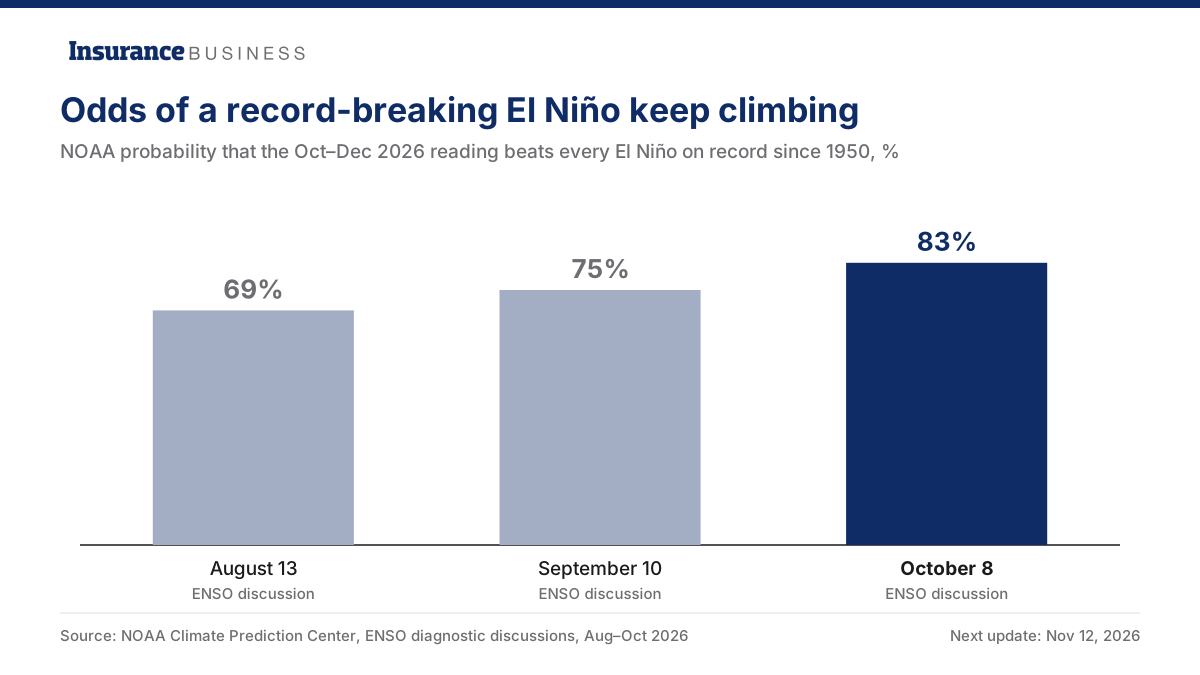
NOAA's Climate Prediction Center said in its October 8 ENSO diagnostic discussion that a strong to very strong El Niño is likely to continue through early 2027, with odds above 83%. It put the chance that the October-to-December reading exceeds every El Niño on record since 1950 at 83%, up from 75% a month earlier. Sea surface temperatures in parts of the eastern equatorial Pacific were more than 4°C above normal.
El Niño has worked in US insurers' favor this year. It typically increases wind shear over the Atlantic, which suppresses hurricane formation, and forecasters expected a quieter season as early as May. The Atlantic produced eight named storms through September and no hurricanes.
Isaias, the season's first hurricane, formed later in the year than any first Atlantic hurricane in records going back to 1851. It briefly reached major hurricane strength and made landfall as a Category 2 near Destin, Florida, on October 9. Its losses fall outside the nine-month total; Gallagher Re expects insured losses in the low-to-mid single-digit billions.
Read next: KCC puts Hurricane Isaias insured losses at $3 billion
Strong El Niño events have often been followed by a quick shift to cooler Pacific conditions. The forecasts cited in Gallagher Re's report point to a possible move toward La Niña later in 2027, a phase historically linked to higher US losses.
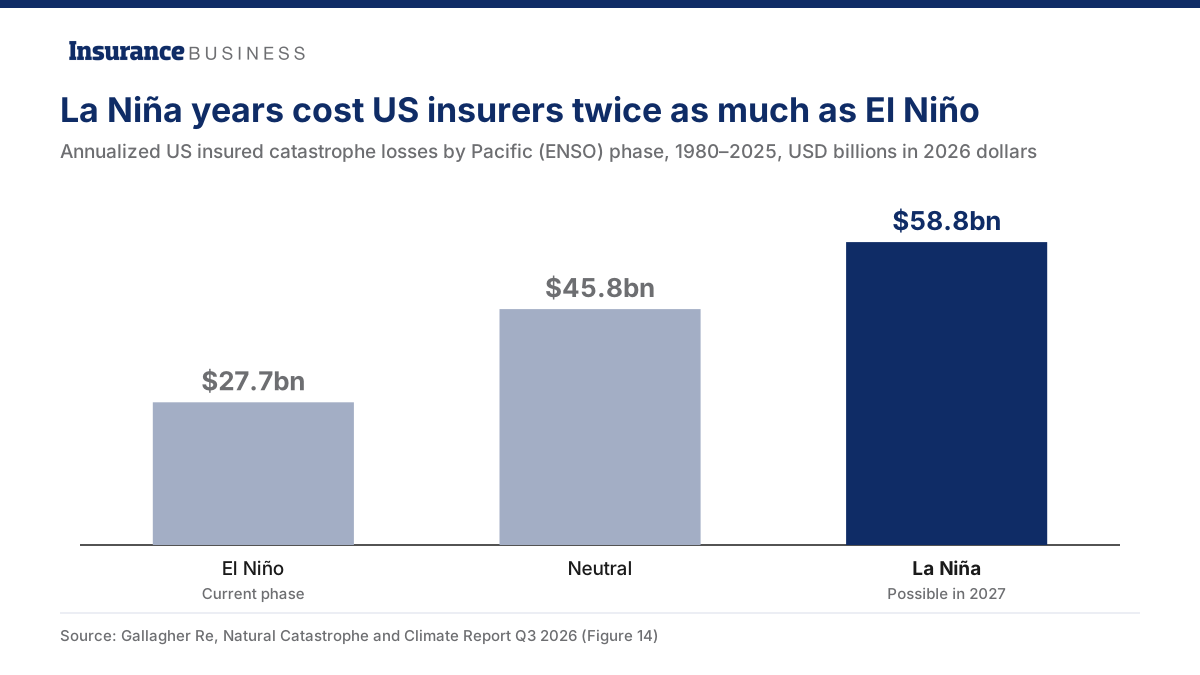
Gallagher Re compared its loss database with monthly ocean temperature readings back to 1980. On an annualized basis, US insured catastrophe losses averaged about $27.7 billion during El Niño conditions, $45.8 billion during neutral conditions and $58.8 billion during La Niña, in 2026 dollars. For Atlantic and western Pacific tropical cyclones from 1990 to 2025, insured losses in La Niña years were about 200% higher than in El Niño years, mainly because of more frequent US hurricane landfalls.
Gallagher Re stresses that these are historical averages, not forecasts. Losses within each phase have varied by a factor of 10 to 20, and the ENSO cycle cannot indicate where a storm will make landfall. The report suggests insurers use it as an early input for portfolio reviews, accumulation checks and capital planning.
Read next: The strongest El Niño in recorded history is building. Insurers are already paying the price
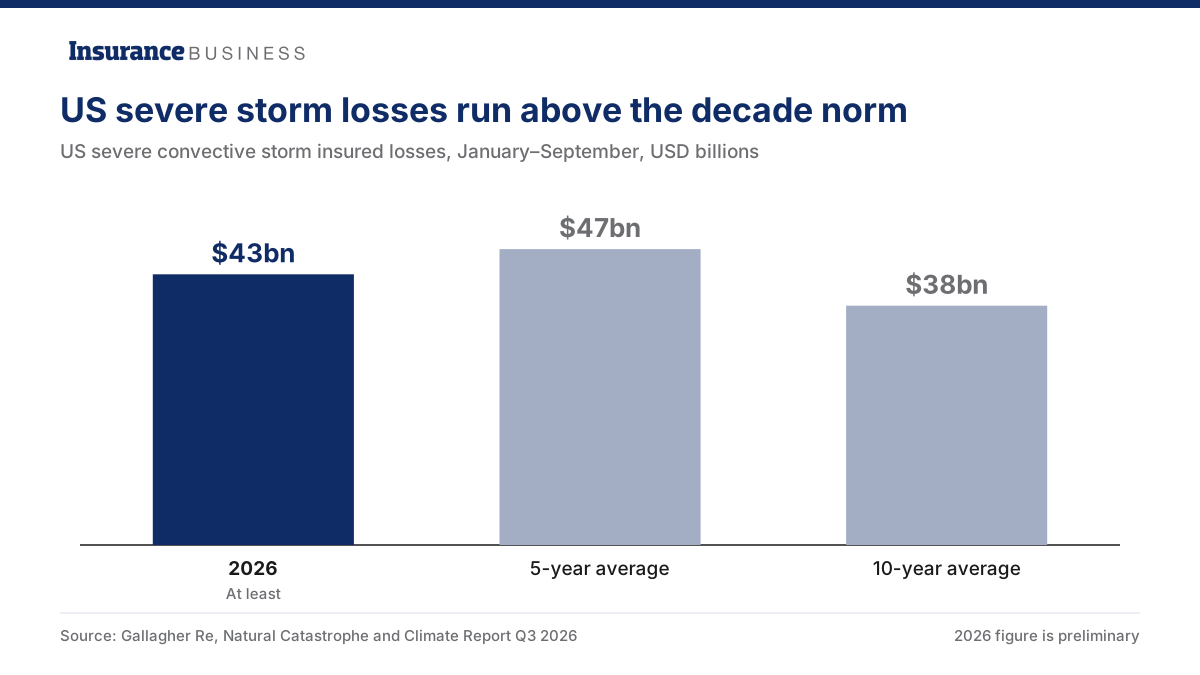
Severe convective storms cost US insurers at least $43 billion through September, according to Gallagher Re. That is below the five-year average of $47 billion and above the 10-year average of $38 billion, making 2026 the sixth-costliest January-to-September period on record for the peril. It is also the fourth consecutive year in which US insured losses from these storms have passed $40 billion. Worldwide, severe convective storms accounted for nearly 60% of insured catastrophe losses through September.
Illinois recorded a state-record 211 tornadoes through September, the highest count of any state this year. A series of storms from August 9 to 17, including a derecho that crossed northern Illinois and Indiana on August 11 with gusts of up to 100 mph, caused at least $3 billion in insured losses and pushed year-to-date US storm losses past $35 billion by mid-August.
The contiguous US also recorded its hottest summer on record, narrowly beating the 1936 Dust Bowl summer, mainly because of record-warm nights. More than 8.6 million acres had burned by the end of September, well above the 10-year average. The Spokane-area wildfire complex in August caused close to $1 billion in insured losses, the costliest wildfire on record for Washington State insurers.
For brokers and buyers, conditions heading into January are favorable, with ample capacity, falling rates and reinsurers looking to deploy capital.
The El Niño is expected to peak this quarter. If La Niña follows, US insurers could face more active hurricane seasons. Bowen said a possible shift toward La Niña in 2027 shows how quickly the catastrophe picture can change, and that companies that "use quieter years to prepare" are often best placed when conditions shift.