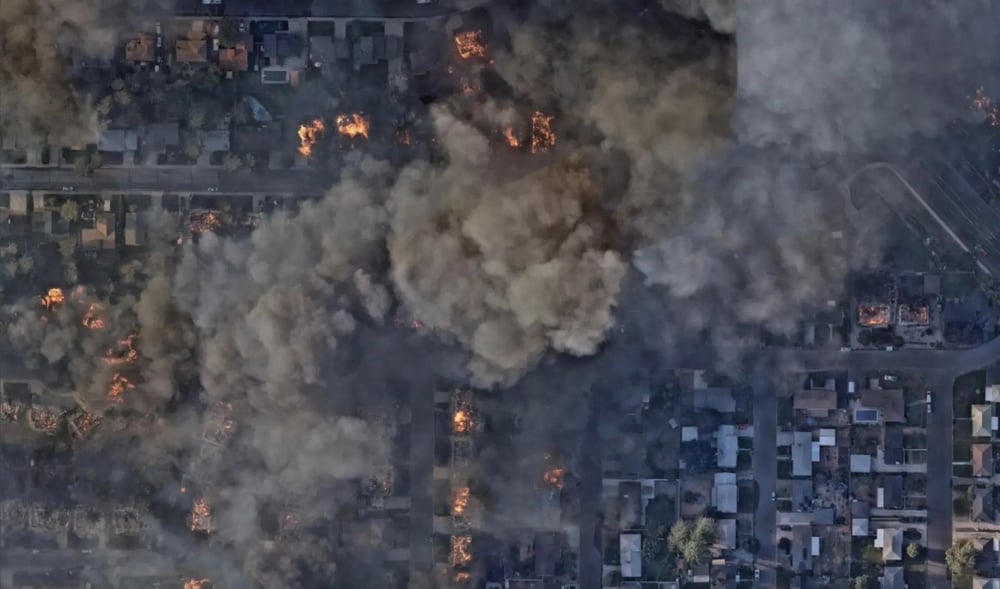
Image from Nearmap
Wildfire claims are becoming increasingly data-driven as insurers use aerial imagery, artificial intelligence and historical property information to assess damage sooner after a catastrophe.
The shift has become more visible following major events on the West Coast. Last year’s Palisades and Eaton fires in California created an unusually severe claims event because of the scale of destruction across densely populated, high-value communities.
This year’s Spokane wildfires have provided another test for insurers and claims technology providers, although the loss profile has been different.
The growing use of property intelligence is changing how quickly clients can receive an initial assessment, how claims are triaged after a major event and what evidence may be available when questions arise over pre-existing damage.
Andrew McCallum, vice president, specialty operations at Sedgwick, said the scale of last year’s Palisades and Eaton fires stood apart because of where the flames struck.
“I would definitely call it a one-off moment because it was such an extensive amount of damage,” McCallum said. “Because you’re talking about entire multimillion-dollar dwellings, entire neighborhoods, being wiped out.”
This year’s wildfire events have generally differed because they have not struck major metropolitan areas to the same extent. Population density, insured values and carrier concentration can all influence the severity and complexity of the resulting wildfire claims.
The claims environment has changed alongside the risk. Even where a fire leaves little of a structure to inspect, adjusters now have access to property information that would have taken days or weeks to obtain a decade ago.
Claims teams can obtain measurements and other information about a dwelling even when the structure itself has burned to the ground. Digital databases can also accelerate searches for ownership history, liens and other property issues that could complicate payment.
“There’s the ability to look at the dwelling before the wildfire ever happened,” McCallum said. “Just 10 years ago, you didn’t really have all these digital resources and this library of information that people have gathered and put into a repository so that we can use it to say, ‘Okay, what did the building look like before? What does it look like today?’”
The speed matters when carriers are dealing with hundreds or thousands of losses simultaneously. It could mean substantially different claims journeys for clients affected by the same catastrophe, with straightforward losses moving more quickly while complex claims still require more intensive adjustment.
The Spokane wildfires this year have also demonstrated how quickly aerial imagery can be deployed after a catastrophe.
Nearmap chief product manager David Tobias said the company was among the first in the air following the fires, with imagery captured within hours of the event beginning. He said that unlike a tornado, where the damage path is largely fixed once the event has passed, wildfires can continue moving, requiring repeated flights and updated imagery.
Insurers can also compare recent pre-catastrophe imagery with pictures captured after an event, helping establish what damage existed before the wildfire and what was caused by the latest loss. That historical comparison, Tobias said, can be particularly important when claims involve questions over whether deterioration or damage predated the event.
The technology could eventually bring far more information into the earliest stages of a claim. Property measurements, roof characteristics and material-pricing data can potentially be assembled before an adjuster physically visits a damaged building.
“I’m excited about how bringing property intelligence data together in one spot can actually affect those types of workflows in a way that takes something that could be 30 days, down to hours and minutes,” Tobias said.
Faster property intelligence may allow insurers to identify straightforward total losses, prioritize more complex claims and begin making some payments sooner.
There are limits, however. McCallum said aircraft cannot necessarily be sent over properties while a wildfire remains active, creating a potential delay before detailed imagery can be captured. Tree canopy can also obscure structures and reduce the quality of information available following some losses.
“The timing of getting the information and getting a drone up in the air can be problematic as well,” McCallum added. “You have to take all those things into consideration.”
The existence of sophisticated aerial and AI tools does not necessarily mean detailed property-level information will be available while an event is still unfolding.
At the same time, insurers are proceeding cautiously around AI and other digital claims tools. McCallum pointed to concerns around cybersecurity and the protection of personal information, as well as the need to establish which technologies consistently produce useful results. That leaves insurers balancing the potential for much faster catastrophe claims handling against the reliability, timing and security of the data supporting those decisions.
As wildfire claims become more technology-driven, the speed of the tools will matter, but so will knowing when the information is strong enough to act on.