AI is already cutting across cyber, professional liability, D&O and crime, but brokers are increasingly being asked a more fundamental question: will the technology ultimately need an insurance market of its own?
An Insurance Business LinkedIn poll suggests many expect at least some separation. Half of respondents said AI-specific insurance would eventually become a major commercial line, while 22% expected that to happen quickly. Another 14% said AI risk would mostly continue to be handled through existing lines.
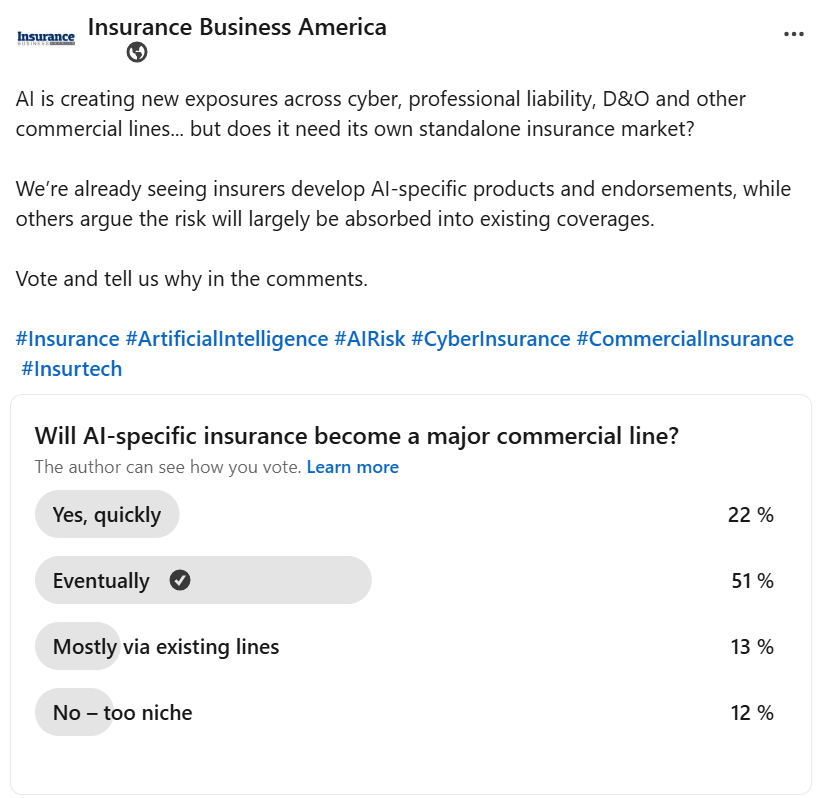
The market is already testing both approaches.
Lloyd’s coverholder Armilla AI launched a standalone affirmative AI liability policy in April 2025 and increased available limits to US$25 million in January 2026. The cover is aimed at companies developing or deploying AI and can respond to model errors, inaccurate outputs and agent actions.
In February, Armilla and Chaucer launched Vanguard AI, pairing Chaucer’s cyber and technology E&O coverage with Armilla’s standalone AI liability policy. Predefined allocation rules are intended to clarify which policy responds when a loss spans a cyber event, technology failure and AI behavior.
Munich Re has also been writing AI-specific risks through aiSure, a suite covering contractual liabilities, financial losses and legal liabilities arising from AI performance errors. Mosaic Insurance partnered with Munich Re in February to offer aiSure with up to US$15 million in initial capacity for defined AI performance failures.
Others are keeping AI closer to established lines. HSB, part of Munich Re, introduced AI Liability Insurance for small and midsized businesses in March, covering certain bodily injury, property damage and advertising injury claims arising from AI use. The coverage is designed to be added to partner carriers’ business policies rather than sold directly as a separate policy.
The “patchwork” nature of the marketplace is something WTW’s Jennifer Wilson flagged as a source of ambiguity for brokers in both the retail and wholesale chain. Insurance has not quite caught up with AI risk,” Wilson sid. “Right now, we’re relying on silent AI coverage in our cyber and technology policies.”
Keith Savino, US CEO of cyber insurer Emergence, said the distinction starts with whether a carrier is actually insuring AI as a separate risk or simply allowing AI-driven losses to fall within an existing policy.
“There’s a difference between saying, ‘I’m insuring AI,’ versus saying, ‘We’re a cyber insurer and we’re not excluding AI,’ or, ‘We’re a cyber insurer and we recognize that AI is part of the risk we’re taking on,’” Savino told Insurance Business.
“I think there are carriers coming out with exclusions because their existing forms probably provide coverage they never intended to provide. As a result, they don’t want to allow a claim to be settled in court and have a judge find coverage where it was never intended.”
That leaves brokers needing to identify what is affirmative, what is silent and what has been expressly carved out.
Commenting about the Linkedin poll, Evaa Saiwal, head of liability insurance at Policybazaar For Business, said: “I don’t see AI becoming a fully standalone commercial line across the board,” Saiwal said. “It is less a single new risk than a new cause of loss cutting across existing lines.”
She pointed to PI/E&O for incorrect outputs, privacy and IP exposures, cyber or financial losses from autonomous agents, and D&O issues around governance and disclosure. Standalone policies are more likely to emerge where AI creates losses outside traditional triggers, including model drift, hallucination, underperformance or autonomous actions causing economic loss without a cyber breach or conventional negligence.
Meanwhile, Savino believes carrier positions are likely to keep changing as insurers learn more about those exposures. “This is not a done deal yet,” he said. “Come back in three months and see if that answer has changed.”