
For most of the past decade, the excess and surplus lines market has been measured by a single yardstick: how big it got. Adam Mazan thinks that habit needs breaking.
"One of the things that people get lost on is size means value," said Mazan, president of Risk Placement Services (RPS), speaking to IBA at the Wholesale & Specialty Insurance Association's Annual Marketplace in San Diego in October. RPS, based in Rolling Meadows, Illinois, is the wholesale broker and MGA arm of Arthur J. Gallagher & Co. As the market has swelled, he said, the responsibility of wholesalers is to keep proving their worth rather than ride the volume.
RPS has kept adding to its stable this year. Its 2026 deals include businesses such as Kansas-based MGA Med James, West Coast surety specialist S Philips Surety & Insurance Services, and Pennsylvania wholesale brokerage W.N. Tuscano Agency.
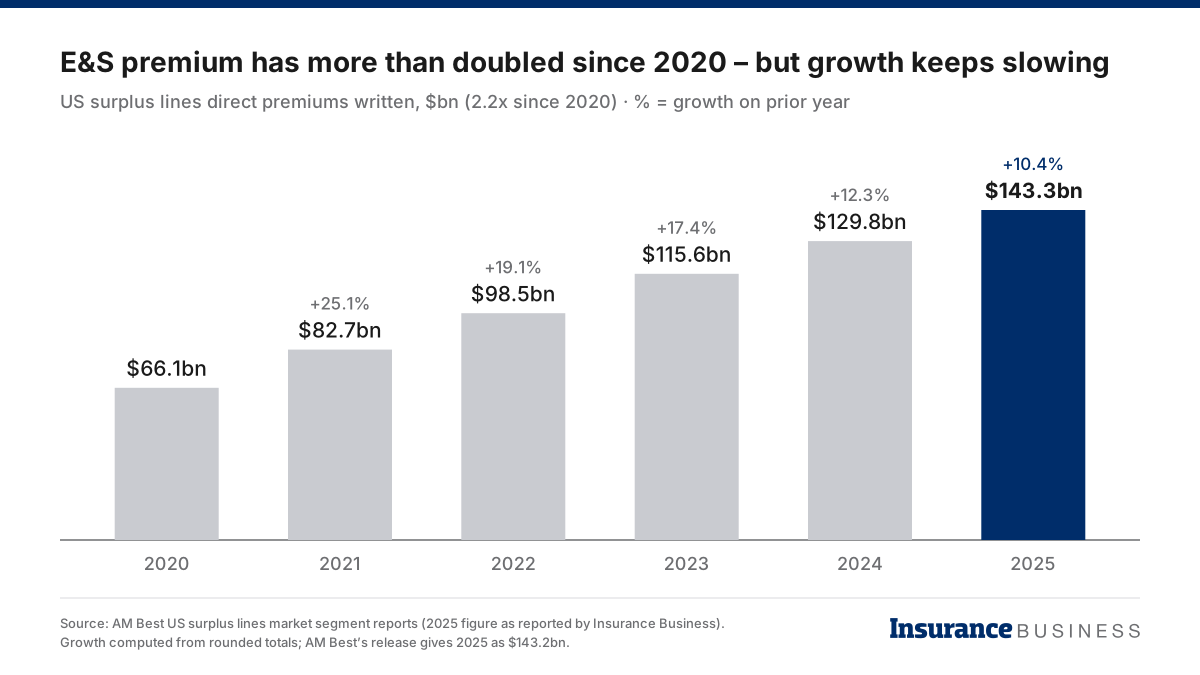
The numbers behind that volume are hard to ignore. The US surplus lines market wrote a record of roughly $143 billion in direct premium in 2025, up 10.4% on the prior year. That was the eighth straight year of double-digit growth – but also the third year in a row that growth slowed, and the rating agency moved its outlook on the segment to stable from positive in November 2025.
When capacity is plentiful and admitted carriers are drifting back into lines they once abandoned, a wholesaler can no longer win simply by having somewhere to send a risk.
Asked what the non-admitted market can do that the standard market cannot, Mazan pointed to three features of the risk itself: how hazardous the exposure is, whether the insured needs coverage built creatively around what the business actually does, and whether the account demands specialized underwriting.
The second leg of his answer was about people rather than paper. Wholesale brokers, he said, bring a particular skill to "program architecture" – the job of assembling a layered and shared property tower or stacking an excess casualty program. As firms like his grow, he added, they have to keep deepening that expertise rather than letting it thin out.
That view tracks with AM Best's own read of the market. The rating agency has said complex, hard-to-model exposures – catastrophe-exposed property, large construction projects, environmental liability, and casualty lines under pressure from social inflation – are likely to stay in the surplus lines channel even as other segments soften, as detailed in this breakdown of the record $143bn surplus lines year.
Read next: Property softens, liability hardens: what E&S midyear data means for brokers
Mazan's also had important advice retail agents deciding when to involve a wholesaler. Too often, he said, the wholesaler is brought in only once the strategy is set, the client's expectations are fixed, and the admitted markets have already declined.
Throughout his own time as a broker, he said, his request to retail partners was the same: bring me in early. The point, he stressed, isn't simply to add names to the marketing list. It's to have the wholesaler at the table with the insured, helping to set strategy and manage expectations before anything is promised.
The alternative, he said, is the wholesaler arriving after "the strategy has already been laid, the expectations have already been set and the admitted markets [have] already said no."
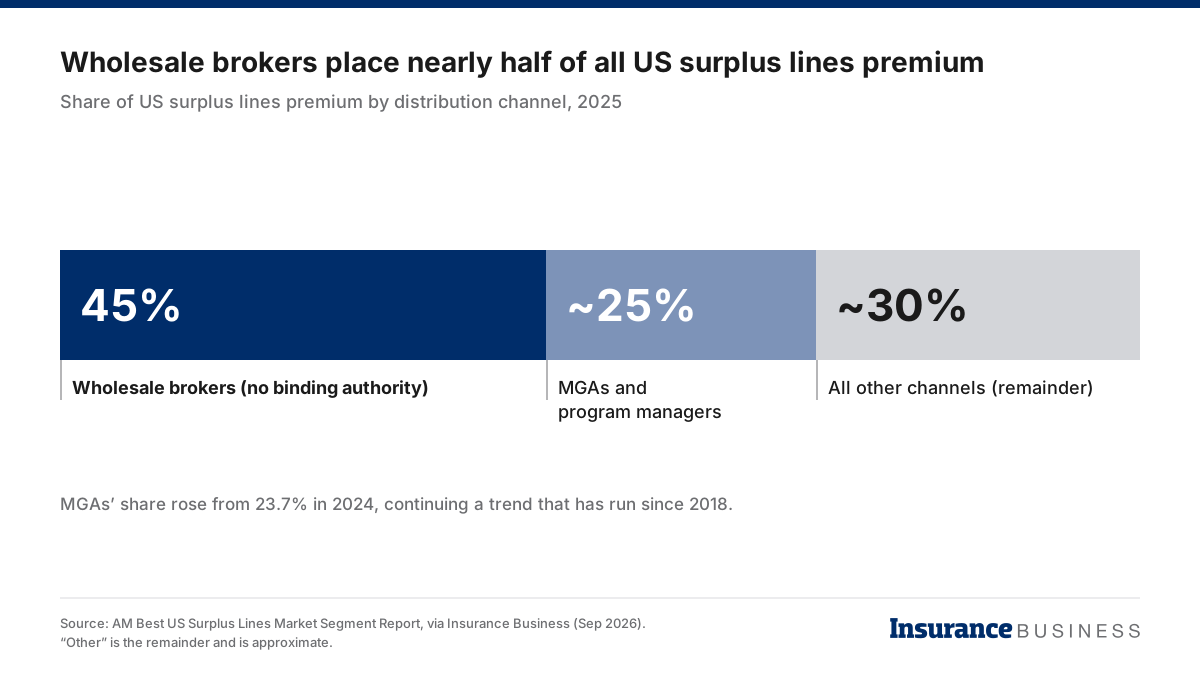
The process matters more as the wholesale channel takes on a larger share of retail books. Wholesale brokers without binding authority handled about 45% of surplus lines premium in 2025, while MGAs and program managers accounted for nearly a quarter, according to AM Best figures reported in the record-year analysis. Retail producers surveyed for IBA's 2025 report on wholesale brokers and MGAs also signaled rising expectations of their wholesale partners on responsiveness and product knowledge.
Read next: Wholesale brokers and MGAs gain ground as surplus lines market surges
Mazan's case for early involvement carries extra weight as conditions turn. AM Best says the surplus lines and specialty commercial market became highly competitive in the 18 months to mid-2026, with supply outweighing demand and negotiating power shifting toward buyers, according to its September market segment report.
In that environment, a retailer who works the admitted market first and calls a wholesaler only after a declination risks a client whose expectations on price and terms are already set – exactly the scenario Mazan warns against.
Read next: US surplus lines market continues strong growth
For a market that has spent years celebrating its own growth, Mazan's message is a modest correction: a wholesaler's worth shows up earliest in a placement, not after everyone else has said no.