For most of its history, the excess and surplus lines market has been where hard-to-place risks went when nobody else would take them. Ben Johnson (pictured) thinks that description is badly out of date.
"The admitted market has, frankly, been structured a little stale," said Johnson, who took over as president of Ironshore, Liberty Mutual's wholesale specialty unit, this spring. The gap between what E&S carriers can build and what standard carriers can offer, he told Insurance Business, is "continuing to widen despite market conditions."
Those words land in an E&S market that spent most of 2026 cooling off after a long hot streak, with property rates sliding and premium growth slowing to a crawl. His argument is that the structural case for the non-admitted market has little to do with the rate cycle and a lot to do with what buyers now need from a policy.
Liberty Mutual named Johnson president of Ironshore in March, describing the unit as the standalone wholesale segment within its North American business. He succeeded Matt Dolan, who retired in April, and had previously run field operations for Liberty's Global Risk Solutions North America. He first joined Ironshore in 2009, after a stint at AIG.
The old logic of E&S placement was simple. A risk landed in the surplus lines market, Johnson said, because "the quality of the risk was lower" and "the severity exposures were extremely high."
Today, he sees accounts moving for another reason entirely: brokers want "specific terms and conditions," and the kind of underwriting creativity and flexibility that "the admitted markets don't offer." Bespoke coverage, syndicated placements and tailored structures are now what draws the business in, he says.
The pressure behind that shift, he says, is coming from the courthouse. He pointed to the growing sophistication with which policyholders are being targeted by the plaintiffs' bar, arguing that the E&S market has become "absolutely critical" in protecting insureds against it.
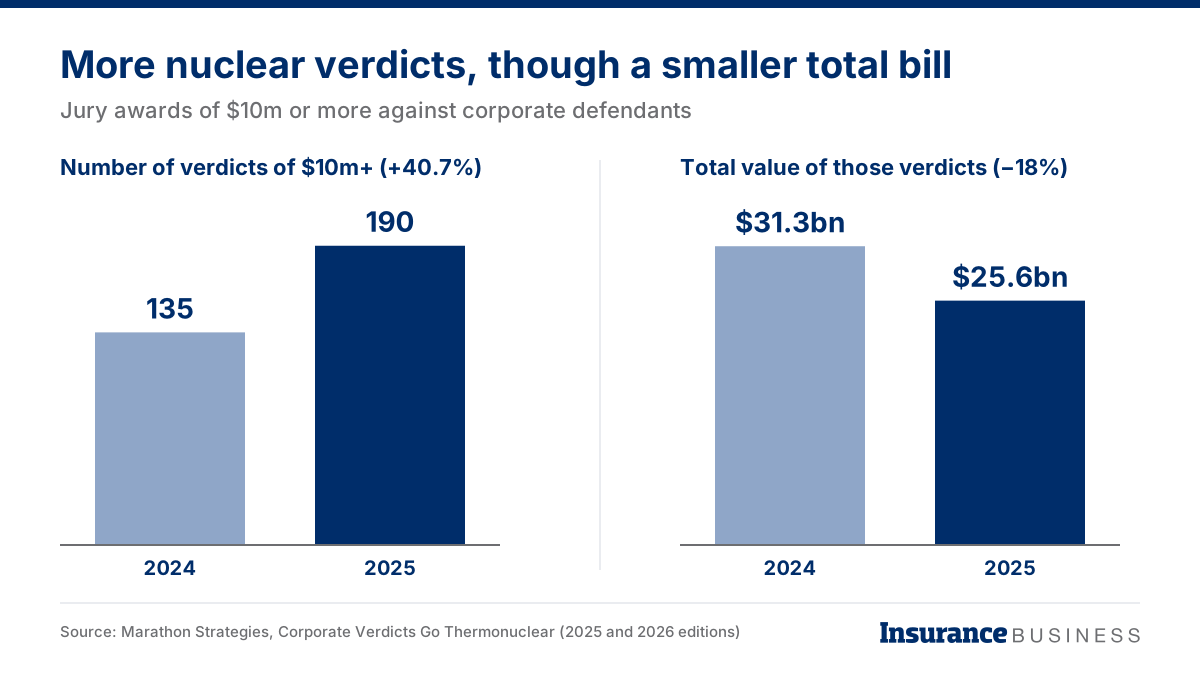
The verdict data backs up his concern, though not in a straight line. Corporate defendants faced 190 jury awards of $10 million or more in 2025, a 40.7% jump in the count from the prior year, according to Marathon Strategies' annual nuclear verdicts report. Those verdicts totaled roughly $25.6 billion and touched 68 industries, up from 55 a year earlier. The dollar total was actually lower than 2024's $31.3 billion, but the breadth of industries hit keeps widening. Johnson made a similar case earlier this year when he described litigation as a structural, not cyclical, force reshaping specialty insurance.
Read next: Specialty insurance enters era of "micro-cycles" as risk complexity grows: Ascot COO
Surplus lines direct premium written hit a record $143.3 billion in 2025, up 10.4%, according to AM Best's annual segment report.
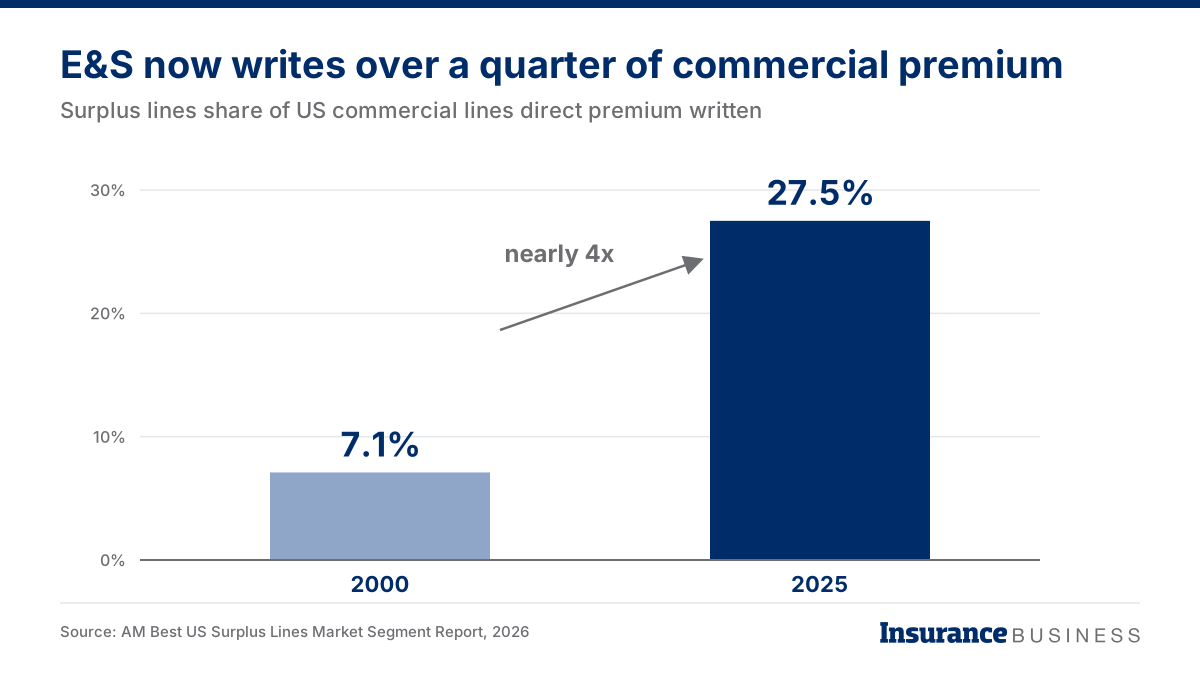
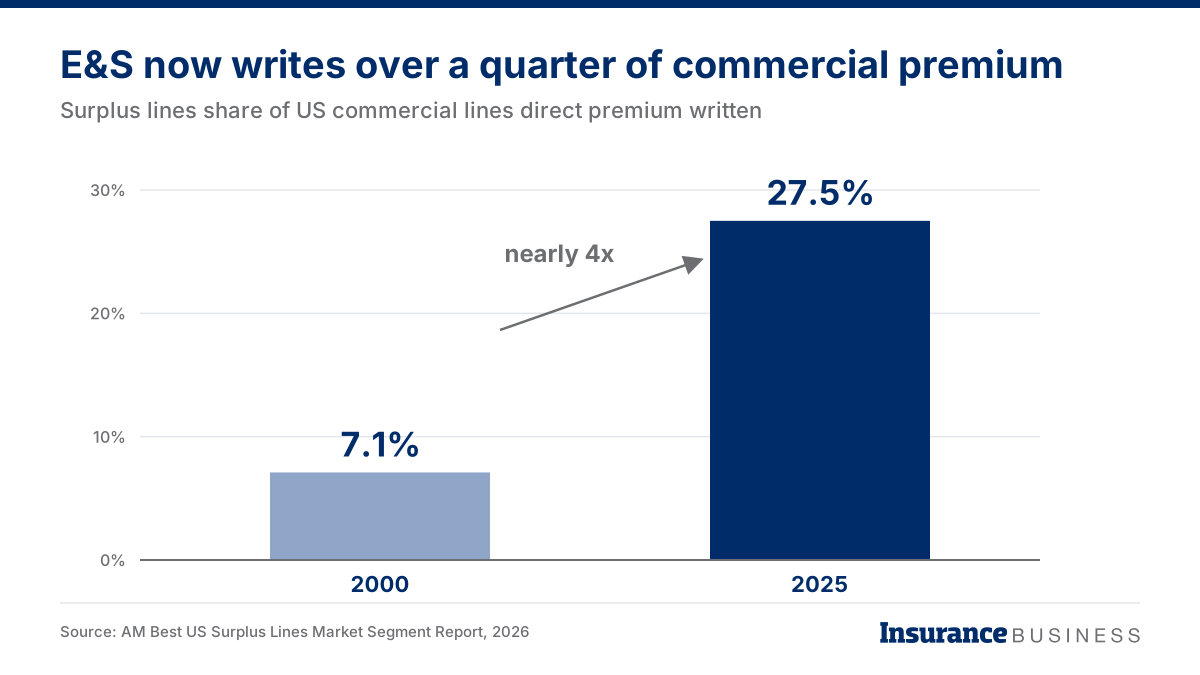
Even that record understates how central the channel has become. Surplus lines now account for 27.5% of US commercial lines premium, up from 7.1% in 2000, and carriers wrote more than $51 billion of general liability premium in 2025, or 39% of the industry's total, according to AM Best. The rating agency also expects general liability and commercial auto to stay in E&S, as social inflation and litigation funding keep pushing claim costs up. That is the same courtroom pressure Johnson described.
There is a counterweight. Admitted carriers are returning to lines they had pulled back from, and AM Best says the pricing edge surplus lines carriers enjoyed through a decade of hard conditions is fading on some lines. What the channel keeps is its balance sheet record: AM Best has counted just one surplus lines company impairment since 2003, against 311 in the admitted market.
Momentum has faded fast since. Across the 15 states with stamping offices, surplus lines premium rose just 2.8% to $47.6 billion in the first half of 2026, compared with 13.2% growth a year earlier, according to the Wholesale & Specialty Insurance Association's midyear report. Filings, meanwhile, jumped 16.9% to about 4.28 million.
Look beneath the totals and Johnson's point gets stronger. Non-professional liability, the largest surplus lines segment at 39.6% of premium, grew 11.2% to $18.8 billion. Property fell 13.7% to $13.6 billion as fresh capacity drove down rates on cleaner accounts. In other words, property is softening while liability keeps hardening, and it is precisely the litigation-heavy casualty business Johnson described that is still flowing into the non-admitted market.
More placements at lower average premiums also fit his view that the market is increasingly being used for its flexibility, not only for its appetite for the worst risks.
Read next: Changing carrier appetite keeps E&S central to the market: WSIA CEO
The biggest change in how capacity reaches the end client, in Johnson's view, is the managing general agent model, and specifically the depth of focus it rewards. MGAs are "driving sub-specialization into our market," he said, in a way the industry has not seen before.
The winners, he argued, are not generalist property or casualty shops. They are underwriters that zero in on a single slice of an industry, a single region or a single coverage. That narrow focus, Johnson said, creates value for policyholders and for the capital providers that back the MGAs.
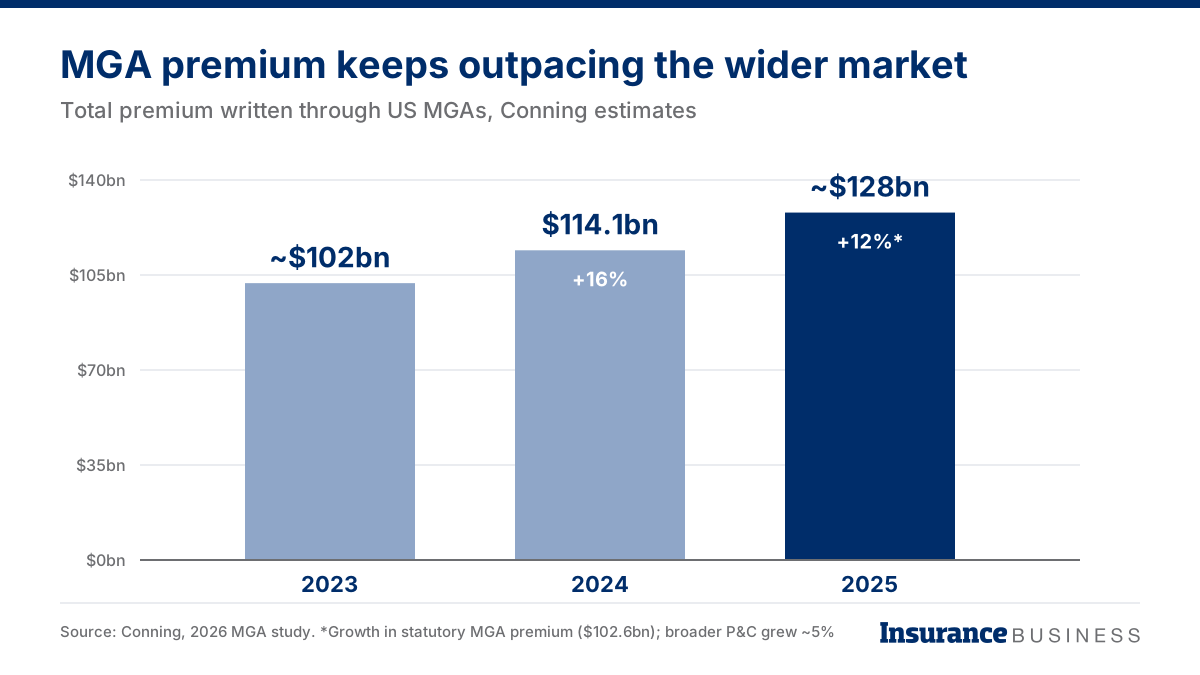
The capital has certainly followed. Conning estimates that total premium flowing through US MGAs reached about $128 billion in 2025, with statutory MGA premium up 12% to $102.6 billion, more than double the roughly 5% growth of the broader property and casualty market, according to our report on the US MGA market. AM Best, using a different method, puts MGA-produced premium at $108.7 billion, or roughly 10% of the US P&C market, Risk & Insurance reported.
The growth is not without strain. AM Best cut its outlook on the delegated underwriting segment to stable from positive in late 2025, citing slower growth and tougher scrutiny from carriers and reinsurers. That puts a premium on exactly the kind of proven, specialist expertise Johnson described.
Read next: Unrated reinsurers creep into $30-billion US fronting market
If MGAs are carving the market into ever-smaller niches, and retail brokers are building their own specialty teams, where does that leave the wholesaler? Right in the middle, and as essential as ever, according to Johnson.
He called wholesale distribution "absolutely critical" to the model, arguing that its value lies in the industry expertise concentrated there. The most successful wholesale brokers and wholesale underwriters, he said, are the ones focused on "lining up experts with experts."
The distribution data points the same way. Wholesale brokers without binding authority were still the largest surplus lines channel in 2025, handling 45% of premium, while MGAs and program managers produced nearly 25%, up from 23.7% a year earlier, according to AM Best's breakdown of surplus lines distribution. AM Best also found that wholesalers and MGAs with genuine class-specific expertise are pulling away from the rest of the field.
Rather than squeezing the wholesaler out, Johnson expects specialization to cascade through the whole chain. As retail gets more specialized, he predicted, wholesale will follow, and so will the underwriting market behind it.
For brokers, that is both reassuring and demanding. The middle of the distribution chain is not going away, but the bar for earning a seat there keeps rising. Generalists, on either side of the placement, may find there is less room for them each year.
Read next: 2026 marks turning point in war against litigation financing: CSAA legal chief
Quotes are lightly edited for clarity from an on-camera interview with Insurance Business.