Skyward Specialty Insurance Group has never been shy about saying no. This fall, it said no a lot.
Submissions to the company’s excess and surplus property unit rose 60% in the third quarter, chairman and CEO Andrew Robinson told analysts on Friday. Over the same stretch, Skyward’s hit ratio on that business fell by a third and its average premium dropped about 20%. Robinson’s read was that some rivals are writing on terms he considers reckless, and “those competitors will not be long for the market.”
The restraint has hardly dented the bottom line. The Houston-based group, which now trades as Skyward Group after buying Lloyd’s platform Apollo, reported diluted operating earnings of $1.28 a share for the quarter ended September 30, up from $1.05 a year earlier, according to its third-quarter 2026 earnings release filed with the SEC. That topped the $1.22 consensus estimate according to MarketWatch. Net operating income rose to $58.5 million from $44.2 million.
The GAAP picture was flatter. Net income edged up to $49.8 million from $45.9 million, but diluted EPS slipped a penny to $1.09. Amortization expense jumped to $8.8 million from $0.5 million, and the share count grew after the Apollo deal.
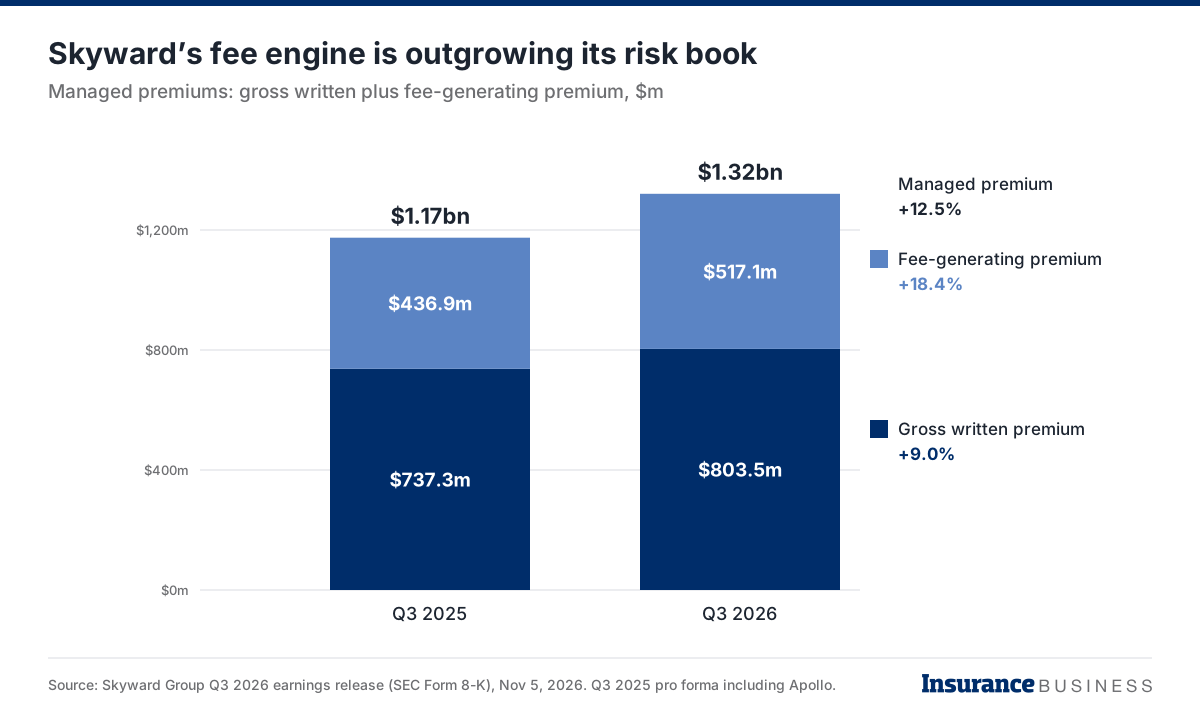
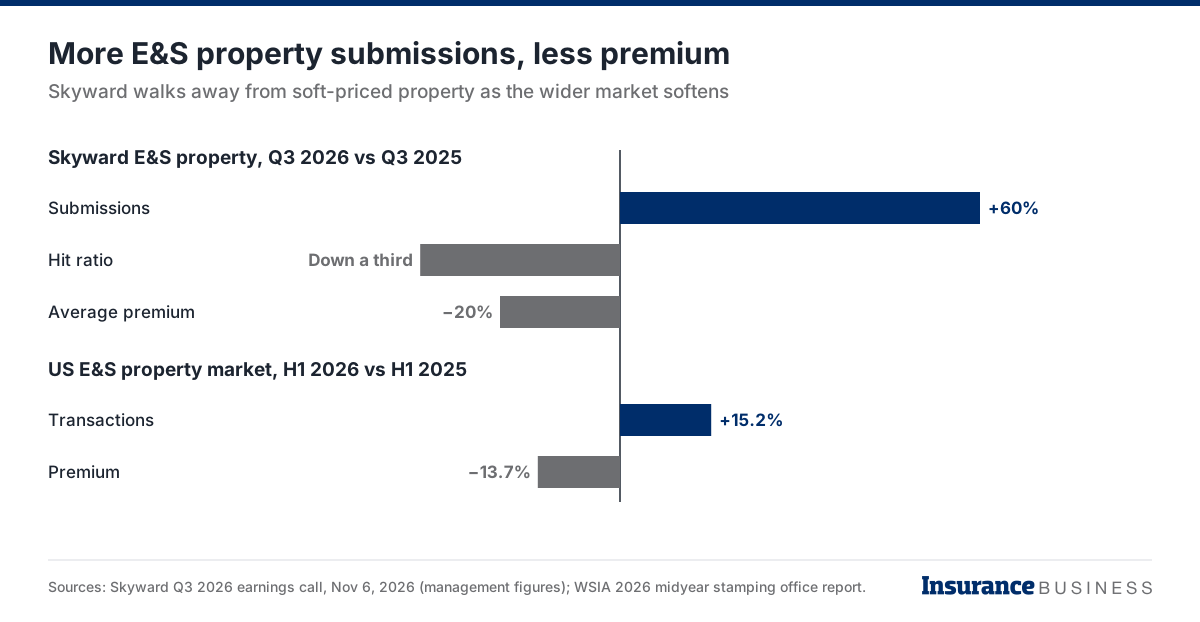
Premium growth was steady rather than spectacular, the carrier saw gross written premiums rising 9.0% to $803.5 million. Fee-generating premiums however, which Apollo manages for Lloyd’s syndicates in return for fees, climbed 18.4% to $517.1 million. Add the two together and Skyward’s managed premiums reached $1.32 billion, up 12.5%. Year-ago comparisons include Apollo on a pro forma basis.
Partner syndicates, which Apollo runs for third-party capital without committing its own, were the standout. Their fee-generating premiums rose 71.7% to $115.6 million. Apollo launched two more partner syndicates in the quarter, and deputy CFO Taryn McHarg said a Generali-backed syndicate will start underwriting shortly. Skyward does not plan to take a participation in either new syndicate.
Skyward agreed to acquire Apollo for $555 million in September 2025, and the deal closed in January. Apollo’s own written premiums grew 3.4% to $135.2 million. Specialty Syndicate 1969 rose 10.5%, while the digital-economy-focused ibott Syndicate 1971 dipped 2.9%, which management blamed on the timing of a single renewal. Apollo ran a 90.5% combined ratio.
Read next: Skyward Specialty grows agriculture and A&H as it trims property and captives
Inside the US Skyward Specialty segment, the portfolio is being visibly reshaped. Accident and health premiums surged 57% to $99.1 million. Strategic distribution partners, the renamed specialty programs division, grew 32.4% to $109.6 million. Credit and surety rose 27.3% to $67.2 million, and global agriculture, the largest division, added 20.8% to $192.2 million.
On the other side of the ledger, transactional E&S fell 20%, global property shrank 19.3%, energy solutions dropped 16.4% and captives slid 26.2%.
Robinson held up the A&H book, which focuses on medical stop-loss for smaller employers, as the model. He said its 76% loss ratio ranked fourth among 30 carriers writing more than $250 million of premium, about 15 points better than an industry average near 91%, citing the National Association of Insurance Commissioners’ 2025 stop-loss analysis.
Surety is another bright spot. Robinson said Skyward is now the 14th-largest surety writer in the US and is on track to pass $200 million in premium. He expects to add a team within about six weeks that could bring roughly $20 million of business, and the company is seeking a license in Puerto Rico to pursue federal bonding work.
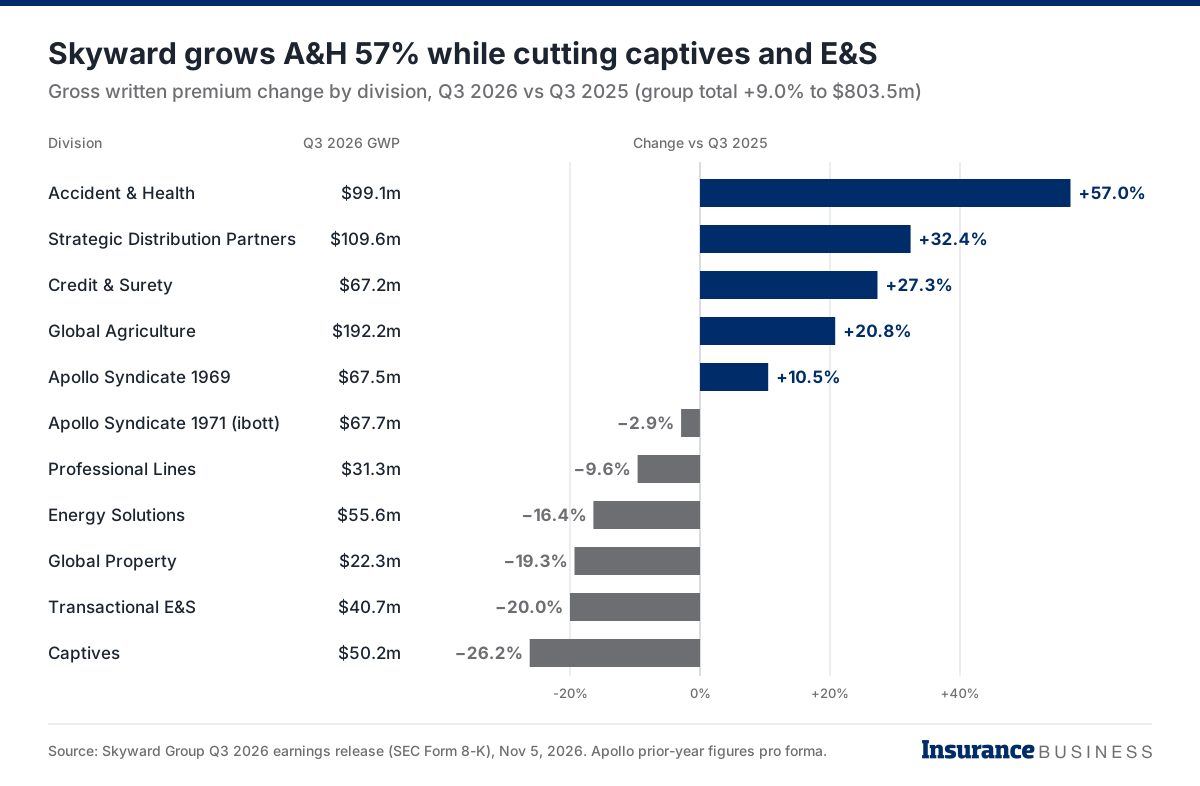
The E&S pullback mirrors the broader market. Industry stamping office data showed E&S property premium fell 13.7% in the first half of 2026 even as property transactions rose 15.2%: more deals, less money per deal. Casualty is tightening too: Robinson said Skyward’s retention on primary liability fell 6 points in the quarter.
Robinson said that one competitor’s fast-track liability application strips out the assault and battery exclusion if the applicant simply checks a box saying it has no abuse exposure. Asked whether E&S business is drifting back to the admitted market, as some peers have suggested, he said Skyward is not seeing it. Submissions for excess liability in its E&S unit were up roughly 30%.
Read next: Property softening levels off as casualty diverges: Baldwin
One wrinkle for the insurer came from the farm. Skyward reinsures a voluntary dairy livestock product that farmers use to lock in margins, and take-up fell as fuel costs climbed. Robinson said diesel cost roughly $3.50 to $3.70 a gallon early in the year and about $6.25 by October. That is broadly consistent with the US Energy Information Administration’s weekly diesel survey, which put the national average above $6 through October.
The upshot was a true-up on the treaty year that ended June 30 and a more cautious premium estimate for the new one. Net earned premium in the Skyward Specialty segment fell to $330.0 million from $351.8 million, though Apollo lifted the group total to $406.9 million. CFO Mark Haushill said a dairy livestock reinsurance placement at July 1 cut exposure and locked in part of the profit through ceding commissions.
The consolidated combined ratio came in at 89.9%, up from 89.2%, with catastrophe losses, mostly from convective storms, adding 1.8 points. The Skyward Specialty segment’s loss ratio rose 1.8 points as faster-growing A&H and agriculture business carries higher loss ratios. Its expense ratio improved 1.6 points to 25.7%, which management credits to AI-driven “bionic underwriting” absorbing heavier submission flow without new hires.
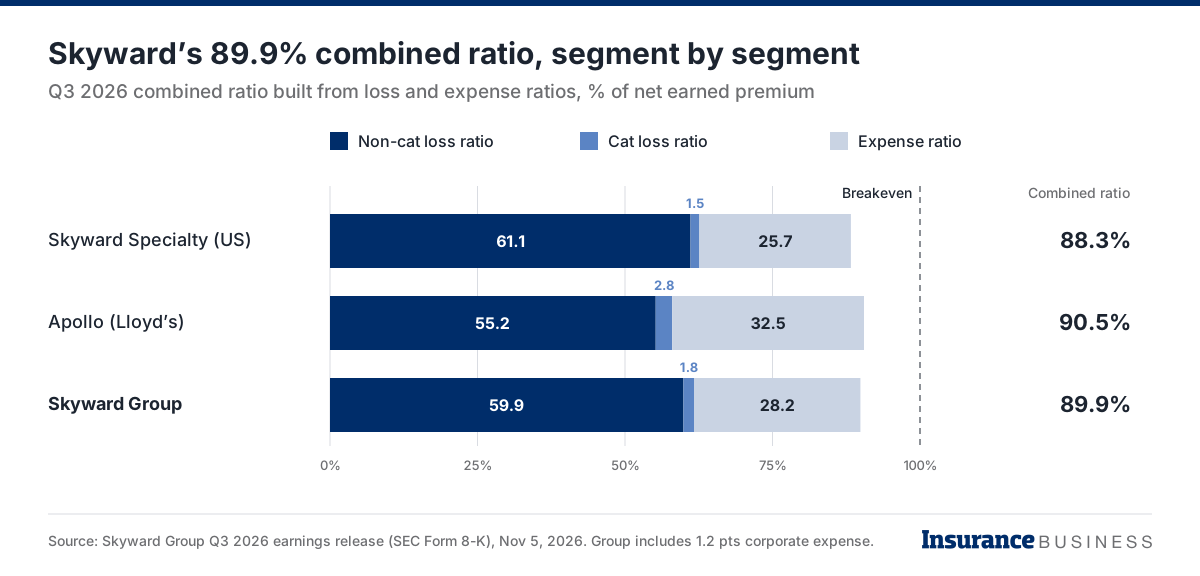
On reserves, incurred-but-not-reported claims now make up 77% of total reserves, the highest in the company’s history. Skyward recognized no prior-year development in the quarter. Haushill said its ground-up review looked positive overall, with some pressure in exited commercial auto and claims-made professional liability books; the full update comes with fourth-quarter results.
E&S bellwether Kinsale Capital posted a 75.4% combined ratio for the quarter in its third-quarter 2026 results, while gross written premium fell about 5% as commercial property shrank. RLI reported an 86.2% combined ratio on 2% premium growth, according to its Q3 2026 earnings release. Both were helped by favorable prior-year reserve development; Skyward booked none.
Read next: Ryan Specialty grows revenue as property softening squeezes E&S returns
Net investment income rose 54% to $33.9 million, helped by the Apollo portfolio. New money went to work at 6.4%, and the group portfolio’s embedded yield reached 5.5%. Book value per share climbed 15.3% since year-end to $28.74, and annualized operating return on equity hit 20.4% for the first nine months.
As for excess capital, Haushill said the business comes first, and that he currently leans toward paying down debt over buying back stock. Haushill is set to retire on March 31, 2027, with McHarg, Apollo’s CFO, named as his successor.
Skyward expects full-year premiums near the top of its original $2.65 billion to $2.8 billion range, and will give 2027 guidance with its fourth-quarter results. Management warned that competition tends to sharpen in the fourth quarter. Investors seemed wary: shares fell about 5.5% to $60.35 on the day of the call.
Robinson’s bet is that a diversified book lets Skyward, as the release put it, “remain disciplined in deploying capital toward the most compelling opportunities.” The next two quarters will test how much business it is willing to walk away from.
Read next: E&S property insurers face profit squeeze as rates fall, capacity grows – RPS