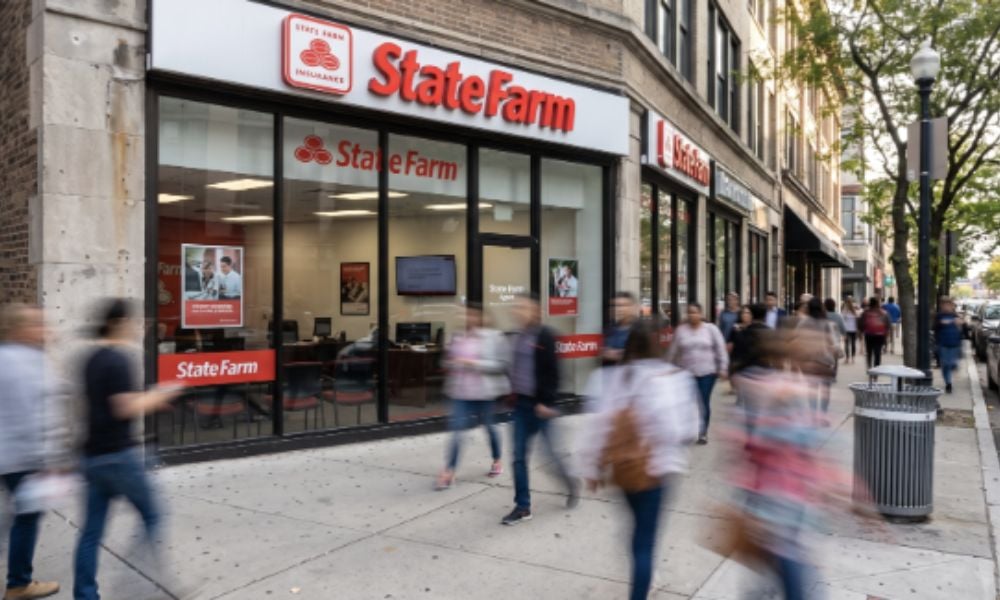
State Farm's actuaries have calculated that its Illinois homeowners program needed rates 12.5% higher - the company has filed for 7.9%.
The figures come from State Farm Fire and Casualty Co.'s rate filing with the Illinois Department of Insurance, tracking number SFMA-135045614, which is available through the department's public SERFF filing portal. The new rates apply to new business from Oct. 1 and to renewals from Dec. 1. The department marked the filing "Filed" on Oct. 5. Because Illinois is still a use-and-file state, that status does not mean the department approved the rates.
The change affects 1,483,264 policies and adds $190.3 million in written premium. Spread across every policy, that comes to about $128 a year, consistent with State Farm's statement that the average customer will pay about $10 a month more.
That average combines three products moving in different directions. Standard homeowners rates rise 8.5%, against an indicated need of 13.1%. Renters rates rise 5.8%. Condominium unitowners get a 3% reduction.
Read next: JB Pritzker challenges State Farm's homeowners rate hike in Illinois
In State Farm's projections for standard homeowners policies, expected catastrophe losses account for 55.2% of premium. All other losses together account for 27.9%. The filing says the rate need is "primarily driven by expected catastrophe losses." In a September response to regulators, the company said it treats any event that produces at least 500 claims and $500,000 in losses as a catastrophe.
The company's Illinois results back up the request. Its homeowners combined ratio was 130.7% in 2023, 126.6% in 2024 and 109.1% in 2025. From 2011 through 2025, the book made an underwriting profit only in 2021 and 2022. Over the full 15 years, the combined ratio was 114.6%.
The new filing comes after a 12.5% increase in 2024 and last summer's 27.2% increase, which also brought in a minimum 1% wind and hail deductible. Before 2024, State Farm's Illinois homeowners rate changes had not exceeded 4.4% in any filing since at least 2015.
This year's storms are not in the filing's data, but they are adding to the pressure. State Farm has said it paid more than $799 million for Illinois storm losses through July. In August, a derecho pushed US severe convective storm losses for the year past $35 billion, with Illinois hit hardest. According to BestLink data, State Farm wrote 33.68% of Illinois homeowners premium in 2025. That is more than Allstate and Country Financial, the next two largest writers, combined.
Read next: Illinois sues State Farm over homeowners insurance data dispute
The filing also changes how individual homes are priced. Homes with basic 3-tab asphalt shingles will pay a new 5% surcharge on the wind and hail portion of their premium. State Farm says it based the surcharge on a loss ratio analysis.
Discounts for impact-resistant roofs now shrink as the roof ages. For a new roof in the highest-rated class, the discount on the hail portion of the premium is 50%. By the time that roof is 15 years old, the discount has fallen to 34%. Roofs in the next class down start at 42% and fall to 24%.
State Farm is also adding external auto data, public records and more consumer credit information to its Customer Rating Index, the model it uses to price individual policyholders.
The department asked about those changes in a Sept. 3 letter, in which it asked State Farm to define an "Insight Score" used in the model, identify where the score comes from, and say how many years of history the public records model uses. State Farm filed its answers as confidential. A second letter, on Sept. 21, reminded the company that it could not support its model by pointing to another insurer's filing, because each filing in Illinois must stand on its own.
Read next: KCC projects below-average US severe convective storm losses for 2026
Rate filings will get closer scrutiny under two laws Gov. JB Pritzker signed on Aug. 4. House Bill 4273 covers homeowners insurance and Senate Bill 714 covers auto. They allow the Department of Insurance to challenge rates it finds "excessive, inadequate or unfairly discriminatory" and to order rebates.
Homeowners insurers will also have to give 60 days' notice before raising a renewal premium by more than 10%. "If you're telling your customers that rate hikes are necessary, you should be able to prove why," Pritzker said when he signed the bills.
The laws take effect July 1, 2027. State Farm and the main industry trade groups opposed them, arguing they do nothing about rising repair costs and more severe weather.
For agents and brokers, the most visible effect at renewal will be on roofs. Homes with older or basic shingle roofs will see the largest changes, and the difference in price between a new impact-resistant roof and an aging one is now larger.
The 4.6-point gap between the indicated and selected rate changes also suggests State Farm may still face pressure to raise rates, although the company has not said what it plans to file next.