Florida officials have spent two years saying the property insurance crisis is over. Most of the state's homeowners disagree.
A survey of 1,511 Florida policyholders, published Friday by the South Florida Sun Sentinel and Orlando Sentinel, found that 55% see no sign the market is improving and 26% think it is getting worse. The University of North Florida's Public Opinion Research Lab conducted the poll for the two papers.
On the same day, the newspapers published in full a 2022 consultant's analysis of what Florida insurers paid their affiliated companies. Regulators had never released it, and the Florida Senate had recently demanded that the papers destroy their copy.
Taken together, the two releases put a question to carriers, MGAs and the agents who sell their policies. The industry's finances have recovered, so why do so few customers believe it?
The regulator's numbers are strong. In its July 2026 Property Insurance Stability Report, the Florida Office of Insurance Regulation said the state's domestic property insurers posted a pooled combined ratio of 83% in 2025, their best in more than a decade. Twenty-one new companies have been approved to write residential property coverage since the reforms took effect.
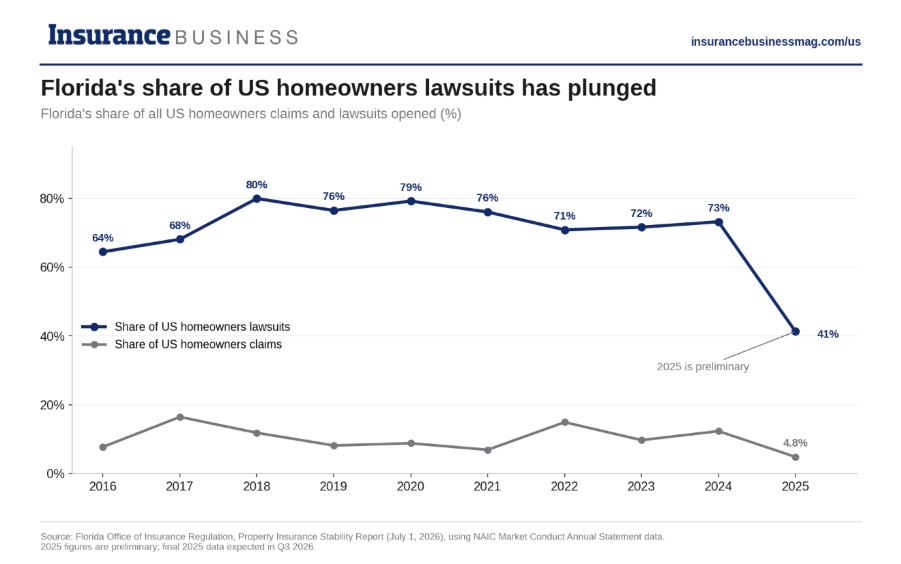
The litigation picture has also changed. Florida's share of the country's homeowners lawsuits fell from 79% in 2020 to 41% in 2025. OIR's data shows that share was still above 70% as late as 2024, so almost all of the drop came last year, and the 2025 figure is preliminary.
Citizens Property Insurance Corp. has shrunk sharply as private carriers have moved from recovery to rate competition. It had 255,099 policies as of September 18, against more than 1.4 million at its 2023 peak.
Read next: Florida personal property carriers book $1bn underwriting swing
Premiums are the main complaint. Almost half of respondents (47%) said their premiums had risen 50% or more over five years. In Consumer Reports' 2025 national survey, only 2% of policyholders reported increases that large. Just 8% of Floridians said their bill had held steady or fallen.
Many said the increases haven't stopped. More than a third reported a rise of 25% or more in the past year, even though officials say average rates are coming down. The pollsters noted that the state's figures are market-wide averages, while the survey records what individual households pay. Policyholders who had filed a claim fared worse: 53% of them said their premiums had gone up by half or more.
Other data points the same way. Insurify puts Florida's average homeowners premium at $8,292 after an 18% increase in 2025. Morningstar DBRS estimates homeowners premiums rose about 50% between 2020 and 2025.
Costs are highest in the south of the state. There, 60% of respondents paid $3,000 or more for their current policy and 44% paid more than $4,000. In North and Central Florida, about a third paid $3,000 or more.
Party affiliation made little difference. The share who saw no improvement was 55% among Republicans and 54% among Democrats. Most respondents in every group said the 2022–23 reforms mainly helped insurers: 79% of Democrats, 74% of independents and 57% of Republicans.
Read next: Floridians pay 181% more for home insurance than US average – report
For agents, the most striking result is how often Floridians are pushed out of their coverage. Over the past five years, 54% of respondents switched insurers at least once. Nearly half of those who switched (47%) did so because they were dropped. That breaks down as 22% non-renewed by a private carrier and 25% moved out of Citizens through its depopulation program. Nationally, 9% of switchers told Consumer Reports they had been dropped.
Sean Freeder, the UNF political scientist who ran the poll, called the difference "absolutely insane."
The type of carrier also shaped how customers feel. Customers of national insurers were more than twice as likely as those with Florida-focused companies to say they were strongly satisfied (34% vs 16%). They were also more than twice as likely to be very confident their insurer could pay for serious storm damage (36% vs 17%). Only 32% of Floridians who had filed a claim were strongly satisfied with how it was handled, compared with 64% nationally.
Mark Friedlander of the Insurance Information Institute rejected the survey. He said its results "appear to be intentionally skewed toward an anti-insurance industry false narrative." He added that it ignores a far healthier market that most consumers are benefiting from.
The second release has been building for months. OIR hired Risk & Regulatory Consulting to review the fees Florida insurers paid to companies under common ownership, such as managing general agents and attorneys-in-fact. Those affiliates often handle underwriting, policy administration and claims for the insurer. The executive summary is dated March 31, 2022, and covers 2017 through 2019. Of the 53 companies reviewed, 41 used an MGA or attorney-in-fact to run policy and claims operations. The summary also notes that Florida law doesn't define "fair and reasonable" for affiliate agreements.
Parts of the analysis became public in early 2025 and led to Florida House hearings into alleged accounting tricks by property insurers. The Sentinels later obtained an unredacted copy, attached to a legislative email released under a public records request. When the papers told OIR they had it, the Senate emailed a demand the next day to destroy the document, warning of possible civil or criminal consequences. On Friday the papers published the full report.
The consultant found that 20 insurers paid affiliates at rates presumed not to be fair and reasonable. The newspapers' review of its figures found that, excluding outliers, the insurers reported combined losses of $432 million over the three years. The affiliates they paid earned $1.3 billion in net income over the same period. Affiliated MGA agreements took between 20% and 34% of premium, and total affiliate fees reached as high as 63%.
Several named carriers disputed the findings. Security First CEO Locke Burt said his company's affiliate contracts are priced in line with the open market. HCI Group CEO Paresh Patel called the consultant's standard arbitrary and said it wasn't applied consistently. OIR now describes the report as a flawed, outdated draft. The consultant who worked on it told lawmakers in 2025 that she considered it finished.
Jeff Brandes, a former state senator who now chairs Patriot Select, defended affiliate structures. He noted that regulators typically set rates around a profit margin of about 4.5%, and said: "Nobody would run any insurance business in Florida for a 4.5% return."
Legislative efforts have stalled. The House voted 106-3 this year for a bill giving regulators more power to examine affiliate deals, but the Senate didn't pass it. The Sentinels' review of 2025 filings found that key Florida insurers still pay affiliates 20% to 35% of direct premium, about the same range the consultant found for 2017 to 2019.
Read next: Florida's 2026 governor candidates split on how to fix insurance affordability
Insurer transparency is now a campaign issue. Republican candidate Byron Donalds wants to create an "Insurer Scorecard" that would publish claims approval rates and payment times alongside prices. Whoever wins in November, carriers using the MGA model should expect more questions about how their affiliates are paid.
Agents are the ones who take those questions from clients first. Their customers are asking why they were non-renewed, why their premium jumped after a claim, and whether a carrier they've never heard of will pay after a hurricane. The poll suggests that many homeowners still don't have satisfying answers.