What happened: USSIC alleges its airport premises policy does not cover a propeller death at a Kansas skydiving operation because the policy excludes aircraft liability
Who's involved: US Specialty Insurance Company (insurer), Myrtle Aviation / Air Capital Drop Zone (policyholder), Crosswinds Aviation (landlord), Harco National Insurance Company (landlord's insurer)
What's at stake: $1 million per-person, $1 million per-occurrence policy limits, plus defense costs in the underlying wrongful-death suit
Why it matters: A skydiving operator bought premises coverage but no aircraft liability - the case tests whether a premises insurer can walk away when the hazard is a running aircraft parked on the insured premises
Where it stands: Filed October 9, 2026, in the US District Court for the District of Kansas
The propeller was still spinning when she stepped backward into it.
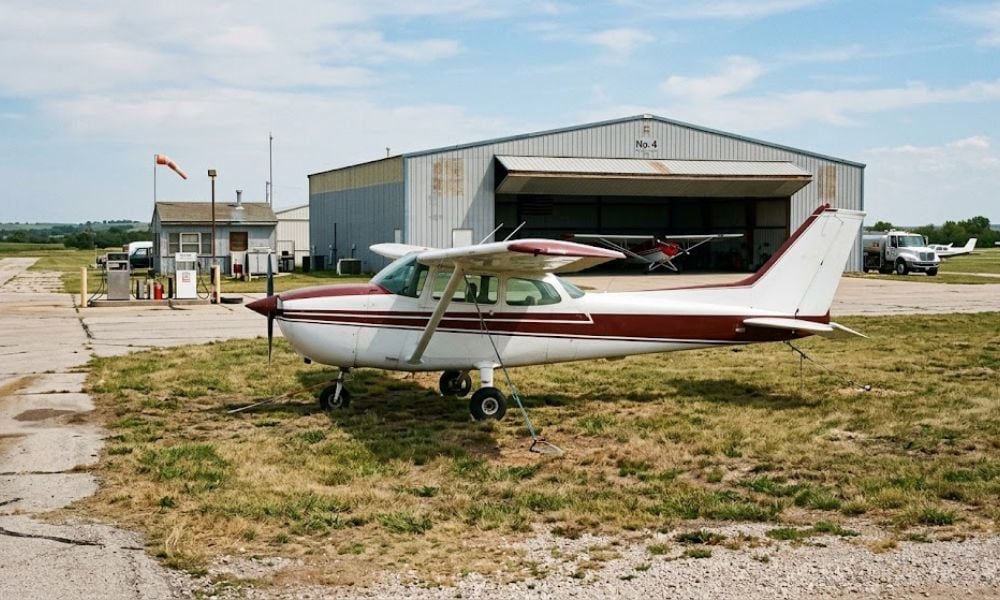
A woman had just ridden a jump flight at Air Capital Drop Zone, a skydiving operation at Cook Airfield in Sedgwick County, Kansas, to photograph skydivers, according to the complaint. After landing, she got out of the 1977 Cessna 182Q - but its engine kept running while the next group of skydivers boarded. She stood between the wing strut and the propeller, stepped back, and moved into the propeller arc. The propeller struck her. She died from her injuries.
That was October 26, 2024. Nearly two years later, the insurer that wrote the airfield's premises policy wants a federal court to confirm it does not have to pay.
US Specialty Insurance Company filed the complaint on October 9, 2026, in the US District Court for the District of Kansas, naming Myrtle Aviation (which operates the drop zone), Crosswinds Aviation (the airfield's landlord), the decedent's estate administrator and her father, and Harco National Insurance Company, which insures Crosswinds.
The central fact is stark. Myrtle Aviation bought an airport premises liability policy from USSIC - with $1 million per-person and $1 million per-occurrence limits. That policy covers injuries arising out of ownership, maintenance, or use of the covered premises.
It does not cover aircraft.
The complaint states that the policy "contains no aircraft liability coverage" and that Myrtle Aviation "did not buy aircraft liability insurance that would cover the accident, from USSIC or from any other insurer." A skydiving business that flies people out of aircraft had no aircraft liability policy in force when one of its aircraft killed a person on the ground, according to the filing.
The policy's aircraft exclusion, quoted in the complaint, bars coverage for bodily injury "arising out of the ownership, maintenance, use or entrustment to others of any aircraft" owned or operated by any insured. The exclusion specifies that "use includes operation and loading or unloading." None of the exclusion's three exceptions - which cover watercraft ashore, parked autos, and contractual watercraft liability - applies to aircraft.
USSIC's core argument is clean: the death arose from the operation of an aircraft, not from a condition of the premises. The propeller was turning because the aircraft was being operated between jump flights. Every negligence theory in the underlying wrongful-death suit - failure to guard the propeller area, failure to shut down the engine, failure to separate pedestrians from aircraft - traces back to that running aircraft, the complaint states.
On Myrtle Aviation, the argument is straightforward: the company owned the aircraft, and the exclusion applies. But USSIC pushes further. Crosswinds, the landlord, is listed as an additional insured under a landlord endorsement - but only for liability "arising out of your maintenance or use of the covered premises," where "your" refers to the tenant, Myrtle Aviation. USSIC argues that the wrongful-death claims against Crosswinds rest on Crosswinds' own alleged ownership and control of the airfield, not on Myrtle Aviation's use of the leased hangar.
Even if Crosswinds qualifies as an insured, USSIC says the aircraft exclusion still applies because it bars coverage for injuries involving an aircraft owned by "any insured" - meaning Myrtle Aviation's ownership of the Cessna triggers the exclusion for Crosswinds too.
There is also a dispute between the two carriers. According to the complaint, Harco - Crosswinds' liability insurer - told USSIC on September 25, 2026, that Crosswinds was an additional insured under USSIC's policy and asked USSIC to extend Crosswinds' deadline to respond in the wrongful-death suit. By October 7, 2026, Harco was demanding that USSIC pay the legal fees of counsel Harco had already retained for Crosswinds, the complaint states.
USSIC agreed to defend both Myrtle Aviation and Crosswinds under a reservation of rights - but wants the court to declare it owes neither a defense nor indemnity, and that Harco cannot recover its defense costs from USSIC.
The lease between Crosswinds and the drop zone's operators also features. That hangar lease ran from 2013 to 2022 and continued month-to-month after it expired, according to the complaint. It required the tenant to carry $1 million in general liability naming the landlord. It contained no agreement by the tenant to cover Crosswinds for bodily injury claims.
The case tests a gap that aviation and premises liability professionals will recognize: what happens when an operation that obviously needs aircraft coverage buys only premises coverage, and the one loss that was always going to happen finally does.
None of the allegations in this complaint have been tested, and no court has ruled on the merits.