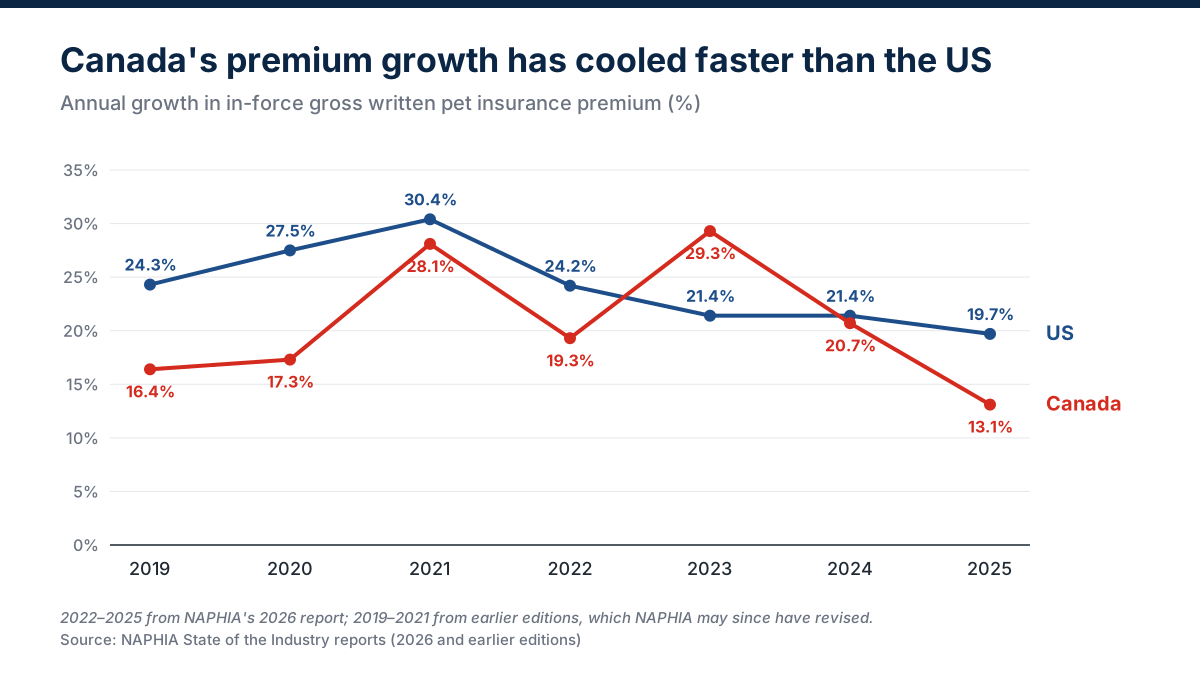
South of the border, pet insurance is having a moment. Vets can now offer chemotherapy, advanced imaging and monthly antibody injections for arthritic dogs, treatments that were rare a decade ago, and American owners are buying cover to pay for them at a record pace. Canada shares the same veterinary science and many of the same insurers. Its market, though, is growing noticeably slower.
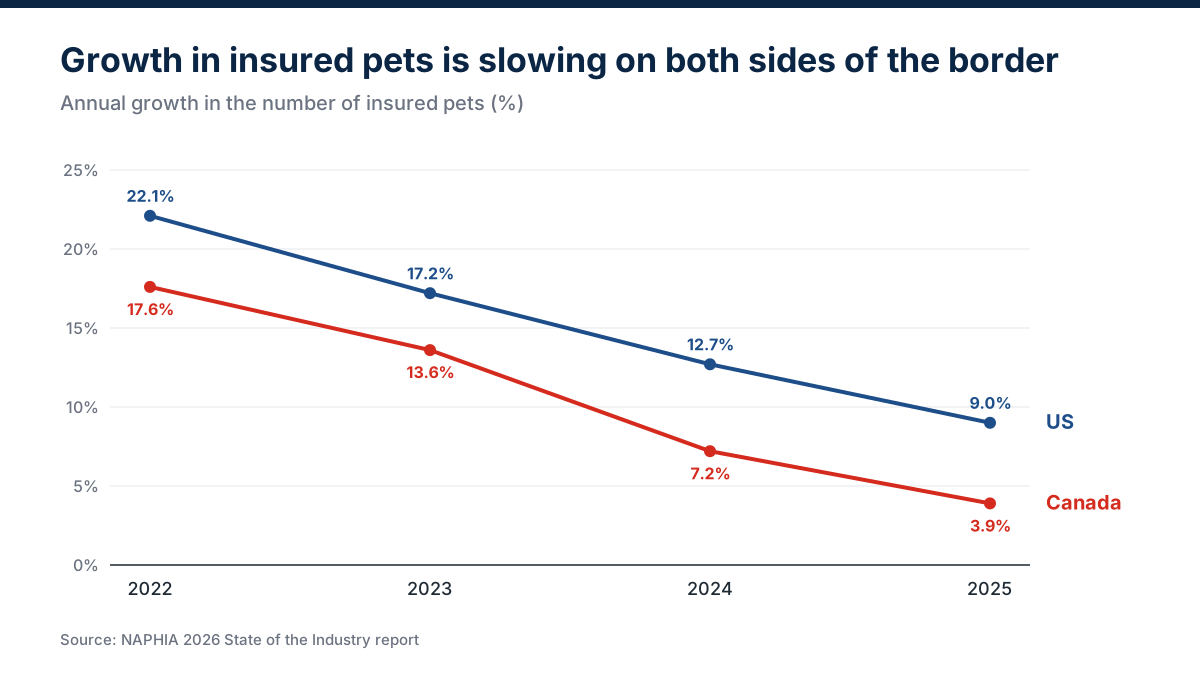
The North American Pet Health Insurance Association's 2026 State of the Industry report put US gross written premium at roughly US$5.7bn at the end of 2025, up close to 20% on the year. The number of insured American pets rose 9% to 6.98 million.
S&P Global Market Intelligence logged a record US$1.53bn in US direct pet premiums in the first quarter of 2026, and its analysts expect full-year premiums to climb a further 17% to about US$6.4bn. That would make pet the fastest-growing line in US property and casualty.
Vet bills there are still climbing. The US Bureau of Labor Statistics puts the rise in veterinarian services prices at 4.6% in the year to September 2026.
Read next: NAPHIA: Only 4.27% of US pets insured despite decade of double-digit growth
Canada also set records in 2025, just more quietly. NAPHIA counted more than 643,000 insured Canadian pets, including about 473,600 dogs and nearly 170,000 cats. In-force gross written premium reached a record C$660.5m.
The pace, however, is easing. The insured pet population grew 3.9%, the slowest annual increase in five years, and premium growth of 13.1% was the weakest since the pandemic, well below the five-year average of about 20%.
The longer view tells the same story. According to NAPHIA's report, Canada's insured pet count has grown 48.8% over five years, against roughly 76% in the US, and Canadian premium growth has averaged 20.5% a year compared with 21.7% south of the border.
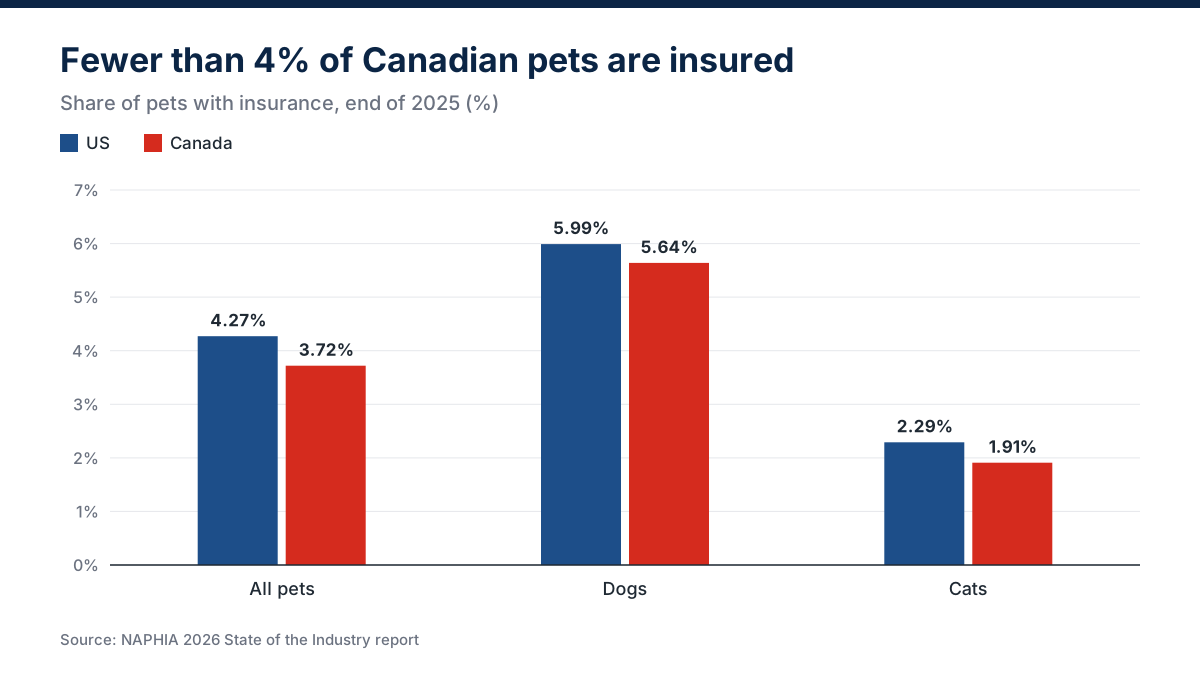
That leaves a wide protection gap. NAPHIA estimates just 3.72% of Canadian pets are insured, against 4.27% in the US. Cats are the starkest case: only 1.91% carry cover in Canada, compared with 5.64% of dogs.
Cats, though, are where the momentum is. Canadian cat premium rose 18% last year against 12.2% for dogs, and cats now make up 26.4% of insured pets in Canada, a bigger share than the 25.1% in the US.
Sammi-Jo Nevin, NAPHIA's president, said the industry's growth also "highlights the vast number of pet families who are still vulnerable".
Read next: Canada's pet insurance market grows, but coverage remains sparse: Report
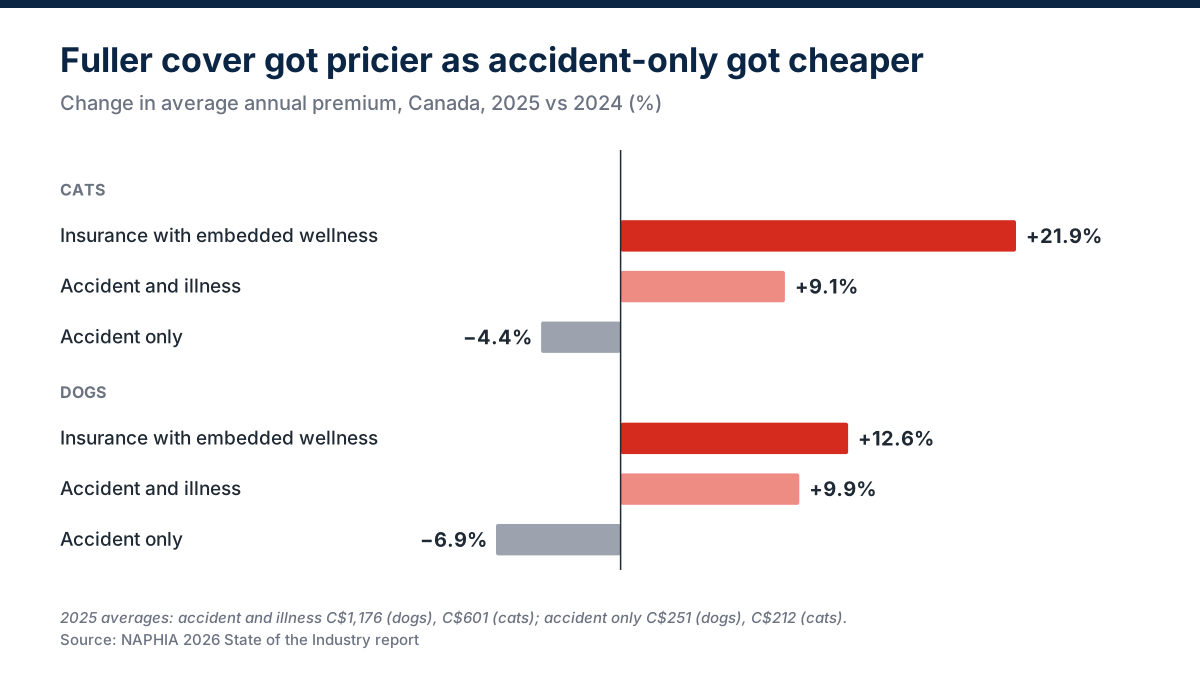
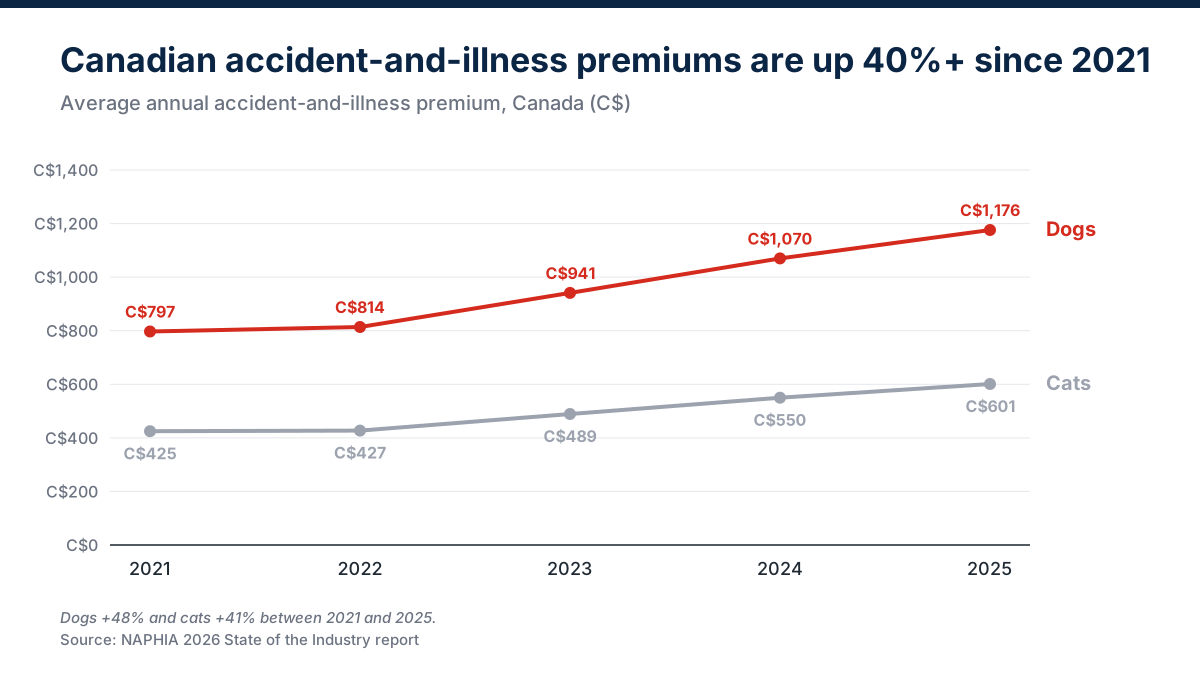
Cost is part of the story. NAPHIA figures show the average annual accident-and-illness premium for a Canadian dog rose 9.9% to C$1,176 in 2025, and 9.1% to C$601 for a cat. Since 2021, the average accident-and-illness premium has risen about 48% for dogs and 41% for cats. Plans with embedded wellness went up faster still last year, while accident-only premiums fell for both dogs (down 6.9% to C$251) and cats (down 4.4% to C$212), which suggests some owners are trading down to cheaper, narrower cover.
2025 global pet insurance barometer found that Trupanion, Petsecure and Desjardins together write more than 80% of Canadian premiums, while more than half of owners said they could not cover a surprise C$1,000 bill. Complex wording and pre-existing condition exclusions also put people off.
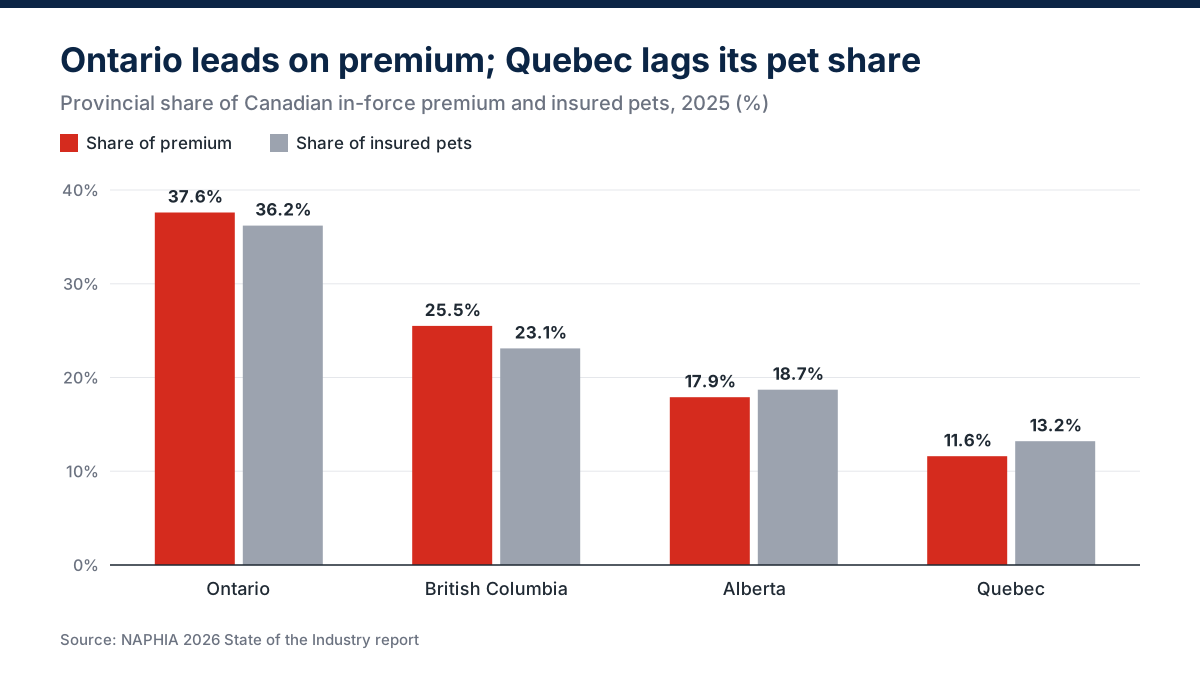
Geography skews the picture as well. Ontario accounts for the largest share of premium, followed by British Columbia and Alberta, while Quebec's share of premium trails its share of pets.
Read next: Australian watchdog hands UK-linked pet insurer Petcover a 'Shonky' award
Distribution may be where Canada catches up. In November 2025 BMO Insurance teamed up with Trupanion to sell pet cover online through a new BMO brokerage, starting in Ontario with the aim of reaching owners across Canada. Despite the low insurance uptake, BMO's polling found 79% of Canadians see their pets as full family members.
Trupanion, founded in British Columbia in 2000 and now headquartered in Seattle, gives a read on the economics. Its third-quarter 2026 results, covering North America and parts of Europe, showed subscription pets up 6% to about 1.15 million while average monthly revenue per pet rose 8% to US$88.95. Chief executive Margi Tooth highlighted "the seventh consecutive quarter of improvement in retention". It is the same pattern as the wider market: price is rising faster than the number of pets covered.
Employee and member benefits are another route. Pets Plus Us has partnered with the Canadian Federation of Independent Business to offer discounted cover, with up to C$15,000 a year for accidents and illnesses, to more than 100,000 member businesses and their staff. The policies are underwritten by Northbridge.
Read next: Pets Plus Us to expand pet insurance access to small businesses
Canadian insurers watching vet costs climb might look at the UK, where the Competition and Markets Authority found that average vet prices rose 63% between 2016 and 2023, roughly twice the rate of inflation. Britain is now forcing practices to publish price lists and give written estimates for bigger bills. UK insurers, meanwhile, are cutting prices in an aggregator-driven price war while pushing co-payments into 41% of policies.
In Canada, pet cover is licensed and supervised province by province, by regulators such as Quebec's AMF and Ontario's FSRA, under the Canadian Council of Insurance Regulators' guidance on the fair treatment of customers. Clear disclosure of limits and exclusions is already expected of insurers and brokers.
The lesson for Canada is that transparency rules tend to arrive after years of complaints about price. Insurers here can get ahead of that with clearer products now, or wait for owners and policymakers to force the issue.
Read next: Pet insurers cut prices hardest on lowest-cover policies as Lifetime premiums fall 14%
With fewer than one in 25 pets insured, the opportunity for Canadian brokers is obvious. So is the risk. The move toward accident-only cover means more clients may be underinsured when a serious illness hits. Brokers can earn their fee by explaining annual limits, deductibles, co-insurance and pre-existing condition rules at the point of sale, rather than at the point of claim.
For brokers new to the line, IB's pet insurance guide covers the main product types and the questions clients ask most.