A study published this week gives the most credible population-level estimate yet of how common chronic traumatic encephalopathy (CTE) is in professional contact sport - and it arrives at a moment when Canadian carriers and brokers are navigating one of the hardest classes in the market.
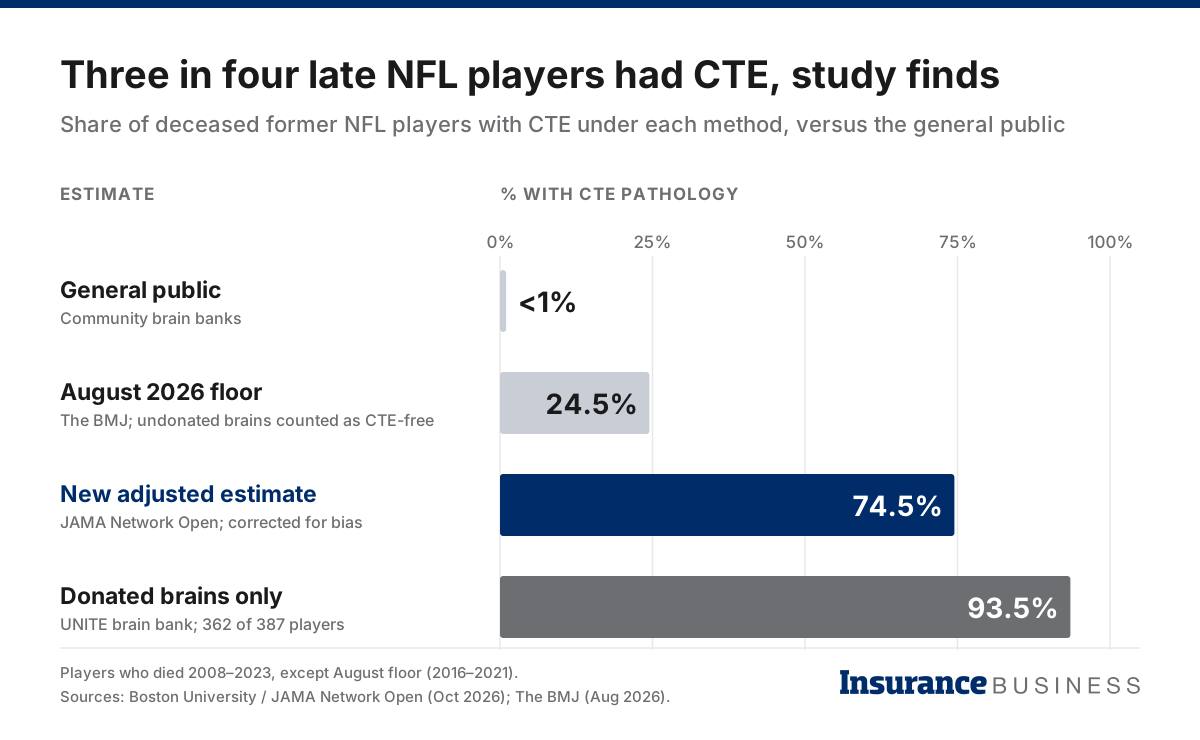
Researchers at Boston University estimated that 74.5% of the 2,362 former NFL players who died between 2008 and 2023 had CTE, the degenerative brain disease linked to repeated head impacts. That is roughly 1,760 men. The paper, published October 28 in JAMA Network Open, is the first to put a population-wide figure on the disease in a professional football code rather than a count drawn from donated brains alone.
The researchers tackled the main objection head-on. Of 387 former NFL players examined through Boston University’s UNITE brain bank, about 94% had CTE. But brains tend to be donated by families who already suspected something was wrong, pushing every brain-bank count upwards. The team matched donated brains against US National Death Index records for every player who died over 16 years, and found that players with cognitive decline were about five times more likely to have their brains donated. Correcting for that brought the estimate down to 74.5% - still three times the minimum the same group published in August in The BMJ.
“An estimated 75% prevalence among NFL players who died over a 16-year period is concerning,” said lead author Julia Gallini, a PhD candidate in biostatistics at Boston University.
The authors are careful about the limits. The estimate covers players who died in one era, many of them long before modern concussion protocols. It does not predict how many living or active players have the disease. Not every player with CTE pathology goes on to develop symptoms, the university noted, although earlier research has found former NFL players develop dementia at four times the rate of the general population.
The NFL study covers American football, but its implications extend to every collision sport - and in Canada, the insurance market for contact sport was already hardening before this week’s numbers landed.
Sarah Hanson, broker to Rugby Canada and principal at NFP, has said carriers writing contact sport routinely carve out long-term neurological risk. “Specifically, neurodegenerative conditions can be excluded,” she said. That pattern is consistent across rugby, Canadian football and hockey accounts.
Hockey presents the most concentrated exposure in Canada. The sport is played at every level from minor hockey associations to the NHL, and the long-tail nature of neurodegenerative claims means policies written years ago may respond to conditions only now being diagnosed. CTE can currently be confirmed only after death, which pushes many claims far into the future - but researchers are actively working on diagnostic tools for living patients, and if those succeed, claims that today surface in claimants’ 70s could arrive in their 50s.
The CFL has dealt with its own concussion litigation. Former players sued the league over head injuries, and the case drew direct parallels with the NFL settlement - an uncapped deal that has paid out more than a billion dollars in the US and triggered years of coverage disputes between the league and its liability insurers.
The scientific groundwork on sport and neurodegeneration is not limited to American football. The University of Glasgow’s FIELD study, published in the New England Journal of Medicine, found that former Scottish professional footballers were around three and a half times more likely to die of neurodegenerative disease than the general population. Similar research has followed in other sports. Each peer-reviewed study that establishes a causal link between repeated head impacts and neurodegenerative disease makes causation easier to prove for claimants in any contact sport jurisdiction - including Canada.
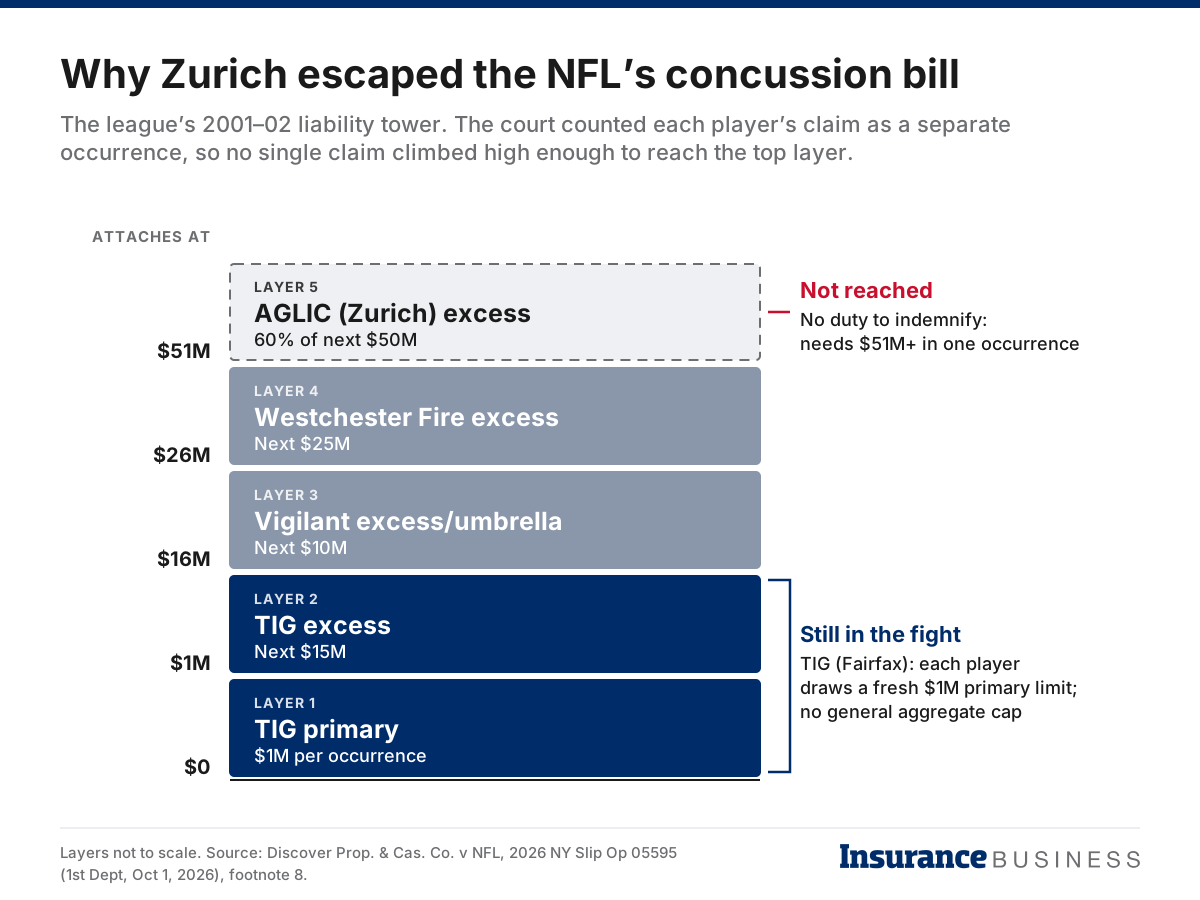
On October 1, a New York appeals court ruled in Discover Property & Casualty Co. v National Football League that each former player’s claim counted as at least one separate occurrence, because the generic grouping language in the NFL’s old policies did not name repeated head impacts as the triggering event. That left a primary insurer exposed player by player.
Canadian courts apply their own principles on aggregation, and a US ruling does not set precedent here. But the drafting lesson travels. Whether a group of CTE claimants against a Canadian sports body or league is treated as one loss or as individual occurrences could determine which layers of a liability tower ever pay - and policies written in the 1990s and 2000s were not drafted with that question in mind.
For brokers placing hockey associations, rugby clubs, Canadian football organisations and schools with contact sport programmes, the practical response is to get ahead of the renewal conversation rather than wait for underwriters to ask.
Expect carriers to ask harder questions about concussion protocols, return-to-play rules, junior programmes and head-injury claims history. Neurodegenerative exclusions, sublimits and conditions around concussion management are becoming more common. Where a client’s protocol is strong and documented, that is material information for the submission.
For larger governing bodies and leagues, the historic exposure is the harder problem. Much of what may ultimately be claimed in Canada relates to play from decades ago, when concussion management was minimal. Liability policies from that era will be the ones that respond - and they were priced without any expectation of this exposure. Clients holding those historic risks should be taking legal advice on what their coverage position looks like now.
“An estimated 75% prevalence among NFL players who died over a 16-year period is concerning,” Gallini said. For Canadian brokers and carriers placing contact sport, the question is no longer whether the exposure is real. It is whether the policies that respond to it were ever written to do so.