
France spent the last three years designing a way to keep riot cover affordable after a string of costly outbreaks. Its answer, which passed in February, makes riot cover compulsory in property policies and backs it with a government-guaranteed pool. The pool is not yet running, and last weekend, nationwide protests turned to looting and arson in several cities.
DBRS Morningstar estimates the resulting insured losses at up to €1.2 billion. That would hurt French property and casualty earnings this year, the rating agency says, but should not on its own affect the capital or credit ratings of the country's main insurers.
For Canadian readers, the episode raises a question that comes up whenever a large, hard-to-model risk arrives: when should government share it with the private market? Canada has no federal backstop for riot or terrorism losses.
France is used to sharing hard-to-model risks with the private market. It has run a government-backed regime for natural catastrophes for decades, and its GAREAT pool has covered terrorism since the early 2000s. Riot was the exception, left to individual insurers and their reinsurers.
That changed after two expensive shocks. The 2023 riots produced the largest riot bill France had seen, and unrest in New Caledonia in May 2024 added around €1 billion more, prompting some insurers in France's overseas territories to drop riot cover from certain policies. Paris responded with Article 171 of the 2026 Finance Law, signed on Feb. 19 and modelled on the natural catastrophe regime.
Under the law, qualifying property damage policies must include riot cover with no exclusions, and business interruption where the policy already carries it. A business refused cover because of its riot exposure can ask the Bureau Central de Tarification to compel an insurer to write it.
Insurers can then cede riot losses to a pool managed by state reinsurer CCR, which reimburses at least 90% of what they cede. The pool is funded by a levy on insurers of no more than 1.5% of relevant premiums, and the French state guarantees it each year up to €4 billion (about C$6.4 billion) or ten times its expected income, whichever is lower, in exchange for a fee.
The scheme starts only when a government decree sets the date, which must come within 12 months of European Commission approval under EU state aid rules. France Assureurs officials are working toward Jan. 1, 2027. DBRS says the October losses fall outside it.
Read next: The insurance backstop 9/11 built almost everywhere - except Canada
Damage reports are still coming in. Serge Papin, France's minister for commerce and small business, says at least 3,000 stores were hit and has promised a support fund. Fire badly damaged the city hall in Limoges, and cars were burned in several cities. Industry group France Assureurs said insurers would give policyholders 30 days to report claims instead of the usual five business days, and Axa and BPCE Assurances are among those that have. The violence came during Oct. 17 protests over living costs and public services that drew more than half a million people, and France's Interior Ministry reported 2,397 arrests that day.
Riot losses in France have grown sharply over two decades. DBRS puts the 2005 suburban riots at roughly €200 million and the 2018-19 "yellow vest" protests at roughly €220 million. The 2023 riots, after police shot a teenager near Paris, cost between €730 million (DBRS) and €793 million (France Assureurs' latest estimate), with commercial property and municipal buildings taking most of the damage.
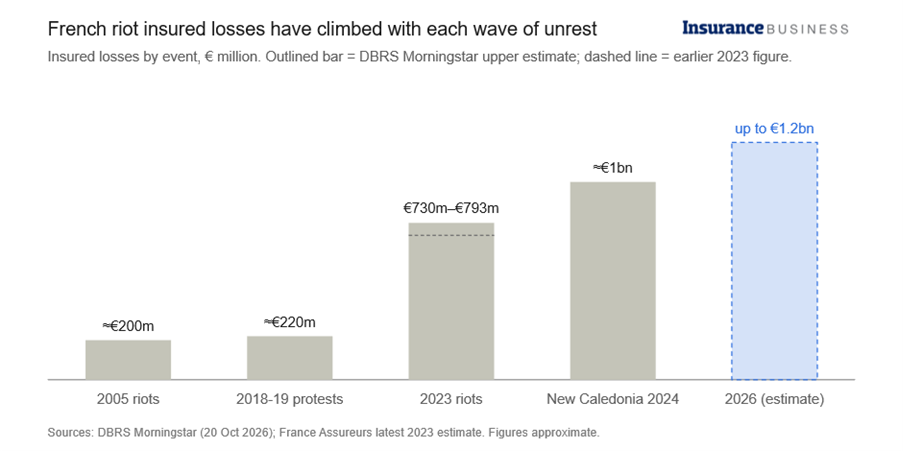
DBRS's ceiling for October is €1.2 billion, assuming no further rioting, with stores and public buildings again expected to account for most of the cost. The no further rioting is far from a given, however, with authorities looking to extend curfews to try to curtail the damage. Without the new pool, France's large carriers will pay the claims and pass losses above their retentions to reinsurers, and corporates holding specialist strikes, riots and civil commotion (SRCC) or political violence cover will recover part of their losses there. Retailers will still carry much of the cost themselves: business interruption cover is optional in France, and DBRS expects their total economic loss to be several times the insured figure.
Read next: What factors are behind the increased demand for strikes, riots and civil commotions insurance?
DBRS analysts Marcos Alvarez and Elisabeth Rudman argue that riots now behave more like natural catastrophes than routine property claims, because unrest that spreads across several cities produces thousands of related claims at once. Single episodes of unrest in the US, Chile and South Africa have each cost insurers more than US$2 billion, they note, and they expect SRCC cover to keep getting tighter and more expensive. In France especially, they say, insurers can no longer price civil commotion as a minor extra on a property policy.
Canada has taken a different path on shared risks. It never built a government terrorism pool after 9/11, unlike the US, the UK, France and Germany, and a 2007 Guy Carpenter report described that as a deliberate choice. There is no federal backstop for riot losses either.
Read next: Halifax bomb threat renews questions about Canada's terrorism insurance gap
The closest Canadian debate is over flood. Ottawa committed to a national flood insurance program in Budgets 2023 and 2024, and a 2025 campaign pledge of $450 million targeted an April 2026 launch. That date has passed without a confirmed timeline. The Insurance Bureau of Canada has proposed a federal reinsurance entity, run through a Canada Mortgage and Housing Corporation subsidiary, to reach the roughly 1.5 million high-risk households that cannot buy affordable flood cover.
France's riot scheme offers one working template for the design questions Ottawa still has to settle: who must be covered, whether insurers pay a levy into the pool, and how far the state's guarantee should go.
For Canadian companies with sites in France, the question is more immediate. Once the French regime starts, local property policies will include compulsory riot cover, and global insurance programs will need to work around it.
Read next: Prairie storms add $728 million to Canada's flood bill as national backstop misses launch target