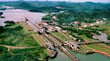
Drought-linked restrictions at the Panama Canal could create a wider cargo accumulation problem for marine insurers as ships are rerouted and concentrations of goods build at alternative ports.
During a Marsh webinar on El Niño and global supply chains, experts warned that restrictions could reduce capacity and increase competition for transit slots. The canal carries about 5% of global maritime trade annually, including roughly $270 billion in US cargo. Its reliance on rain-fed Lake Gatun makes the waterway particularly exposed to drought associated with El Niño.
According to Sadie Frank of N4EA, container shipping was already beginning to feel the effects, with some vessels paying millions of dollars to move ahead in the queue. N4EA is predictive intelligence and quantitative trade risk analytics company that models disruptions in global supply chains
“Just in the past couple of months, we’ve seen container ships pay millions of dollars to skip the line to get through the canal,” Frank said. “In this heightened risk environment, shippers are taking proactive action, which is going to raise costs overall as companies operate in a more competitive transport environment.”
Rerouting vessels around constrained waterways can change where insured cargo becomes concentrated, potentially creating accumulation exposures at ports or logistics hubs that would normally see cargo move through more quickly.
Frank said N4EA’s data was already showing risks stacking on key routes between Panama and the US, increasing the potential for disruption on routes that already carry higher tail risk. The pressure could intensify if canal authorities maintain strict water-management measures.
“What we can expect to see is shippers try to utilize alternatives, which can potentially raise the cost of goods,” Frank said. “But also, if you’re thinking about accumulation and cargo risk, [it could] allow for vessels to stack up in places where they might not be because they could get dispersed through the rest of the logistics network.”
Potential accumulation points include ports on the US West Coast and in Canada, as well as some Mexican ports, she added.
From a risk perspective, rerouting does not necessarily remove the underlying exposure. Instead, it can transfer concentrations of cargo into different locations while introducing additional transport, delay and weather risks.
Time-sensitive cargo is particularly exposed. Frank highlighted consumer goods destined for major US retailers, agricultural products, fertilizer and refrigerated cargo, as well as pharmaceuticals and foodstuffs.
The Panama Canal is also only one part of a wider routing problem facing global shipping.
Marcus Baker, global head of marine, cargo and logistics at Marsh Risk, said worsening water conditions at Panama were occurring alongside geopolitical disruption affecting the Suez Canal and Bab-el-Mandeb.
Alternative routes can introduce their own physical risks. Cape Horn, for example, can expose ships and cargo to heavy weather, strong currents and difficult navigation through the Drake Passage and Straits of Magellan, Baker pointed out. Severe weather can increase machinery stress as well as the potential for cargo damage, delay or loss.
Baker said shipping companies increasingly need to assess routing options against both cost and the likelihood that cargo will arrive safely. “Safe routing costs are rising and simply adding costs for cargo owners, ship operators and, of course, the ultimate consumer,” he said.
“This particular El Niño event and weather volatility generally should be a critical business discussion and could be an essential business differentiator if approached positively.”
The changing risk environment puts greater emphasis on understanding not simply where cargo originates and ends up, but how it travels between those points.
Frank urged cargo owners to map exposures at a product level and determine which goods rely on the Panama Canal and which alternatives are realistically available. “Not every product is exposed to Panama, but many will be,” she said.
Analysis can help companies distinguish between exposures that can be rerouted relatively easily and those where delays, spoilage or large physical dimensions make alternative transport more difficult.
At the same time, companies should treat El Niño-related shipping disruption differently from sudden geopolitical events because there is greater scope to anticipate it.
The insurance environment may provide some relief for buyers. “We’re a reduction in rates, and insurance pricing that’s proving to be very attractive for buyers,” said Baker.
“Shipping has always shown its ability to be resilient through storms of all kinds, but the current climatic conditions, combined with geopolitical conflict, serve to seriously challenge operational efficiency.”