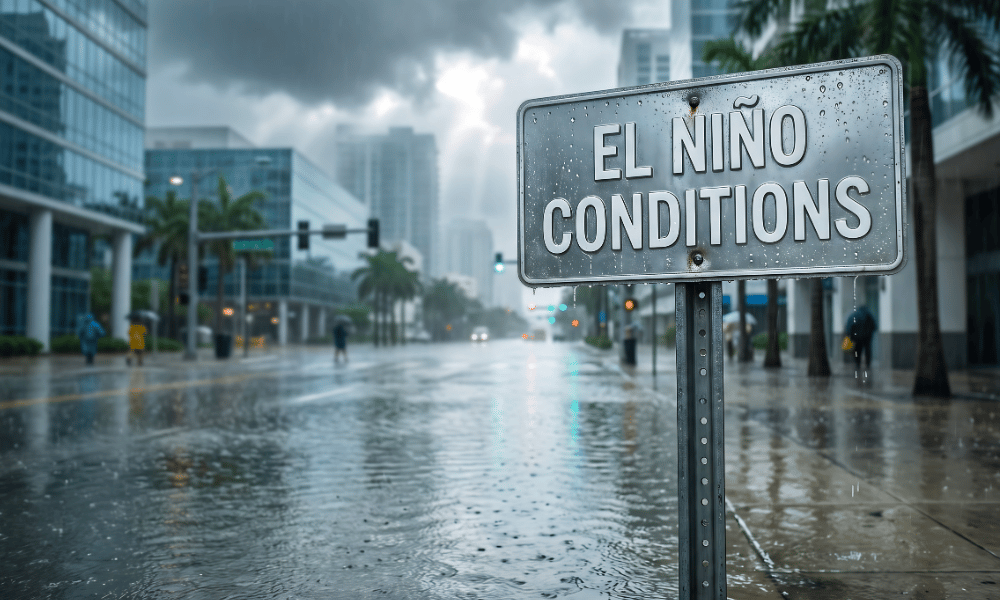
The 2026-2027 El Niño has broken a temperature record that stood for 150 years. Sea surface temperatures at the heart of the event in the equatorial Pacific have reached 3.05 degrees Celsius above the 1991-2020 average, surpassing the previous record of 3.02 degrees Celsius set in late November 2015 - the highest level since modern records began, according to the Guardian, which first reported the new high. The event has not yet peaked. Climate scientist Zeke Hausfather has forecast temperatures could reach 4.0 degrees Celsius above average in November and December, which he described as "mind-blowing."
The 2026 event is forecast by the UK Met Office to be "the largest since the 19th century" and by the World Meteorological Organization to be the largest in at least 1,000 years. NOAA gives a 90% or greater probability of a very strong El Niño persisting between September 2026 and January 2027. The WMO described its September 2026 advisory as carrying "exceptionally high likelihood of nearly 100%" that the event will persist through February 2027 - language the organisation itself called "unequivocal."
UN Secretary-General António Guterres did not equivocate: "The planet is in uncharted waters, and those waters are heating up."
El Niño's insurance implications are not a future risk. They are a current one. The pattern's effects have been visible in loss events throughout 2026: destructive hurricanes in Hawaii, floods across the United States, record heat domes worldwide, deadly storms in Chile, and temperature records in Peru, according to the Washington Post's tracking of El Niño's global impact. August 2026 was the hottest month ever recorded at global surface level - 1.65 degrees Celsius above pre-industrial levels, according to Copernicus climate data.
Climate scientist Hausfather put the financial scale in direct historical context. "Very strong El Niño events like those in 1997/1998 and 2015/2016 were associated with hundreds of billions of dollars in damages globally," he said. "This event is leaving those past ones in the dust."
An event forecast to exceed both prior peaks in intensity, developing on top of a warming baseline that has materially elevated the severity of secondary perils associated with El Niño - wildfire, flood, drought, cyclone - presents a loss potential that cat models calibrated on historical events of lesser intensity may underestimate. Swiss Re's sigma published in September 2026 noted that global insured natural catastrophe losses in the first half of 2026 reached an estimated USD 42 billion, and flagged that a strengthening El Niño may temper North Atlantic hurricane activity in H2 but "the risk of a costly major event remains."
El Niño reshapes global weather patterns by warming the central and eastern equatorial Pacific, suppressing the trade winds, and shifting the jet stream. Its effects on insured loss are geographically specific and well-documented from prior events - which means there is no excuse for portfolios in affected geographies to be surprised by them.
In the United States, El Niño typically brings wetter-than-average conditions to the southern states - elevating flood risk in California, Texas, and the Gulf Coast - and drier-than-average conditions to the Pacific Northwest, elevating wildfire risk. The current event has already produced flooding across multiple US states. In Australia and Southeast Asia, El Niño drives drought and elevated wildfire risk. Friederike Otto of Imperial College London noted that the current event is "unfolding on top of a much warmer, human-influenced climate system. So, in many places around the world we will see never-before-experienced heat extremes, with all their consequences on health, food" security, and infrastructure.
Real-time tracking from Climate Brink showed Niño-3.4 temperatures at +2.94 degrees Celsius as of September 11, 2026, with forecasts pointing toward a peak near +4 degrees Celsius in November, according to the Climate Adaptation Center. That means the loss events currently being generated are occurring before peak intensity. The November to December period will determine whether the 2026/2027 El Niño produces the kind of catastrophe loss year that redefines cat model assumptions for the next decade.
For insurers and reinsurers with exposure to the most El Niño-sensitive geographies, the question is not whether this event will affect the loss account. It already has. The more operationally relevant questions are: whether cat models adequately reflect the tail risk of an event calibrated at 4.0 degrees rather than 3.0 degrees; whether property and agriculture portfolios in Australia, Southeast Asia, California, and the Gulf Coast have been stress-tested against a scenario that exceeds any historical El Niño; and whether accumulation management decisions made earlier in the year remain appropriate given the scale now confirmed.
For brokers advising clients with material exposure to the affected geographies - property, agriculture, energy, infrastructure, and any business with supply chain dependencies on El Niño-sensitive regions - the window to review coverage adequacy, sub-limits, and deductible structures ahead of the peak is narrowing. The November to December peak is eight to ten weeks away.