A small San Diego haptics company has won what US legal commentators are calling the largest patent verdict in American history. If it holds, a big share of the money will go to the investors who paid for the case.
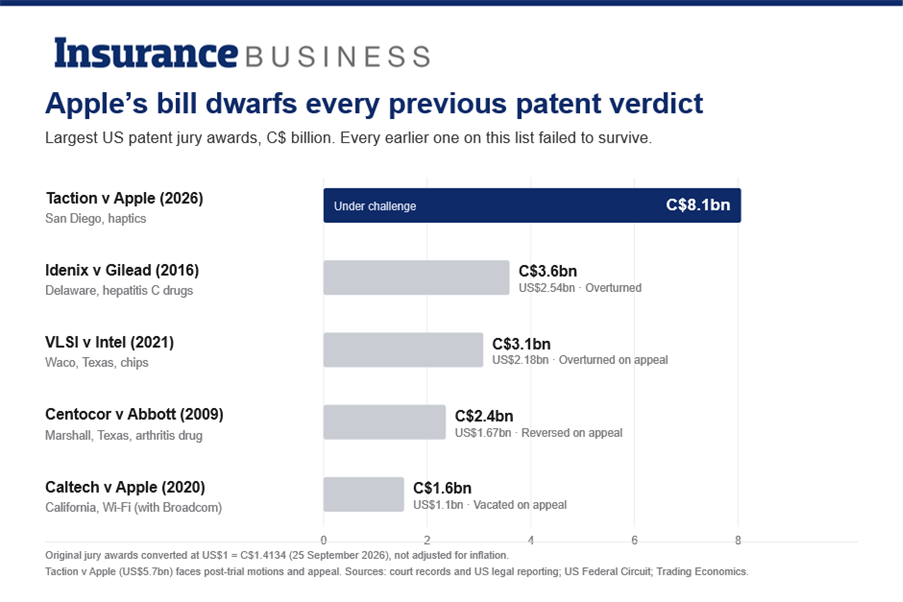
On Friday, a federal jury in the Southern District of California found that Apple had infringed two patents owned by Taction Technology. It awarded more than US$5.7bn in damages, about C$8.1bn at current exchange rates.
The patents cover tactile transducers, the vibration hardware that makes a phone or watch buzz back when you touch it. Taction, which uses the technology in headphones and gaming headsets, argued that Apple's Taptic Engine, built into iPhones and Apple Watches, used its inventions without a licence.
Apple denies it. The company said its Taptic Engine is "fundamentally different" from Taction's technology and that it will appeal. Taction's lawyers at Quinn Emanuel said the verdict vindicated patent rights their client had waited more than five years to have heard.
Taction filed suit in 2021. In 2023, Judge Robinson excluded testimony from Taction's technical expert and granted Apple summary judgment, ending the case before trial. The Federal Circuit then revived it. The trial began on September 14, and seven jurors took parts of two days to find in Taction's favour.
One finding matters for anyone estimating Apple's final exposure. The jury decided the infringement was not wilful. Under US patent law, a judge can increase damages up to three times the jury's figure, but that power is in practice reserved for wilful or egregious conduct. Without a wilfulness finding, Taction has little prospect of enhanced damages – but let’s face is $8billion is not small change..
Read next: Will US social inflation have a contagion effect?
Taction did not fund the litigation alone. US legal reporting on court disclosures shows the case was financed by Gronostaj Investments LLC and Kenosha Investments LP. In separate litigation, Kenosha has been identified as an indirect subsidiary of Burford Capital, one of the world's largest litigation funders.
Insurers have been pushing back against this model for years. The US National Association of Insurance Commissionerslists third-party funding and nuclear verdicts, generally awards above US$10m, among the main drivers of social inflation. In Canada, a Dentons report released by the Insurance Bureau of Canada warned that funding is growing largely without regulatory oversight and could push up commercial insurance costs.
The Taction award is 570 times the US nuclear threshold.
Read next: Litigation funding surge raises red flags for Canadian insurers
Insurers aren't only on the defence side of cases like this. A specialist market has grown up in judgment preservation insurance (JPI), which pays a winning claimant, or its funder, an agreed share of an award if the award is overturned on appeal. Patent verdicts are a core line for JPI because the US Federal Circuit has a long record of cutting large awards down.
The product has cost its underwriters before. In 2024 a US appeals court reversed a US$1.6bn judgment won by BMC Software against IBM, and insurers that had guaranteed part of it had to pay. Brokers say capacity has since become more expensive and more selective. Whether anyone has written cover on the Taction award has not been made public.
Canada's own litigation environment looks very different. Patent cases in the Federal Court are heard by a single judge, with no jury. Canadian courts don't award treble damages, and the losing side generally pays part of the winner's costs.
The pressure is on the cross-border side. Canadian casualty rates fell 5% in the first quarter of 2026, the 11th straight quarter of decline. Over the same period, risks with US exposure saw selective increases, some in double digits. Markel Canada president David Crozier put it bluntly when he spoke to Insurance Business earlier this year: "Anyone who has exposure to the US is still seeing that impact." Crozier also named the growing presence of litigation funding in Canada as one of the biggest emerging themes for 2026.
Most of Canada's funding market is unregulated. The main exception is class actions in Ontario. Since the province amended its Class Proceedings Act in 2020, a third-party funding agreement in a class action needs court approval. The court must be satisfied that the agreement is fair and reasonable, that it leaves the representative plaintiff in control of the litigation, and that the funder can pay any adverse costs award. Commercial disputes outside class actions face no equivalent rules.
A Canadian manufacturer, med-tech developer or software company accused of infringement in Texas or California faces the US system in full, juries included. The Canadian Intellectual Property Office's guide to protecting IP in the United States recommends searching existing US rights before launch to check whether a product might conflict with someone else's patent. That check is also useful to underwriters.
On the insurance side, brokers shouldn't assume a client's general liability policy will respond. Under the standard US commercial general liability wording, patent claims fall outside cover altogether, and the same source puts the average cost of defending a moderate-sized patent case at US$2.9m before any settlement or damages. Brokers should check how their client's Canadian form treats patent claims, and consider standalone IP defence cover for clients with meaningful US sales. That conversation is better had before a demand letter arrives from US counsel.
Read next: Why Canadian claims are going to be more complex in 2026
History is on Apple's side. The previous record was the US$2.54bn (about C$3.6bn) that a Delaware jury awarded Idenix against Gilead in 2016, which was later overturned. The next three largest awards, won by VLSI against Intel, Centocor against Abbott and Caltech against Apple, were all reversed or vacated on appeal.
Taction's award now goes to post-trial motions before Judge Robinson, where Apple will challenge both liability and damages. The appeal Apple has promised will follow. The final figure could be much smaller than the jury's, or nothing at all.
For Canadian insurers, what Apple eventually pays may matter less than the fact that a funded claimant, a revived case and a seven-person jury could produce a C$8bn award in the first place.