
London just had one of its shakier showings in the index that ranks the world's financial capitals, and this time, the insurance-specific numbers buried in the report are concerning for the UK’s insurance industry.
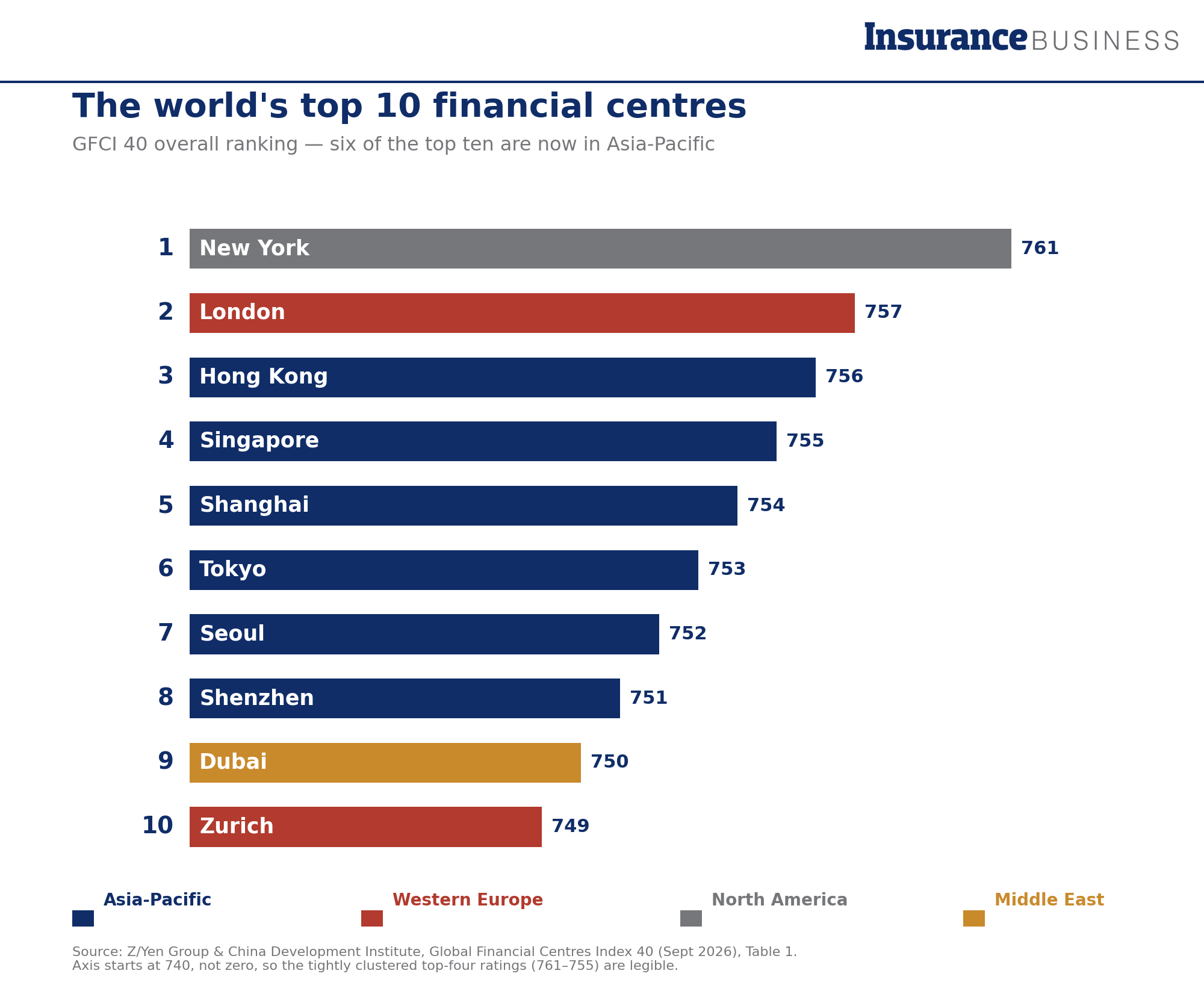
Z/Yen's Global Financial Centres Index (GFCI), the twice-yearly report produced with the China Development Institute that some finance professionals use as a rough scorecard of where the world's money is doing business, has just published its 40th edition, covering 117 centres worldwide. London held on to second place globally, behind New York, but shed nine rating points in the process, the same nine-point fall suffered by Hong Kong and Singapore, and steeper than New York's own six-point slide. Only four Western European centres made the global top 20 this time, down from seven a year earlier, with Paris, Amsterdam and Frankfurt all squeezed out in favour of Abu Dhabi, Beijing and Osaka.
It’s worth flagging up front: GFCI isn't a neutral instrument, and its own back pages show why. Z/Yen is London-based, but its co-producer since 2015, the China Development Institute, is a Chinese state-approved think tank whose stated mission includes advancing Beijing's economic reform agenda. The index's commercial sponsor network, listed at the back of the report, runs to eleven government-linked financial centres including Hong Kong, Busan, Seoul, Dubai and Kazakhstan's Astana without a single Western European or North American body among them, and this edition's foreword is written by the Mayor of Busan.
None of that makes the numbers fiction: New York and London have held the top two spots in every edition since CDI joined in 2015, and the wider Asian gains show up in independent data too, from Hong Kong's IPO volumes to Singapore's wealth-management inflows. But it's a reason to treat GFCI as one directionally useful data point rather than gospel, which is why the rest of this piece leans as heavily on Lloyd's own audited numbers and real M&A activity as it does on the index itself.
Six Asia-Pacific centres now sit in the global top ten, and when respondents were asked which hubs they expect to matter most over the next two to three years, London mustered just 29 mentions against Singapore's 137 and Dubai's 156.
The insurance-specific numbers, buried a few pages into the report, matter more for this audience than the headline ranking. GFCI doesn't just score cities overall, it breaks competitiveness down by industry sector, using only the responses from professionals working in each one (373 insurance specialists took part in this edition, 6% of the total respondents).
In the insurance sub-index specifically, London doesn't rank second, or even third. It ranks fifth.
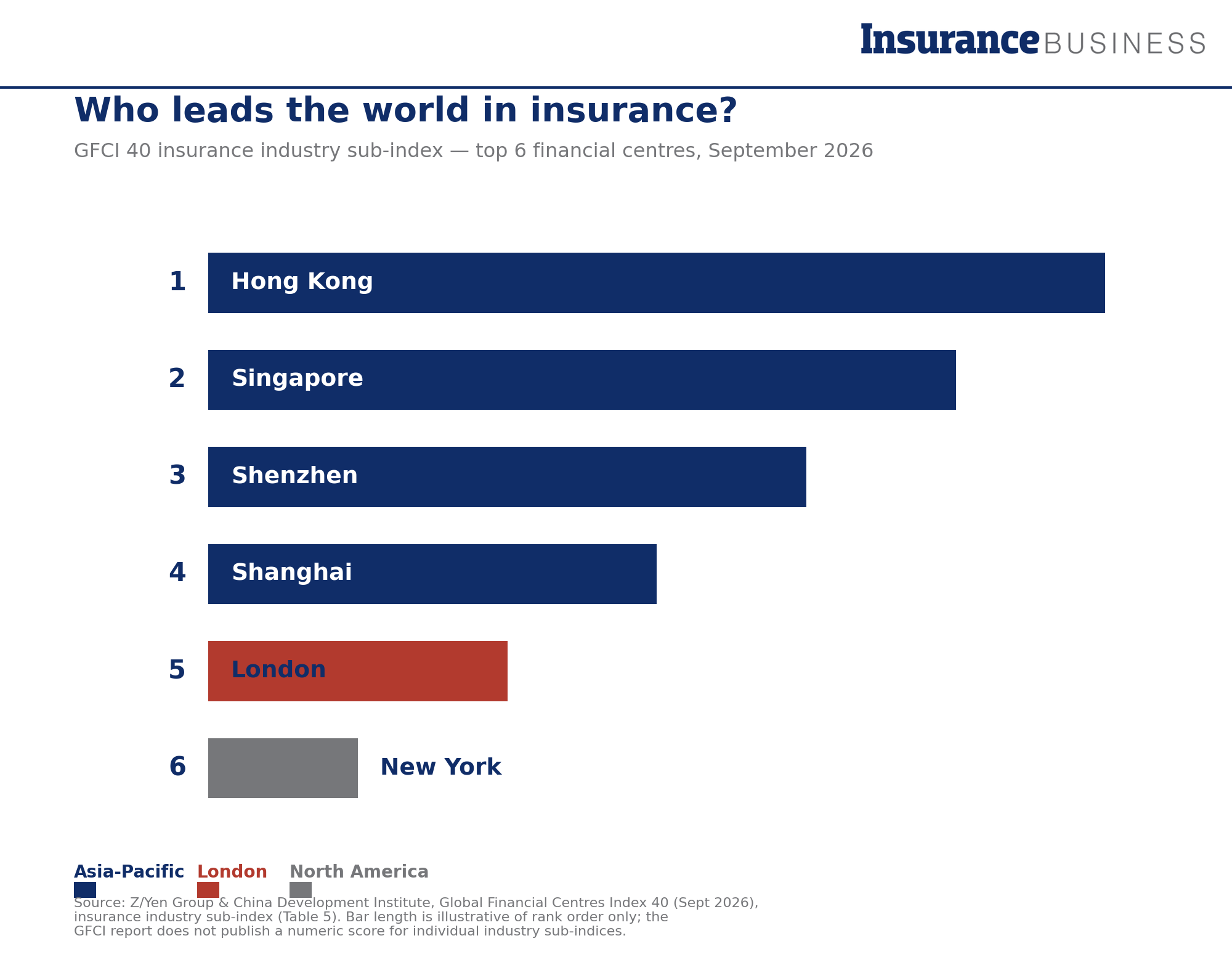
Hong Kong tops the insurance table, followed by Singapore, Shenzhen and Shanghai, with London fifth and New York sixth. Every one of the four highest-placed insurance centres in the financial index is now in Asia a picture that has been building for a while: Singapore overtook New York in the same sub-index back in March 2024, and Hong Kong has held the top insurance spot in the editions since then that Z/Yen has broken down publicly, including the one published a year ago.
It isn't only the ranking. Z/Yen also asks respondents whether they expect their own home centre to become more or less competitive. Among the top four cities, the report notes that London has a relatively high proportion of respondents who think their own market will become less competitive, a markedly gloomier reading than the confidence expressed by people based in Singapore and Hong Kong about their own patch.
One survey respondent, a chief representative at an insurance firm based in London, told Z/Yen that predictable tax policy and personal income tax structures competitive enough to keep hold of international talent are what "truly enhance a centre's edge" which is a fairly direct signal about where London insurance leaders think the pressure points are. By contrast, a New York-based insurance executive surveyed for the same report pointed to regulatory transparency and rule of law as the advantages keeping their market on top.
Insurance Business UK approached Lloyd's of London for comment on the report's findings and whether they reflect what the market is seeing; Lloyd's declined to comment.
One industry source, speaking on condition of anonymity, offered a different reading of the findings: "Whilst the Global Financial Centres Index (GFCI) has undeniably become an influential measure of international competitiveness over the years, it is important to remember how it is calculated. The base data is gathered from an open survey to which any person can respond regardless of knowledge or experience. It also compares London – the leading global specialty insurance centre - against other hubs which may not play a similar role in the global industry (such as Shenzhen and Shanghai); or are part of a complementary range of sources of capital that deliver global client outcomes (such as Hong Kong and Singapore). These factors mean the findings should be considered in the context of a much broader range of measures when assessing London's international competitiveness."
Commercial deal-flow tells the same story as the index. Willis Re announced in the spring that it was building out a Singapore-based leadership team, with the region framed internally as a key growth engine for global reinsurance as insurance penetration and catastrophe exposure both rise across Asia-Pacific.
A few months later, Allianz agreed to pay roughly $2.1 billion (about £1.6 billion) for HSBC's Singapore life and health arm, having lost out on an earlier attempt to buy into the city-state's market back in 2024. Prudential's most recent half-year figures told a similar story, with ASEAN new business profit up 13% even as its mainland China business was squeezed by tighter local rules.
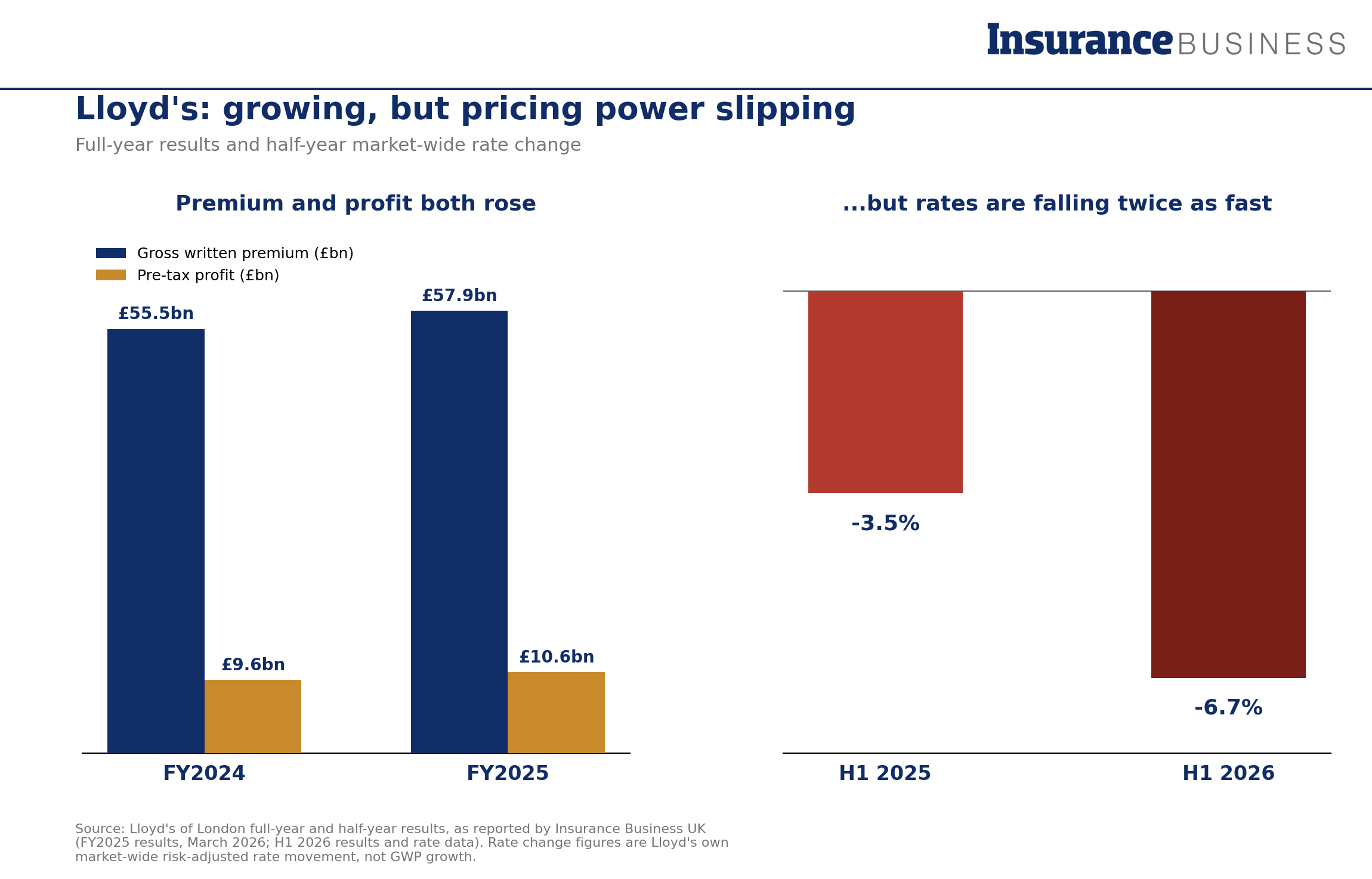
So does that mean Lloyd's and the wider London market are on borrowed time? The numbers say not yet, or at least not obviously. Lloyd's full-year 2025 results, published back in March, showed pre-tax profit up 10.1% to £10.6 billion on gross written premium of £57.9 billion, with a combined ratio of 87.6%, comfortably profitable territory, even if slightly worse than 2024's 86.9%. The market's capital position actually strengthened further, with its central solvency ratio climbing to 496%. That is not the balance sheet of an institution in retreat.
Where the cracks are starting to show is in pricing discipline rather than headline profit. Lloyd's half-year 2026 figures revealed gross written premium up 6.9% to £34.7 billion, but market-wide rates falling 6.7% over the same period, more than double the softening seen a year earlier. Fitch Ratings has assigned a "deteriorating" outlook to the UK London Market specifically, alongside its outlook on global reinsurance, pointing to thinning underwriting margins after a prolonged run of rate reductions. A market that keeps growing premium while giving away price is one storing up questions for later, even if this year's answer looks fine.
There's also a wider City backdrop that London's insurance leaders can't entirely insulate themselves from. The GFCI 40 figures landed against a run of high-profile departures from the London Stock Exchange, from Wise's move away from a UK listing to Klarna's choice of Wall Street for its own float, feeding a narrative, whether fair or not, of a capital market losing confidence in itself.
London also slipped a place in GFCI's fintech rankings, falling to sixth as Shanghai moved ahead, even as Hong Kong retained top spot in that category outright, with New York overtaking Shenzhen for second.
Insurance is more insulated from listing decisions than banking or asset management, given how much of Lloyd's business is written through mutualised syndicate capital rather than public equity, but sentiment in the wider ecosystem of talent, technology investment, and regulatory reputation doesn't stop at the sector's front door.
London hasn't lost its standing so much as ceded one specific, measurable piece of it.
It is still widely regarded as one of the deepest markets anywhere for specialty and hard-to-place commercial risk, and it still sits second globally overall by Z/Yen's own measure, with a reputational score that actually runs ahead of its raw competitiveness rating, the London brand still carries real weight with the market even where the underlying numbers have softened.
But on the one sub-index built specifically around insurance professionals' own judgement, London sits fifth, behind four Asian centres, and London-based respondents themselves are gloomier about their own market's trajectory than their counterparts in Singapore or Hong Kong are about theirs.
This article was updated with comments from an anonymous industry source.