Every September, as the Southern Hemisphere shakes off winter, something predictable happens on Australia's roads: the kangaroos start moving, and so do the insurance claims.
It sounds like the setup to a joke – "why did the kangaroo cross the road" – but for Australian insurers it's a genuinely painful annual event, and one that's arriving at the moment a lot of local drivers have quietly downgraded their cover to save money. For a UK audience used to worrying about rabbits, potholes and the odd pheasant, it's a useful reminder that "wildlife risk" looks very different depending on which hemisphere you're insuring.
New data from the Royal Automobile Association of South Australia shows animal collision claims jump by 21% in spring compared with summer, based on three years of claims figures. On average, the insurer's members lodge 657 animal-related claims each spring, against 543 over the summer months. Roughly nine in every ten of those claims involve a kangaroo rather than any other animal – so this isn't really an "animal collision" problem in Australia, it's a kangaroo problem.
The reason is fairly simple biology rather than bad luck. Kangaroos become considerably more active around dawn and dusk in spring, and fresh roadside vegetation after winter rain tends to draw them straight towards the verges – and the traffic. Local road safety bodies routinely warn that this is one of the most foreseeable seasonal spikes in the entire motor claims calendar, which makes it an odd one for any driver to be under-insured against.
Read next: Motor insurance prices rising again after two years of falls
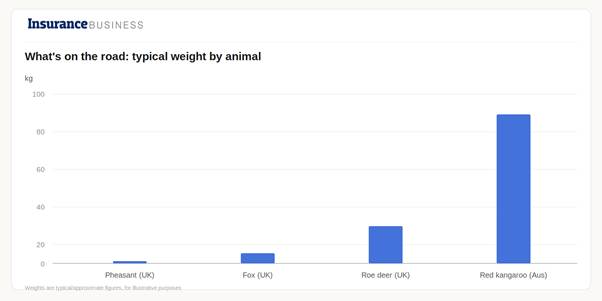
This is the bit that tends to surprise people outside Australia. A large red kangaroo can weigh up to 90kg and cover ground at speeds nudging 70km/h (around 44mph), so a collision is less "clipped a rabbit" and more "hit a solid, unpredictable object roughly the size of a human that is running faster than Usain Bolt and can also jump sideways at the last second." Unlike a static obstacle, a startled kangaroo doesn't necessarily move away from a car – it can just as easily bound directly into its path.
The financial picture backs up the physics. Insurer AAMI logged more than 24,000 wildlife collision claims across Australia in 2025, with over 4,500 vehicles declared a total write-off and average repair bills running above $9,000 (roughly £4,600, though currency conversions move around and are worth checking independently). Looking specifically at claims received between mid-2024 and mid-2025, AAMI found that nearly one in five – 18% – ended in the car being scrapped entirely, with typical damage costs of around $8,000 (approximately £4,100). Separately, NRMA Insurance recorded more than 15,000 animal collision claims in 2025 alone, a jump of 21% on the year before, with kangaroos responsible for 84% of them.
For context, that's not far off the frequency of Britain's own deer problem, just with a very different animal doing the damage. Research coordinated through the UK's Deer Initiative estimates somewhere between 42,000 and 74,000 deer-related collisions happen on British roads every year, with more than 450 injuries and up to 20 fatalities.
Insurer Zurich has separately reported a roughly 45% jump in deer-related claims during the spring fawning season, with an average claim cost of around £4,317 in 2024 – strikingly close to what AAMI's Australian data shows for kangaroos, once converted. The UK's deer population, estimated at around two million, is reportedly the highest it's been in a thousand years, according to Forestry Commission figures, so this isn't a uniquely Australian phenomenon so much as a shared "large wild animal versus windscreen" problem with different local wildlife.
Roughly one in five Australian drivers admit they'd swerve to avoid an animal on the road, and road safety officials keep pointing out that this instinct is often more dangerous than the original collision. A swerve that ends with the car leaving the road, clipping a barrier or rolling is a different – and often far costlier – claim to a straightforward strike, and the type of cover in place changes everything about what gets paid out.
That's because in Australia, unlike compulsory third-party (CTP) or basic third-party property policies, kangaroo strikes are only covered under comprehensive motor insurance. Third-party-only cover will pay out for damage the policyholder causes to someone else's car, but not a cent towards their own vehicle after a kangaroo comes through the windscreen.
Here's where the story stops being purely interesting. Research from comparison site Finder found that 3.2 million Australian drivers have lowered or ditched their car insurance cover in the past 12 months, as cost-of-living pressure bites. Of that group, 10% moved down to a lower level of cover, 5% dropped car insurance altogether, and a further 3% had never carried anything beyond the compulsory minimum in the first place.
The gap in price explains why. Finder puts average comprehensive cover at $1,362 a year (around £695), against $522 (around £266) for third-party-only – a difference of roughly $840, or about £430, that's easy to see the appeal of trimming when household budgets are stretched.
Separately, the Insurance Council of Australia's analysis shows comprehensive motor premiums have risen 42% since 2019 to an average of $1,052 a year (roughly £535), with claims costs up by the same margin and repair costs climbing 26% since 2022 alone. Put plainly: a driver who downgraded when their car was worth less may now be self-insuring a more valuable asset, at the exact point in the calendar when the one risk their new policy doesn't cover is at its highest.
Read next: Motor insurers to stay loss-making through 2026 as rates turn
AAMI's 2025 claims analysis identifies Port Augusta, Coober Pedy and Mount Gambier as South Australia's top kangaroo collision hotspots, with Dubbo, Broken Hill and Sutton leading in New South Wales, and Gisborne, Sunbury and Toolern Vale topping the list in Victoria. Unsurprisingly, it's the regional and semi-rural routes – long, open roads with plenty of roadside vegetation and relatively little street lighting – that carry the highest exposure, rather than city driving.
Britain doesn't have kangaroos, but it does have exactly the same underlying pattern: a wildlife-collision risk that spikes at a predictable time of year, a coverage gap for anyone without comprehensive insurance, and rising temptation among cost-conscious drivers to trim their cover just as premiums climb. The Australian data simply makes the trade-off unusually easy to see, because the seasonal spike and the coverage exclusion line up so neatly. For anyone in the UK market thinking about how affordability pressure interacts with genuinely foreseeable seasonal risk – whether that's deer in an English autumn or kangaroos in an Australian spring – it's a fairly tidy case study in why "cheaper" cover and "adequate" cover aren't always the same thing.