Beijing's latest bailout of its financial sector looks like a purely domestic story, until you spot that one of the companies on the receiving end owns a well-known face in the Lloyd's market.
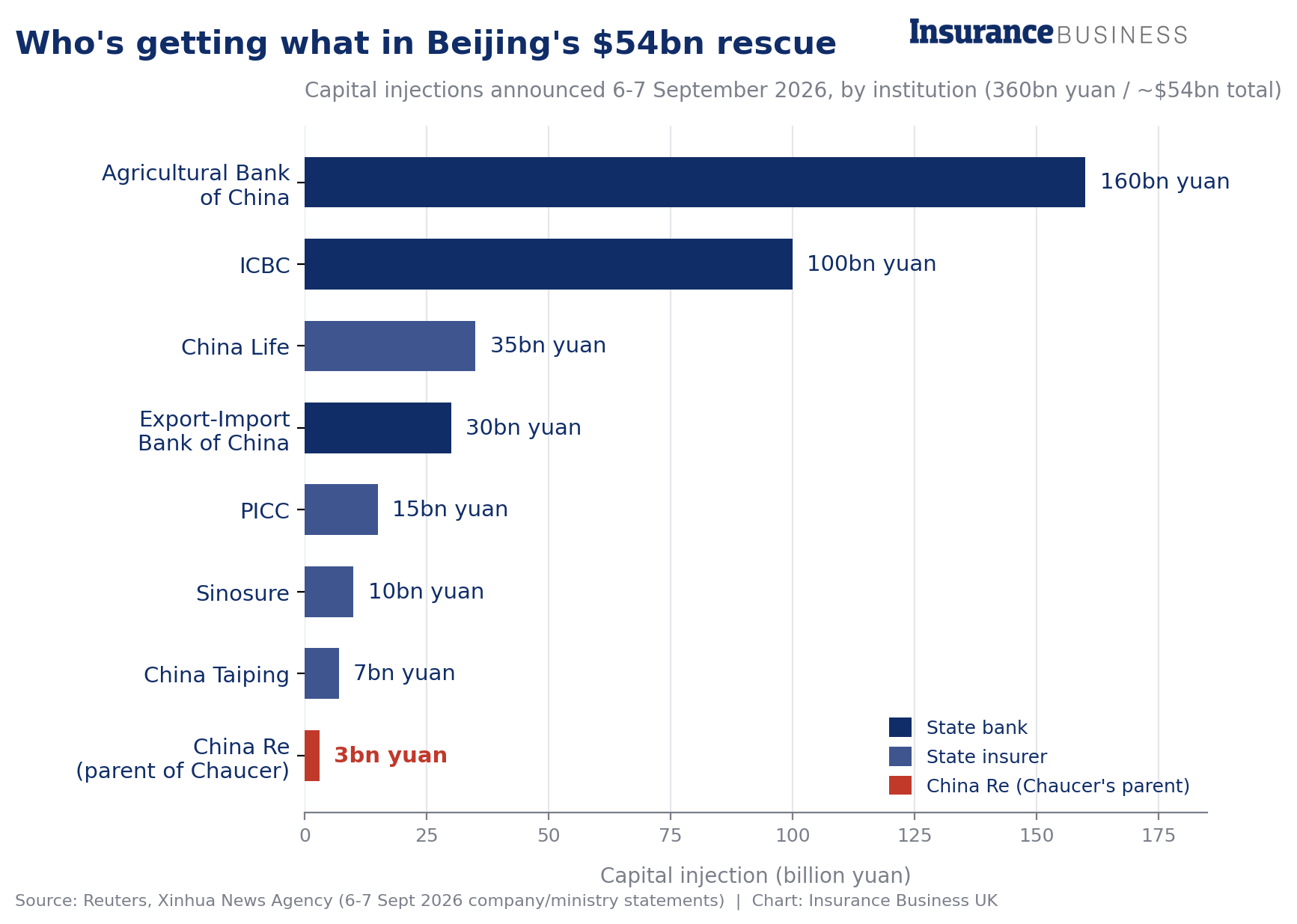
China's finance ministry confirmed over the weekend that it is leading a combined 360 billion yuan (roughly $54bn) capital injection into eight state-controlled banks and insurers. Three lenders, including Agricultural Bank of China and ICBC, will share around 290 billion yuan of that total, while five insurers split the remaining 70 billion yuan between them.
Among the insurers, China Life is getting the biggest cheque at 35 billion yuan, followed by PICC (up to 15 billion yuan via a share placement), export credit insurer Sinosure (10 billion yuan), China Taiping (7 billion yuan) and China Reinsurance - better known in London simply as China Re - which is in line for 3 billion yuan.
Read next: Lloyd's attracts fresh capital
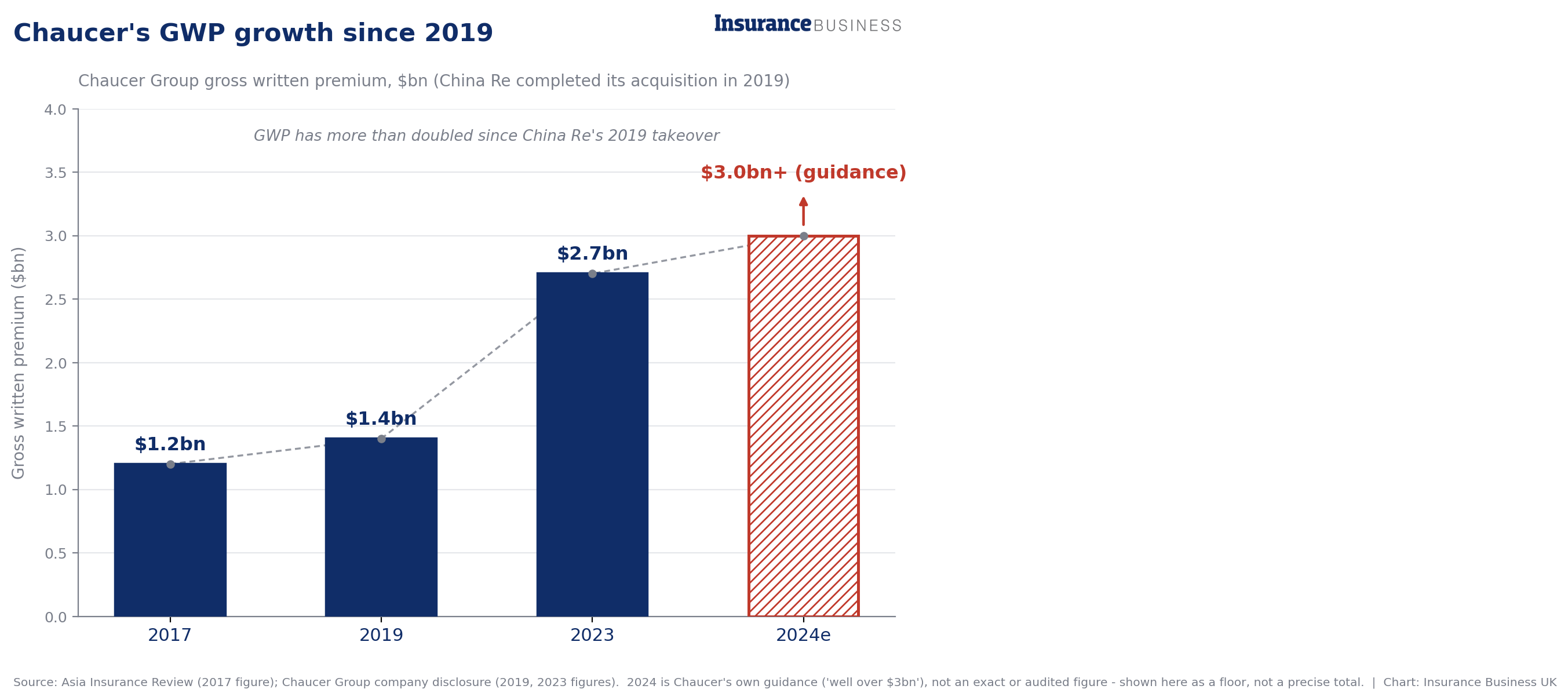
China Re isn't just a distant state reinsurer to London underwriters. It's the parent company of Chaucer Group, which China Re bought outright in 2019 in a deal worth close to $950m. Chaucer is no dormant legacy brand either: its flagship Syndicate 1084 wrote $2.38bn of gross premium in 2024, up 13% year-on-year, and its stamp capacity for 2025 pushed past £2bn, putting it among a small group of syndicates operating at that scale. A capital top-up at group level in Beijing won't change Chaucer's day-to-day underwriting, but it shows how the fortunes of a Lloyd's managing agent can rest on decisions made thousands of miles away.
The funding mechanism matters here as well. Most of the money is coming from 300 billion yuan of special sovereign bonds - central-government debt issued for a specific policy purpose, in this case recapitalising financial institutions, rather than general spending.
China has never used that tool for insurers before, only banks, so its use here signals that insurers' balance sheets have become a real fiscal priority rather than a side concern. Even so, the insurer package landed well below the 200 billion yuan some in the market had expected, which Citi analysts read as a sign the sector's capital position wasn't as fragile as first assumed.
Read next: Chaucer Group names new CEO
Investors weren't entirely convinced. Shares in ICBC and Agricultural Bank of China fell around 2% in Hong Kong trading, and China Life and China Taiping saw similar declines, as some in the market focused on dilution from new share issuance rather than any strategic upside.
For London, what matters most is what the cash is actually meant to do. Gary Ng, senior economist for Asia-Pacific at Natixis, said the injection would make it easier for insurers to buy equities and meet solvency requirements, noting that Beijing has already told insurers to put 30% of new premiums into the stock market since the start of 2025 - even though equities still make up only around a fifth of the big listed insurers' balance sheets. Beijing wants its state insurers acting more like long-term institutional investors, and this injection clears one of the constraints stopping them.
That's a very different capital story to the one playing out at Lloyd's, where the market's own half-year figures showed gross written premium up 6.9% to £34.7bn and a central solvency ratio above 500%.
Lloyd's is attracting capital because returns have been strong; Beijing's insurers needed a top-up because margins have been squeezed. Yet the two markets stay linked: as Chinese institutional money looks for a home, and as state reinsurers such as China Re keep building out their international platforms through UK subsidiaries, London remains one of the places they keep returning to.
Zhongtai Securities analysts framed the injection as easing near-term pressure on insurers' solvency ratios, hit by falling government bond yields, while giving the sector more room to grow long-term equity holdings over time. Whether that eventually pulls more Chinese capital into Western reinsurance markets, or simply strengthens a domestic parent's balance sheet, is a question that we’ll have to wait to see answered.