Most of us have handed a food delivery app our address, phone number and live location without a second thought, then opened the door to a stranger holding our dinner. Suggest that a motor insurer should see how we brake, accelerate and take corners, though, and plenty of people suddenly become privacy campaigners.
Bill Powers, co-founder and chief executive of Cambridge Mobile Telematics (CMT), says that gap explains why usage-based insurance has struggled to break out of its niche. On stage with investor Daymond John at InsureTech Connect (ITC) in Las Vegas, Powers told the audience that people are happy to let a stranger turn up with their food, but monitoring is a different story. "If you have someone measuring your driving performance, that's a problem," he said.
His argument is that the data isn't the real problem. The issue is who wants it. People feel very differently about insurers than they do about the apps on their phones.
The UK is a useful test of that theory, because telematics is already part of the motor market here, mainly through young drivers. In June, Aviva urged the government to consider making black box policies compulsory for 17 to 24-year-olds in their first year on the road. Its claims data, covering January 2023 to March 2025, showed that about 11% of newly qualified drivers made a collision claim in their first year, against 5% of drivers with at least a year's experience. ABI figures put the average premium for a 17-year-old at £1,932 in the third quarter of 2025. Drivers aged 17 to 20 on telematics policies save an average of £379 a year compared with standard cover.
Read next: Aviva calls for mandatory telematics insurance for young drivers
Public opinion is mixed. A Censuswide survey of 2,202 motorists, commissioned by Aviva in January, found that 73% thought telematics should be mandatory for young drivers. Among 17 to 24-year-olds themselves, support fell to 60%. Earlier research for comparison site Quote Goat found that 45% of young drivers considered black boxes unfair, and some described them as intrusive and Big Brother-like. People are noticeably keener on monitoring when it applies to someone else.
CMT has a UK presence too. Admiral has appeared on its published list of insurer customers. In March the Massachusetts-based firm raised US$350 million in a round led by TPG and Allianz X, with State Farm also investing. CMT says its platform covers more than 55 million drivers in 25 countries.
Powers faced the classic objection on stage. The session moderator, a New York driver, said she would never sign up because the aggressive driving needed to survive Manhattan would make her look like a liability. Powers said he hears that all the time, and that the answer is context. CMT's scoring takes location into account. A sudden stop in heavy city traffic is normal and isn't held against the driver. Braking hard at speed on an open road means something quite different.
Powers then said that driving at 85mph on an empty interstate in the American Midwest isn't, in itself, dangerous driving. UK readers may raise an eyebrow at that. Here, 85mph is 15mph over the motorway limit, which is enough to earn a speeding penalty. It's a reminder that scoring models designed for American roads may need careful local calibration before they win over British drivers, insurers or the Information Commissioner's Office.
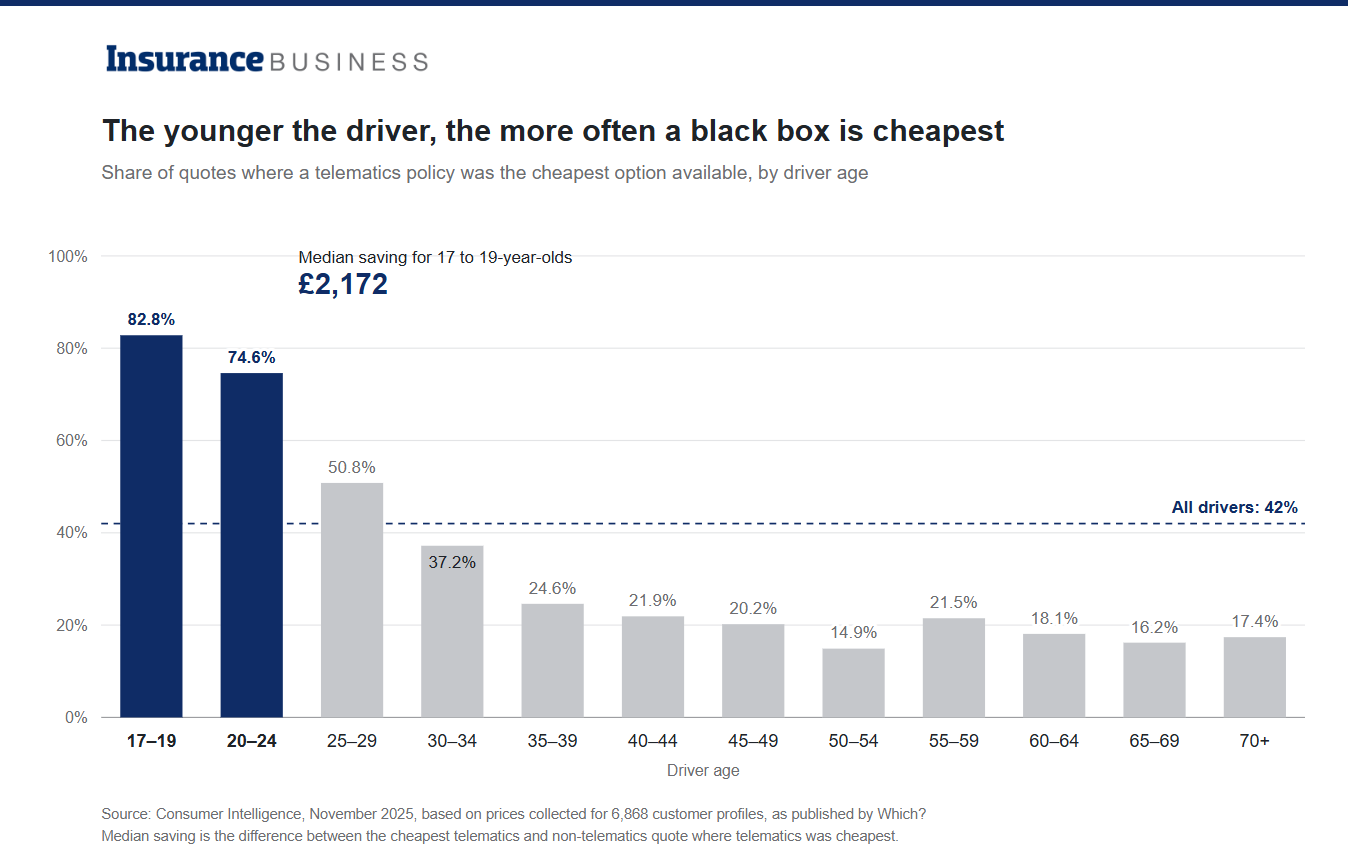
There is better news for UK insurers than for some of their overseas counterparts. Fairer Finance's Spring 2026 Trust in Insurance Index found that trust in car insurers had improved. Claims satisfaction across the main personal lines reached its highest level since 2019, helped by car premiums falling 9% year on year in February.
The broader picture is less flattering. Allianz UK's first Trust Issues benchmark, carried out by Edelman, ranked insurance ninth of 13 sectors on net trust. It found that 78% of UK adults associate the industry with loopholes. People trust their own insurer far more than the industry as a whole, which supports Powers' point that trust is earned customer by customer rather than through the brand.
On personal data specifically, the ICO's latest public attitudes research, a survey of 7,801 UK adults carried out by Savanta in early 2026, found that 57% had at least moderate trust in organisations that store their personal data. However, 27% said their trust had fallen over the past year.
Read next: UK insurers trusted for purpose, not promise – Allianz benchmark
Asked where AI would have the biggest effect on insurance, Powers named claims. He expects faster settlement, better evidence and, he hopes, lower repair bills and less fraud. In the UK, fraud is a growing problem. The ABI reported that insurers detected £1.16 billion of fraudulent general insurance claims in 2024, and motor accounted for 51,700 of those cases, worth £576 million. Aviva said it detected a record £233 million of claims fraud in 2025 across its brands, including Direct Line. The value of motor fraud it detected rose 39%, and it is seeing more claims backed by AI-generated damage photos.
Read next: Aviva detects record £233m in fraud as AI tools and ghost broking accelerate
Inside CMT, Powers said AI has changed how work is staffed rather than eliminating jobs. Tasks that once took around a dozen people now need about half that, and the spare headcount goes towards hiring AI specialists. John took a similar view. In his opinion, AI won't take people's jobs, but a colleague who knows how to use it might.
John also warned that large incumbents can't rely on their size, because big organisations tend to become complacent. That warning applies directly to the UK debate. If ministers do make black boxes compulsory for new drivers, insurers will get the data by law, but not the drivers' trust. Whether a generation of young motorists comes to see telematics as fair, rather than as a curfew with a price tag, will depend on how insurers use that data.