Andrew Pimm pays about $2,336 a year for critical illness insurance through his spouse's employer, United Airlines. He pays roughly another $862 for accident and hospital indemnity coverage. United contributes nothing toward those premiums. Pimm has launched a lawsuit that asks a question that until recently almost no one asked about voluntary benefits: who was supposed to be checking what was built into that price?
A growing share of the answer points at brokers. Since December 2025, proposed class actions under the Employee Retirement Income Security Act have named Mercer, Willis Towers Watson, Gallagher, Lockton and the benefits communication firm BCInsourcing alongside the employers they advised.
In September, USI Insurance Services was sued by its own employees. The size of the commissions gets the headlines. But for group benefits brokers, the arguments with the longest reach are about conduct: how programs were marketed to employees, and how much discretion the broker exercised over them.
Read next: Public filings expose voluntary benefits commissions to ERISA litigation risk
Payroll-deducted, employee-paid coverage can sit outside ERISA entirely. The Labor Department's safe harbor, at 29 CFR 2510.3-1(j), allows that only if four conditions hold:
The department has read the endorsement condition narrowly for decades. In a 1994 advisory opinion, it said a sponsor endorses a program when it expresses any "positive, normative judgment" about it. It found that a brochure carrying the sponsor's logo, and describing the coverage as the sponsor's own, met that test.
The same opinion cites an earlier department letter concluding that telling employees the sponsor was "enthusiastic" about a program would count as endorsement. It adds that saying the sponsor had "arranged" coverage might count too, depending on what else the sponsor did.
Compare that with a typical voluntary enrollment campaign: a co-branded benefits site, reminder emails sent under the HR director's name, and a benefits guide that presents critical illness cover next to the medical plan as part of "your total rewards." Much of that work is designed and produced by brokers.
The fourth condition matters as well. According to a Ropes & Gray analysis of the December complaints, plaintiffs allege that each employer accepted service relationships or other benefits from its consultant.
They argue those were given in exchange for allowing high commissions to be built into employee premiums. The complaints also note that each employer reported its program as an ERISA plan on its own Form 5500.
Read next: Benefits broker fiduciary risk: why disclaimers may not be enough
Most broker agreements disclaim fiduciary status. The complaints try to get around that by focusing on function rather than labels. Plaintiffs contend that brokers become functional fiduciaries as a matter of industry practice because they exercise discretion in administering voluntary programs. In the United case, that includes an allegation that the broker withheld information about lower-cost options from the employer.
Whether a broker can be an ERISA fiduciary over a voluntary program is one of the open questions defense lawyers are watching most closely. If courts accept the theory, brokers would face liability in their own right, not just as vendors to a sued client.
The USI case tests a starker version of the same idea. Seven participants in USI's employee plan allege that the firm ran its own plan and also acted as the broker choosing its voluntary products, collecting the commissions those choices generated. The complaint puts the total paid to USI and its affiliates at about $3.46 million from 2020 to 2024. The suit comes as Aon moves to close its $17 billion acquisition of USI, expected in the fourth quarter.
Read next: USI Insurance employees sue over voluntary benefit commission 'self-dealing'
The Supreme Court made this kind of case easier to bring in April 2025. In Cunningham v. Cornell University, a unanimous court held that a plaintiff alleging a prohibited transaction under ERISA does not have to show at the outset that none of the statute's exemptions applies. The defendant has to raise the exemptions instead.
A payment to a service provider from plan assets can fit the basic definition of a prohibited transaction. That puts more commission-based claims within reach of discovery, the stage where litigation gets expensive and settlements get negotiated.
Courts have not yet ruled definitively on whether ERISA covers these programs or whether the brokers involved acted as fiduciaries.
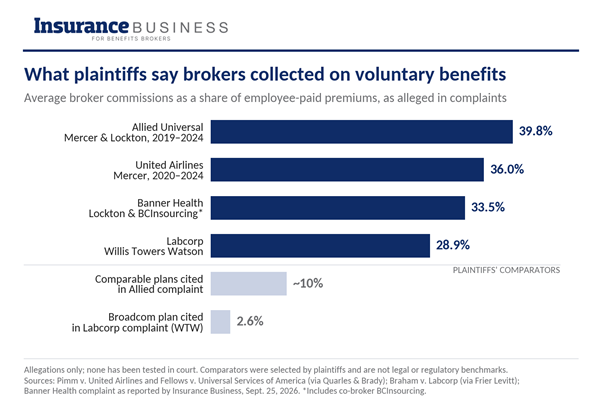
The dollar allegations are large. Plaintiffs say average commissions ran from about 29% of premiums at Labcorp to nearly 40% at Allied Universal. The United complaint sets Mercer's alleged 36% against a table of other plans averaging 2.1% to 19%. The Labcorp complaint points to Broadcom's plan, where it says the same broker, WTW, was paid 2.6%. Those comparisons were chosen by plaintiffs and are not legal benchmarks.
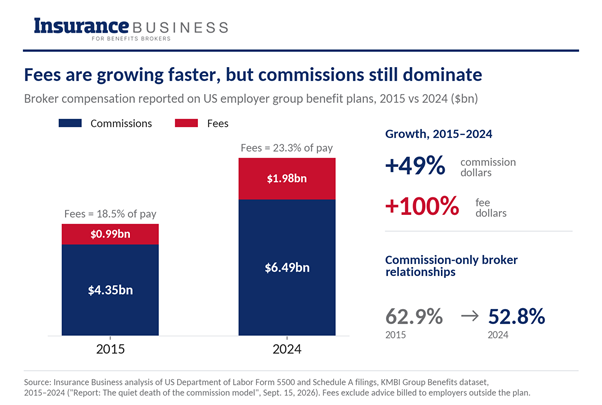
The lawsuits have arrived at a compensation model that was already shifting. An Insurance Business analysis of Labor Department filings found broker commissions on US employer group benefit plans rose from about $4.35 billion in 2015 to $6.49 billion in 2024.
Over the same period, fee income doubled to roughly $1.98 billion. The share of broker-plan relationships paid by commission alone fell from 62.9% to 52.8%.
Some firms already make their pay visible to clients. Rick Kelly of Marsh McLennan Agency told Insurance Business that his firm shows its compensation separately in client work. "Every analysis we do, we have our fee as a separate line item," he said.
Read next: Report: The quiet death of the commission model
Few brokers think their clients are ready. In a 2026 Phia Group survey of 124 benefits brokers and advisors, only 12% said they were very confident their clients had adequate fiduciary processes in place.
For voluntary lines, the practical work starts with brokers' own materials:
Holland & Knight's advice to employers is to monitor voluntary programs and their brokers' commissions the way many already monitor retirement and health plans. For brokers, that is also a service opportunity: the adviser who builds that monitoring process is the one the client keeps.
Read next: Benefits brokers see fiduciary gaps clients aren't asking about yet, survey finds
For years, voluntary benefits were sold as the part of the package that carried no risk because the employer paid nothing. These cases argue the opposite: when the employer pays nothing, someone still has to watch the price.
Brokers may find it better to take on that job voluntarily than to have a court assign it.