
Nobody has declared the broker commission dead, because on paper it looks healthier than ever. Across US employer group benefit plans, the commissions paid to brokers grew from about $4.35 billion in 2015 to $6.49 billion in 2024, according to KMBI's analysis of Department of Labor Form 5500 and Schedule A filings.
A number that keeps rising does not trigger obituaries, but the commission is dying the way most durable things die: not in a collapse, but in a slow loss of share, one point at a time, while everyone is looking at the topline.
That 4.8-point shift over nine years, almost exactly half a point a year, is undramatic by design, which is precisely what makes it durable. In 2015, fees (the flat, negotiated, retainer-style payments brokers and consultants bill for advice) made up 18.5 percent of total broker compensation on these plans, with commissions holding the other 81.5 percent. By 2024, fees had climbed to 23.3 percent and commissions had slipped to 76.7 percent. The direction has rarely reversed: fees rose as a share of broker pay in seven of the nine year-over-year steps, and the dollars behind them nearly doubled, from roughly $0.99 billion to $1.98 billion, growing far faster than commissions did.
A commission is a percentage of premium, so as long as premiums drift upward, commission dollars rise on autopilot even as the model loses ground. That is what makes this a quiet death rather than a loud one: the thing being displaced is still growing, so no one inside the industry has an obvious reason to sound an alarm.
The external cost environment is accelerating that pressure from the employer side.
Lockton's 2026 National Benefits Survey, drawn from 1,705 plan sponsors, found that 54 percent of employers now rank cost reduction as their top benefits priority, up sharply from 38 percent in 2025, with attracting and retaining talent falling behind it for the first time in years.
When cost becomes the only lever a client is asking about, the broker relationship risks narrowing to running RFPs and comparing quotes, work that is increasingly easy for a client to benchmark, and easy for a competing broker to replicate. That commoditization pressure makes the case for a fee-based advisory relationship stronger, not weaker.
Look at how brokers actually get paid on each plan and the shift sharpens. In 2015, 62.9 percent of all paid broker-plan relationships were commission-only: pure product compensation, no fee. By 2024 that had fallen to 52.8 percent, a ten-point drop toward the halfway line.
Meanwhile the share of relationships that involve a fee at all, whether fee-only or fee-plus-commission, climbed from 37.1 percent to 47.2 percent. Put plainly: a decade ago, getting paid a fee was the exception on more than three-fifths of broker engagements; today, close to half of all broker relationships carry one.
That structural shift is visible not just in the aggregate data but in the careers of individual practitioners.
Insurance Business Benefits in the US has featured many voices from within the industry, addressing the topic of commission.
Talia Carbah, pictured right, a benefits consultant at Ethos Benefits in Montana, entered the industry in the most traditional fashion: as a 1099 contractor, working on commission, sitting with employees during open enrollment to walk them through their health insurance, life insurance, and everything in between. Over time, she came to understand the structural pressure the commission model creates, even for well-intentioned advisers.
She said: "On the spreadsheet, you have six different options, and internally, everyone has the one where it's like, if they go with this one..."
She wanted her compensation to be, in her words, "a direct result of the value I was creating for people and not just because they had to pay more money."
She moved to Ethos Benefits, a firm that has operated under a voluntary fiduciary standard, written directly into every consulting agreement, for between ten and fifteen years. The firm does not accept medical carrier commissions. Compensation is fee-based, entirely aligned with the value created for employer clients. Ethos clients, Carbah says, on average perform 10 to 40 percent better on both financial and health outcomes compared to organizations of similar size and risk profile, solely, she argues, because of the fiduciary standpoint.
Ethos's founding philosophy, as articulated by founder Donovan Ryckis, maps directly to what the Form 5500 data captures at scale: "I thought to myself, I'm not smarter than all of these other people who are out here doing this. I just did it with the fiduciary mindset." That observation became the firm's founding principle, and increasingly its competitive argument.
At the major houses, the same principle shows up operationally.
Rick Kelly, pictured left, National Pharmacy Lead and Senior Vice President, Employee Health and Benefits at Marsh McLennan Agency in Raleigh, North Carolina, describes how his firm separates its fee from its analysis by design, so clients never have reason to question whether a recommendation was shaped by downstream compensation.
He said: "Our clients never needed to wonder: are they recommending this because they have some sort of relationship or downstream compensation we don't know about? Every analysis we do, we have our fee as a separate line item. The client always knows here's what you're paying us, and here's what we've saved you."
Kelly frames the financial stewardship role as the primary obligation of any broker-consultant: "The very first critical role of a broker-consultant is to improve the financial performance of the employers they're working with through strategic benefit management. There are levers to pull to save money, or not know to pull, to cost more money without adding more value. First and foremost, we have to help them spend their capital wisely so they can actually take care of their people."
At the firm level, the picture is messier than it looks. You might expect the advisory-lineage consultancies to be far more fee-weighted than the product brokerages, but seeing whether that holds takes care with the data.
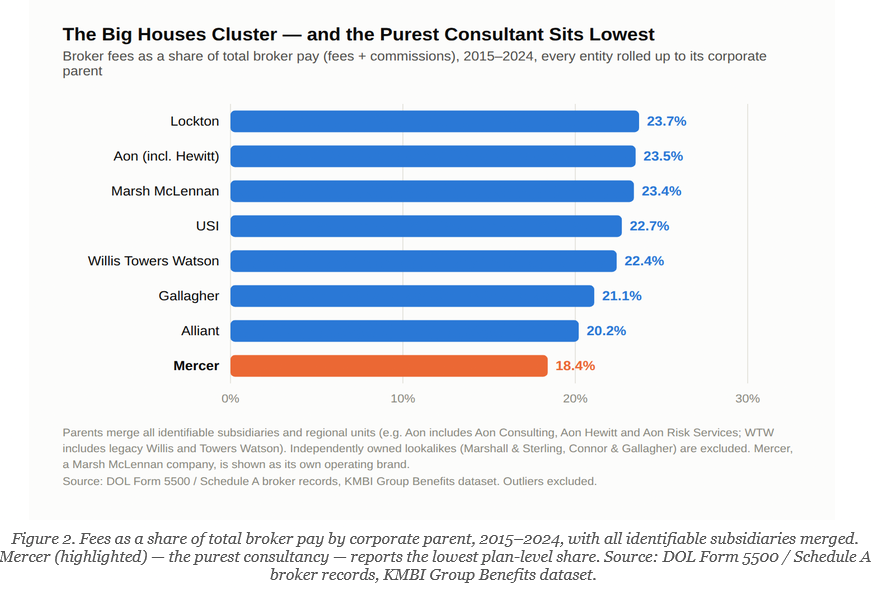
In the raw filings a single parent fragments into hundreds of separate entity names: Aon files as Aon Consulting, Aon Insurance Agency, Aon Hewitt and dozens of regional Aon Risk Services units; Willis Towers Watson is scattered across a similar sprawl of "Willis of [state]" and "Towers Watson" entities. Merge those fragments back to their corporate parents carefully, excluding acquired lines like Aon Hewitt that fold into Aon while keeping out independently owned lookalikes such as Marshall & Sterling and Connor & Gallagher, and the large houses cluster in a surprisingly narrow band.
Across the decade, Lockton is the most fee-weighted at 23.7 percent, with Aon (including Hewitt) at 23.5 percent and Marsh McLennan at 23.4 percent just behind, then USI at 22.7 percent and Willis Towers Watson at 22.4 percent; Gallagher sits at 21.1 percent and Alliant at 20.2 percent.
The real surprise is Mercer, the purest benefits consultancy of the group, whose 18.4 percent is the lowest of any major house named here. That inversion is a clue rather than a contradiction: the most advisory firms bill much of their counsel directly to employers, outside the plan and off Schedule A, so the plan-reported numbers understate exactly the firms you would expect to lead. The lesson is not that one firm type has flipped and another has not; it is that the fee shift is broad, and that the visible figures are a floor.
The conflict-of-interest dimension that sits beneath these firm-level figures is coming under sharper scrutiny.
The Employee Retirement Income Security Act (ERISA) and the Consolidated Appropriations Act (CAA) of 2021 require brokers working with ERISA-covered health plans to disclose all direct and indirect compensation, including overrides and volume-based payments.
The Department of Labor's guidance is unambiguous: failure to disclose is a prohibited transaction. The voluntary benefits lawsuits that emerged in December 2025 sharpened that reality further, naming brokers with allegations of undisclosed conflicts of interest and compensation structures that effectively transferred consulting fees onto employees without their knowledge. "If anything," Carbah observes of large incumbents, "there is a good chance that they're more ingrained in the system."
That broad shift is unfolding inside a consolidating industry. The number of distinct broker names appearing on these filings fell steadily every year, from 73,046 in 2015 to 52,766 in 2024, a 27.8 percent decline, consistent with the well-documented wave of brokerage mergers. Fewer, larger firms now dominate the market: the scale that lets an adviser charge for counsel, rather than only earn on placement, sits with them.
The consolidation wave is accelerating. Inszone Insurance Services, BroadStreet Partners, and World Insurance Associates together accounted for 19.4 percent of 753 announced US broker M&A transactions in 2025.
Employee benefits agencies with revenues of $1 million or more are the highest-multiple insurance category in 2026, trading at 9-12x EBITDA, according to CT Acquisitions. Group health books command these premiums because renewal retention typically runs at 92-96 percent, and commission revenue remains durable across renewal cycles, which is precisely what private equity-backed consolidators are underwriting.
The overall US insurance brokerage for employee benefits market was valued at $34.74 billion in 2022, according to Allied Market Research, and is projected to reach $70.11 billion by 2032, a compound annual growth rate of approximately 7.5 percent. That trajectory, combined with premium acquisition prices, is accelerating exits by independent specialists who might otherwise have stayed independent, concentrating both the commission base and the fee-transition capability in fewer, larger hands.
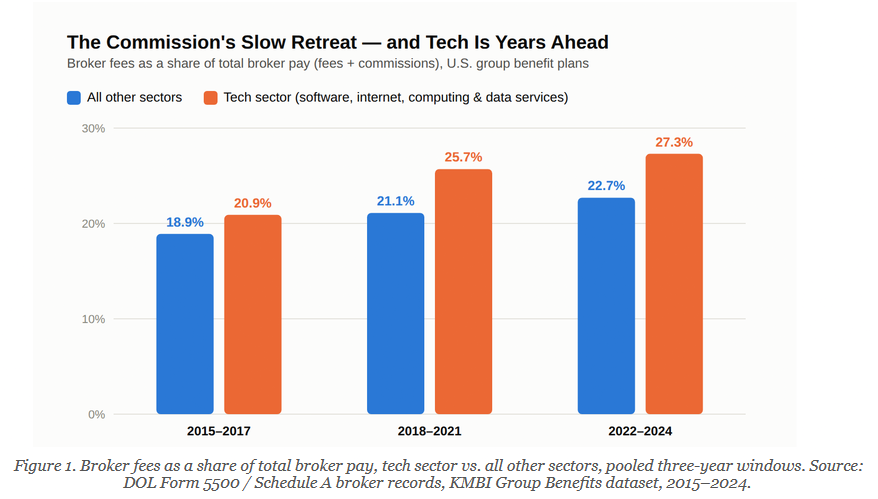
To see where the whole market is heading, look at the sectors already there. Employers in the technology economy — software publishers, computer-systems design, data processing and hosting, and internet services — pay their brokers on a markedly more fee-heavy basis than the rest of the market, and they got there first. Pooling the data into three-year windows to steady the smaller tech sample, fees ran 20.9 percent of tech-sector broker pay in 2015-2017, 25.7 percent in 2018-2021, and 27.3 percent in 2022-2024.
The broad market trailed the whole way: 18.9 percent, then 21.1 percent, then 22.7 percent. Tech led in every window, and the gap widened rather than closed, moving from about two points in 2015-2017 to four or five points since. A count-based measure tells the same story from a different angle: 18.3 percent of tech-sector broker relationships are now fee-only, versus 14.4 percent across other sectors.
The lag is what matters. The fee share the broad market reached only in 2022-2024, tech had already passed years earlier, and tech has since moved on to a level (27.3 percent) the rest of the market will not reach for years at its current half-point-a-year pace. Tech is not an outlier; it is a preview. These are sophisticated, largely self-funded employers who treat benefits as a managed cost center and are comfortable paying for advice as advice, not buried in the price of a product.
That buyer mindset, driven by rising healthcare costs and a growing recognition that commission-embedded compensation creates structural misalignments, was something the tech sector adopted years before the rest of the market caught on.
As Kelly frames it, the broker's financial stewardship mandate has never been more urgent: in a market where pharmacy costs outpaced medical trends and plan sponsors face year-on-year premium increases of 6 to 9 percent, the adviser who can demonstrate savings with a fee on a separate line item is making an argument that a commission-only structure cannot credibly replicate.
Carbah captures the direction of travel: "We're now starting to see more and more brokerages take this framework and make it their own. A rising tide will lift all boats." Her practical advice to any employer not yet working with a fee-based consultant is direct: "Ask them to go fee-based. Ask them to take a fiduciary standard of care and see what happens. The worst they can say is no."
As that buyer mindset spreads, and the consolidating advisory firms have every incentive to spread it, the rest of the market drifts toward the template tech already set.
Three honest caveats. First, these figures almost certainly understate the true shift. Schedule A captures compensation reported through the plan; the purest consulting retainers, billed directly to an employer's finance department outside the plan, may never appear here at all. The real fee-based share of what employers pay for benefits advice is likely higher than 23 percent. This is the visible floor, not the ceiling.
Second, the technology sector is a smaller slice of filings (roughly 3,400 plans a year), so single years are noisy; that is why the tech figures here are pooled into multi-year windows and cross-checked against a separate, count-based measure that shows the same lead.
Third, the firm-level figures required careful merging: in the raw filings each broker parent is split into hundreds of regional and subsidiary names, so every firm number here is rolled up to the corporate parent: all Aon and Hewitt entities as Aon, all Willis and Towers Watson entities as WTW, and so on. Independently owned firms with similar names (Marshall & Sterling, Connor & Gallagher) were deliberately excluded, and a handful of ambiguously labeled entities were left unmerged, so the most acquisition-heavy firms' figures are best read as close approximations.
The market-wide, relationship-structure and sector figures do not depend on any of this, because they aggregate every dollar and every engagement regardless of name; only the firm comparison does, which is why it is reported at the parent level.
None of this means the commission is about to vanish. It still accounts for more than three-quarters of broker pay, and in a market where premiums keep rising, it will keep generating more dollars for years. But share is destiny, and the share is moving in one direction across every robust cut of the data: the market-wide mix, the structure of how brokers are paid, and, out ahead of all of it, the technology sector.
The practitioners already on the other side of that line are clear-eyed about what drove them there and where the rest of the market is heading. ERISA disclosure requirements, the CAA of 2021, and litigation pressure that emerged in late 2025 are together creating accountability structures that make the commission model harder to justify on its own terms.
The employer cost crisis is creating clients who want proof of value, not just competitive quotes. And the consolidation wave is concentrating both the resources to build fee-based advisory practices and the incentives to do so at scale.
The commission is not being killed. It is quietly being retired, a point at a time, and the technology sector has already shown the industry what the far end of that process looks like.
Source: US Department of Labor Form 5500 and Schedule A broker records, 2015-2024, KMBI Group Benefits dataset (GB_Hist_Broker joined to plan-level sponsor industry codes). Statistical outliers and a small number of negative-value records are excluded. Fee-share figures are dollar-weighted; relationship-structure figures are counts of distinct broker-plan engagements; firm figures are rolled up to corporate parent. IBB interview sources: Talia Carbah (Ethos Benefits), August 25, 2026; Rick Kelly (Marsh McLennan Agency), September 10, 2026; Additional data: Lockton 2026 National Benefits Survey; CT Acquisitions; Allied Market Research.