Commercial insurance buyers have had a better year than they're used to. Average commercial P&C premiums fell 1.2% in the first quarter of 2026, the first overall decrease since the third quarter of 2017, according to IMA Financial Group. General liability, umbrella and commercial auto kept rising, though, and so did a small specialty line that grew out of those same casualty pressures: active assailant insurance.
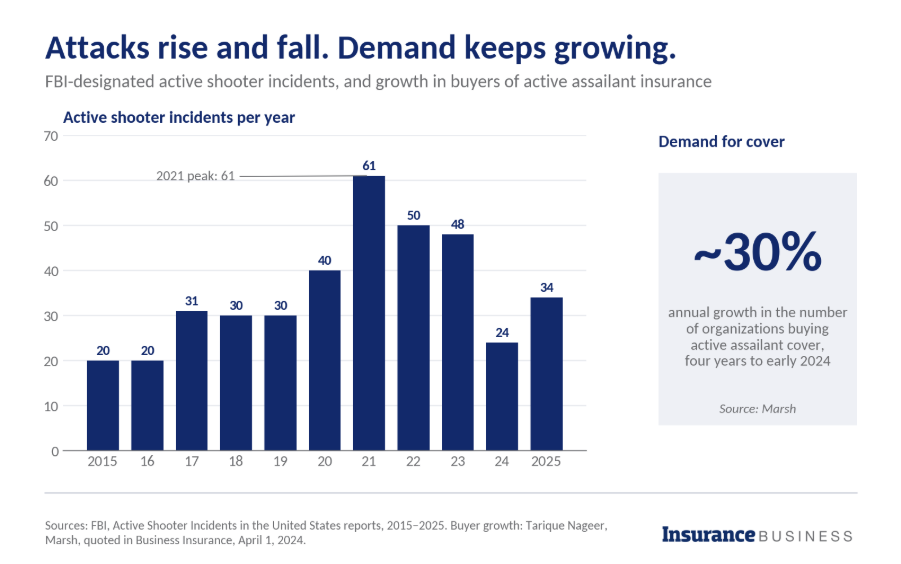
The line is still small, but it is growing fast. Tarique Nageer, terrorism placement advisory leader at Marsh said in an interview that the number of organizations buying the cover had risen about 30% a year over the previous four years. In the same report, Beazley underwriter Justin Peterson named education, hospitality, health care, commercial and residential real estate, retail and nonprofits as the sectors showing the most interest.
Estimates of the market's size vary with how it is defined. Specialist broker New Dawn Risk puts global active assailant premium at $1.35 billion in 2024. It projects that figure will grow 17.6% a year, reaching $5.25 billion by 2033. That is a projection, and it counts more than US standalone policies.
FBI figures show how uneven the threat itself has been. The bureau designated 61 active shooter incidents in 2021, 24 in 2024 and 34 in 2025, and the 2025 figure remains below the five-year average of 43, according to the FBI's latest report. Buyers kept arriving through the rise, the fall and the rebound.
The more consistent driver is the cost of being found liable. Underwriters still cite the October 2017 festival shooting in Las Vegas. Two years later, MGM Resorts agreed to a settlement expected to total between $735 million and $800 million, funded by its insurers with a minimum of $735 million. The pressures behind social inflation and nuclear verdicts apply here as well, including negligent security claims and plaintiff-friendly venues.
Primary carriers are responding by narrowing the base policy. ISO's latest general liability filing, with a proposed effective date of January 1, 2026, added new assault and battery exclusions.The exposure falls heavily on commercial clients. Businesses were the most common location in the FBI's 2025 data, accounting for 41% of incidents.
Read next: Rising tensions, rising premiums: Political violence insurance demand surges
Some risk managers assume their terrorism policy would pick up a shooting. Terrorism wordings are mostly written around physical damage, however, and some require a link to a political motive. A lone attacker who does little damage to property may fall outside both conditions.
Terrorism is still a large market in its own right. Insurers collected an estimated $68.3 billion in terrorism premiums from 2003 through 2023, according to Treasury figures cited by the Congressional Research Service. The federal backstop behind that market expires on December 31, 2027, the GAO notes, so Congress will have to take up reauthorization next year.
Utah shows how the gap can affect a public entity. Charlie Kirk was shot and killed on September 10, 2025, while speaking at Utah Valley University. The state carried terrorism cover at the time and later added a dedicated active assailant program, the Financial Times reported.
In a notice of claim dated September 9, 2026, Kirk's family alleged wrongful death against the university, the state and campus security leadership. A notice of claim is the formal step that comes before a lawsuit in Utah. Suits typically follow about 90 days later.
Read next: Political violence risk grows as polarization deepens – Willis
Capacity is modest by the standards of mainstream commercial lines. In 2024, Beazley offered up to $10 million of US capacity and could access up to $30 million through Lloyd's At the time, he put renewal increases in the mid-to-high single digits, similar to the standalone terrorism market.
Mark Skinner, chief underwriting officer at Samphire Risk, told IB last November that active assailant and kidnap risks are now board-level concerns and part of routine corporate planning.
The wider political violence market is under strain too. Allianz Commercial's 2026 research found that armed conflict had displaced civil unrest as the top political violence concern, cited by 53% of respondents, as political violence hit a record high on the Allianz Risk Barometer.
Read next: 'Preventative' mass shooting insurance product launched
Early active assailant policies mostly paid for the aftermath: victim benefits, counseling, funeral costs and lost income, as described in IB's guide to what active shooter policies typically cover. Insurers now put more emphasis on services before any attack.
For brokers, the work starts at renewal. Check general liability forms for new or broader assault and battery exclusions, and ask whether a client's terrorism wording would respond to an attack with no clear motive and little physical damage. Clients with crowds, public-facing premises or a political profile need that conversation first, and the November midterms add to the urgency for campaign-related clients.
Strong said active assailant cover has the highest retention of any product in Aspen's crisis book. Once clients buy it, they tend to keep it.
Read next: Why active assailant coverage is no longer optional for UK businesses