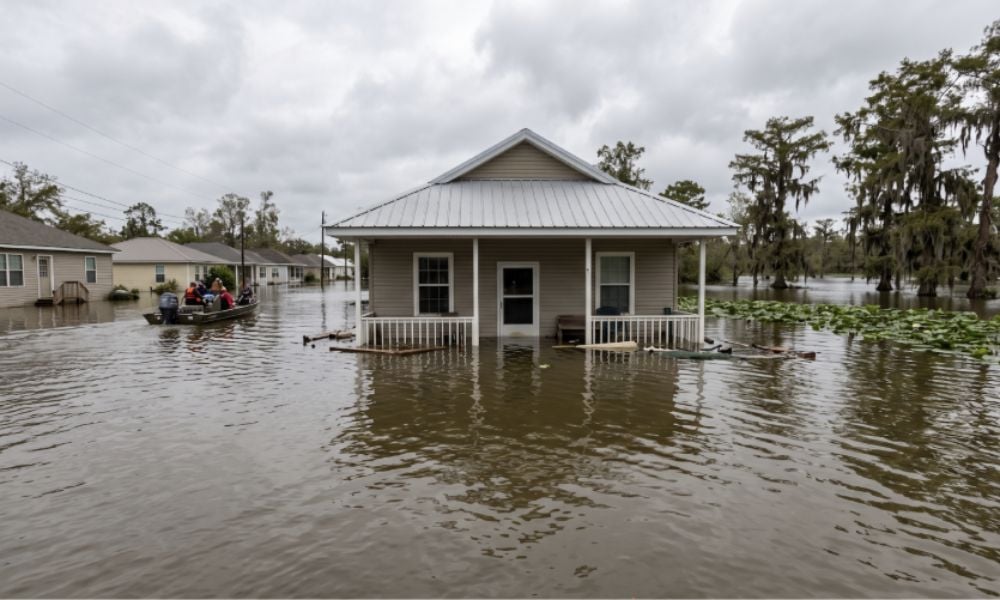
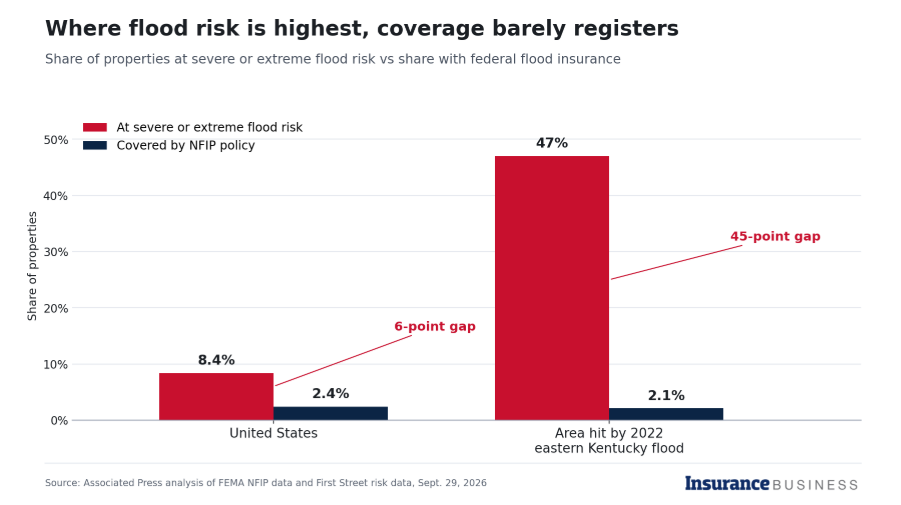
At the present moment, with factoring in a predicted super El Nini, roughly one in 12 US properties faces severe or extreme flood risk. Fewer than one in 40 has a federal flood insurance policy.
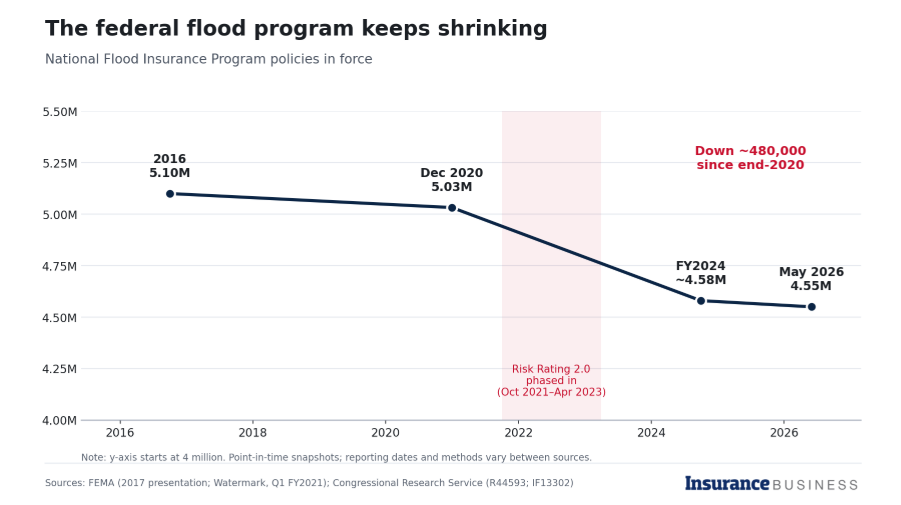
That mismatch comes from an Associated Press analysis published yesterday. The study combined National Flood Insurance Program data with property-level risk modeling from First Street. It counted roughly 4.5 million NFIP policies, covering 2.4% of US properties, while 8.4% fall into the severe or extreme risk tiers. That number of policies has been steadily falling, and has dropped by about half a million in five years.
For agents and brokers, the findings confirm what many already see with clients. The flood protection gap is widening even as private capacity grows and Washington talks about reform.
“Flood events are becoming more frequent and more widespread across the United States,” explains Carson Post, national underwriting director, flood at ICW Specialty. “And at the same time, flood risk has become more complex, with both pluvial and fluvial flooding occurring more often. The severity of these events, along with the time required for communities and businesses to recover, has also risen.”
Nowhere is the gap starker than in eastern Kentucky. In July 2022, upwards of 12 inches of rain drenched the region, pouring off steep hillsides into tight hollows. The flooding killed more than 40 people, and about 600 had to be rescued by helicopter.
In the area that flooded, only approximately 2.1% of properties had flood insurance, and the AP found that share has barely moved since. Nearly half of properties there face severe or extreme risk. That is a 45-point spread, more than seven times the national gap.
Neptune Flood's analysis of the same disaster found that a whopping 95% of damaged homes had no flood insurance. It also found that NFIP policies in Kentucky, Tennessee and West Virginia actuallyfell 17% between 2021 and 2024.
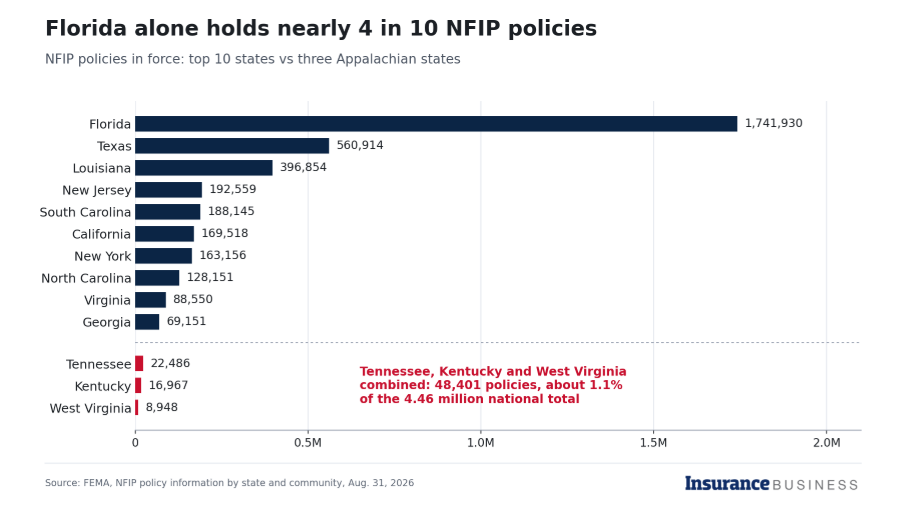
In practice, the NFIP is a coastal program. FEMA's latest state-by-state policy data, as of Aug. 31, shows that Florida alone accounts for about 39% of the program's 4.46 million policies. Adding Texas and Louisiana brings the top three states to about 61%. Kentucky, Tennessee and West Virginia together hold 48,401 policies, about 1.1% of the total.
Many Kentucky homeowners never knew they were exposed. Fewer than one in five structures damaged in 2022 were in a FEMA-designated high-risk zone. That means most owners were never required to buy coverage, even those with federally backed mortgages.
“The biggest mistake people make is assuming that if [their] business isn’t in one of FEMA’s high-hazard zones then [their] risk of flooding is minimal, and that [they], therefore don’t need to purchase any flood coverage,” Post told Insurance Business. “Or, if they do purchase coverage, they don’t buy nearly enough to protect their business.”
Jeremy Porter, First Street's chief economist, told the AP that the largest coverage gaps are where heavy rain causes flooding far from major rivers or coastlines. He named Appalachia, the Midwest and the Northeast. FEMA's flood maps are often out of date, and they don't capture that kind of rain-driven inland flooding well.
Private carriers have been pressing the same point. Neptune CEO Trevor Burgess told Insurance Business in May that "modern flood modelling identifies far more properties at risk than FEMA currently recognizes." Neptune's research found that 45% of NFIP claims come from outside mapped floodplains.
Read next: Only about 4% of US homeowners have flood insurance - despite billions in annual losses
The other force pushing people out is price, a typical NFIP policy now costs about $1,100 a year, up roughly 90% over five years.
Much of that increase comes from Risk Rating 2.0, FEMA's property-level pricing method. It applied to new policies from October 2021 and to renewals from April 2022, and it was fully in place by April 2023. Its goal was to make each premium reflect the actual risk of the property.
Many underwriters would call that a sound principle, but for a large share of homeowners it meant much higher bills. Federal auditors found that Gulf Coast policies had been priced well below their true risk before the overhaul. Annual increases for existing policies are capped at around 18%, so many policyholders are still working toward their full-risk rate. The GAO does not expect the phase-in to finish until 2037.
Researchers have measured how many people the increases drove away. A peer-reviewed study in the Journal of Catastrophe Risk and Resilience found that Risk Rating 2.0 cut new NFIP policies by 11% to 39% and existing policies by 5% to 13%. The bigger a property's premium increase, the larger the drop.
Costs are highest in the places with the least coverage. By FEMA's August figures, West Virginia has the highest average annual NFIP cost of any state, at about $2,280 per policy including fees and surcharges. Kentucky ranks sixth at about $1,825, and Tennessee ninth. Florida, which has by far the most policies, averages about $1,177.
Sen. Bill Cassidy, the Louisiana Republican, has criticized administrations of both parties for keeping the new rating system while his state's homeowners absorb the price increases.
When coverage is in place, it can decide how a family recovers. A household in Letcher, Kentucky escaped the 2022 flood and had an NFIP policy. The claim paid off the rest of their home loan, so they could move to a nearby town free of debt.
The program was set to lapse at midnight on Sept. 30. Instead, Congress acted in early September, attaching an NFIP extension to a stopgap spending law that runs through Dec. 11. The Congressional Research Service counts it as the 36th short-term reauthorization since fiscal 2017. The industry remembers last fall, when a 43-day lapse froze new policies and renewals and delayed home closings.
Longer-term fixes are stuck. Reform proposals have stalled, including options to make coverage cheaper for lower-income households. "Everybody agrees it's broken, but no one can agree how to fix it," Jeffrey Schlegelmilch, faculty director of Columbia University's National Center for Disaster Preparedness, told the AP.
In May, a White House-ordered review concluded that the NFIP, which owes the Treasury more than $20 billion, is flawed at its core. The FEMA Review Council recommended gradually moving policies to private insurers through a voluntary take-out program.
A CRS review of those recommendations noted a common criticism in public comments. The report said nothing about premium rates, program funding, or how to get more homes insured.
Some proposals in Congress would make it easier for policyholders to move between the NFIP and private carriers. The bipartisan Continuous Coverage for Flood Insurance Act would direct FEMA to treat compliant private policies as continuous coverage. Under current rules, a policyholder who switches to a private carrier can lose NFIP discounts if they later return to the program.
FEMA says the answer lies in tougher construction standards, better land-use decisions and a healthy private market, not in Washington carrying the whole burden. The agency says affordability is ultimately a question for lawmakers.
FEMA is also developing a replacement for today's flood zones, an initiative known as Future of Flood Risk Data. It hasn't said when that will be ready.
Read next: Trump council approves FEMA overhaul, eyes private flood market
The private market is growing but remains small. As of May, private carriers wrote about 643,000 flood policies, compared with about 4.55 million in the NFIP, according to CRS. Neptune estimates that more than 15 million flood-exposed US properties have no flood coverage at all.
At Hiscox, flood specialists say capacity isn't the problem; the harder task is persuading customers to buy. That is especially true where incomes are low and nothing requires the purchase. In eastern Kentucky, a nonprofit report found that a majority of households in flood-damaged homes had annual incomes below $30,000.
Read next: Private flood capacity is growing – so why aren't more customers buying?
Uninsured owners have little to fall back on. FEMA disaster aid is only available after a presidential declaration. Its two largest individual assistance programs, one for housing and one for other needs, are each capped at a little over $40,000, adjusted every year for inflation. Few applicants receive the maximum.
Repeat disasters bring another catch. An owner in a flood zone who receives aid once and then stays uninsured generally won't get aid the next time.
After the 2022 Kentucky floods, FEMA paid close to $90 million in direct assistance. That was about a fifth of even the lowest estimate of rebuilding costs. Researchers at the Ohio River Valley Institute, including senior researcher Eric Dixon, saw a steady exodus. Families moved in with relatives, resettled elsewhere in eastern Kentucky, or left Appalachia altogether.