Allstate Insurance has asked California regulators for permission to start writing new homeowners policies again, ending a freeze that has locked homeowners out of one of the state's biggest carriers since November 2022.
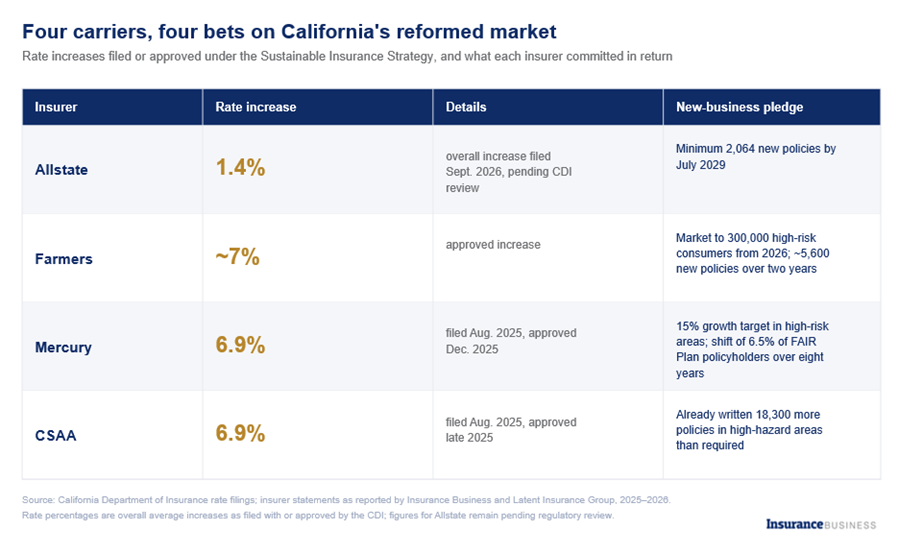
The insurer's rate application, submitted to the California Department of Insurance on Monday, ties a return to new business to approval of an overall 1.4% rate increase spanning both new and existing homeowners customers. According to the filing, roughly two-thirds of policyholders would actually see their premiums fall. Close to 30% would face increases of up to 55%, and fewer than 4% would see rates rise between 55% and 185%. The department can still adjust those figures before signing off.
If regulators approve the request, Allstate would be obligated to write a minimum of 2,064 new home insurance policies by July 2029 — a modest 0.6% bump on its current California book of just under 350,000 homes. The company has not said whether it intends to exceed that floor. A spokesperson said Allstate is "working with the California Department of Insurance to create a plan that would expand homeowners insurance options" for residents of the state.
Read next: California's FAIR Plan carries growing load as insurers retreat beyond wildfire zones
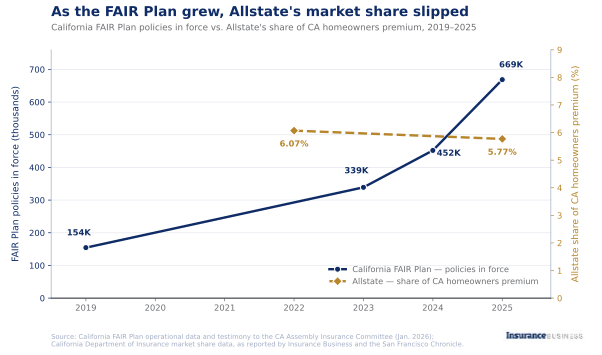
Allstate pulled back from new California homeowners business in late 2022, pointing to worsening wildfire losses, higher construction costs and steeper reinsurance pricing. Its market position has slipped since then: state data shows Allstate held 6.07% of California's homeowners premium in 2022, when it ranked sixth among carriers in the state, and had fallen to 5.77% and seventh place by last year.
The freeze didn't spare existing customers from rate action. In 2024, Allstate secured a roughly 34% average rate increase for its California book - the steepest single approved hike among the state's major insurers in recent memory, affecting more than 350,000 policies. That increase, layered on top of the new-business pause, made Allstate a frequent example cited by consumer advocates of carriers extracting higher rates while limiting the market's availability.
Allstate isn't the only major name still sitting out new business in the state. State Farm, California's largest home insurer, has not accepted new homeowners applications since 2023, despite its own sizable rate increases.
Allstate's about-face traces back to changes pushed through under Insurance Commissioner Ricardo Lara's Sustainable Insurance Strategy, which took full effect at the start of last year. Before the reform, insurers were barred from pricing in the cost of their own reinsurance and had to set rates using only historical claims data rather than forward-looking risk models — a system insurers said didn't reflect the real, escalating cost of wildfire exposure. Consumer groups countered that the old method was at least transparent and auditable.
The new framework lets carriers fold reinsurance costs into their rate filings and apply catastrophe modeling to estimate future wildfire losses. In return, insurers that use the new tools must direct new business toward ZIP codes the department has flagged as "distressed" — areas where coverage has been hardest to find. Allstate's Monday filing does exactly that, building in both catastrophe modeling and reinsurance costs while committing its minimum new-policy count to those higher-risk areas.
Allstate signaled it would eventually take this step nearly two years ago. At a 2024 department workshop, a company executive told regulators, "If the regulations were in effect today, we would begin selling new homeowner insurance policies tomorrow." The Monday filing is the first time that pledge has moved from testimony to paperwork.
Read next: Travelers to expand homeowners coverage in California
Allstate is not the first big carrier to trade a rate increase for a written commitment to expand availability under the Sustainable Insurance Strategy. Farmers Insurance, Mercury Insurance and CSAA have already filed for increases of their own alongside pledges to add coverage in wildfire-exposed ZIP codes, part of a broader push by the department to lure carriers back into voluntary-market territory rather than leaving homeowners dependent on the state's FAIR Plan.
Whether that trickle of new business meaningfully changes the picture for homeowners is still contested. Critics of the reform package note that the numbers being pledged by admitted carriers are tiny next to the growth of the FAIR Plan, the state-created insurer of last resort, which has added hundreds of thousands of policies since the crisis accelerated.
Read next: 'You cannot depopulate the FAIR Plan if it's cheaper'
The California Department of Insurance, however, is treating Allstate's filing as evidence its strategy is working. Lara framed the move as a turning point in a LinkedIn post Thursday, writing that "as a major national carrier and top market leader in our state, Allstate's return to active writing is a critical step toward opening up the market aggressively and restoring real availability and choice for Golden State homeowners."
For agents and brokers who have spent the past several years fielding non-renewals and referring clients to the FAIR Plan, Allstate's filing offers a data point worth watching rather than an immediate fix. The rate request still has to clear the department's review, and even in the best case, the required volume of new policies is small relative to California's overall insurance gap.
But alongside Farmers, Mercury, CSAA and Travelers, Allstate's move adds to a growing cohort of admitted carriers testing whether the state's new rate rules can actually coax capacity back into wildfire-exposed areas — rather than just raising the price of what's already on the books.
Read next: California's FAIR Plan files for largest rate hike in seven years
Rate and policy figures cited above are drawn from Allstate's September 2026 rate filing with the California Department of Insurance, as reported by the San Francisco Chronicle, and from California Department of Insurance market share data. Final rate terms remain subject to the department's review and approval.