Reinsurers heading into the January 1, 2027 renewals, where property catastrophe rates are expected to fall again, can test their main vendor model against alternative models more easily than they could two years ago.
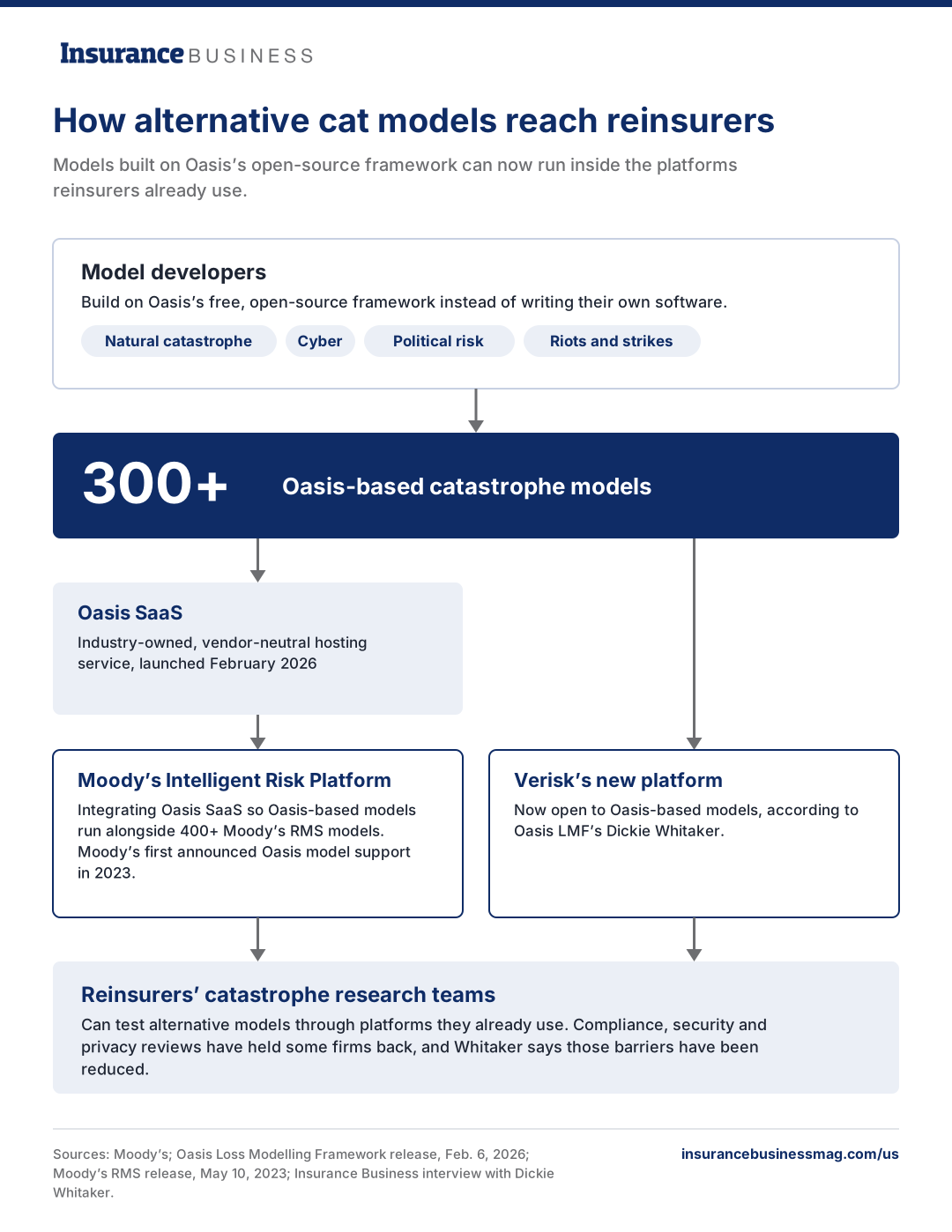
Dickie Whitaker, chief executive of London-based Oasis Loss Modelling Framework, credits Moody’s and Verisk, the two dominant model vendors. Over the past two years, both have opened their platforms to models built on Oasis’s open-source framework. A firm using either vendor can ask for an Oasis-based model and run it through Moody’s Intelligent Risk Platform (IRP) or Verisk’s new platform, he said. “Some of the barriers have been reduced because it’s easier to deploy these models,” Whitaker said.
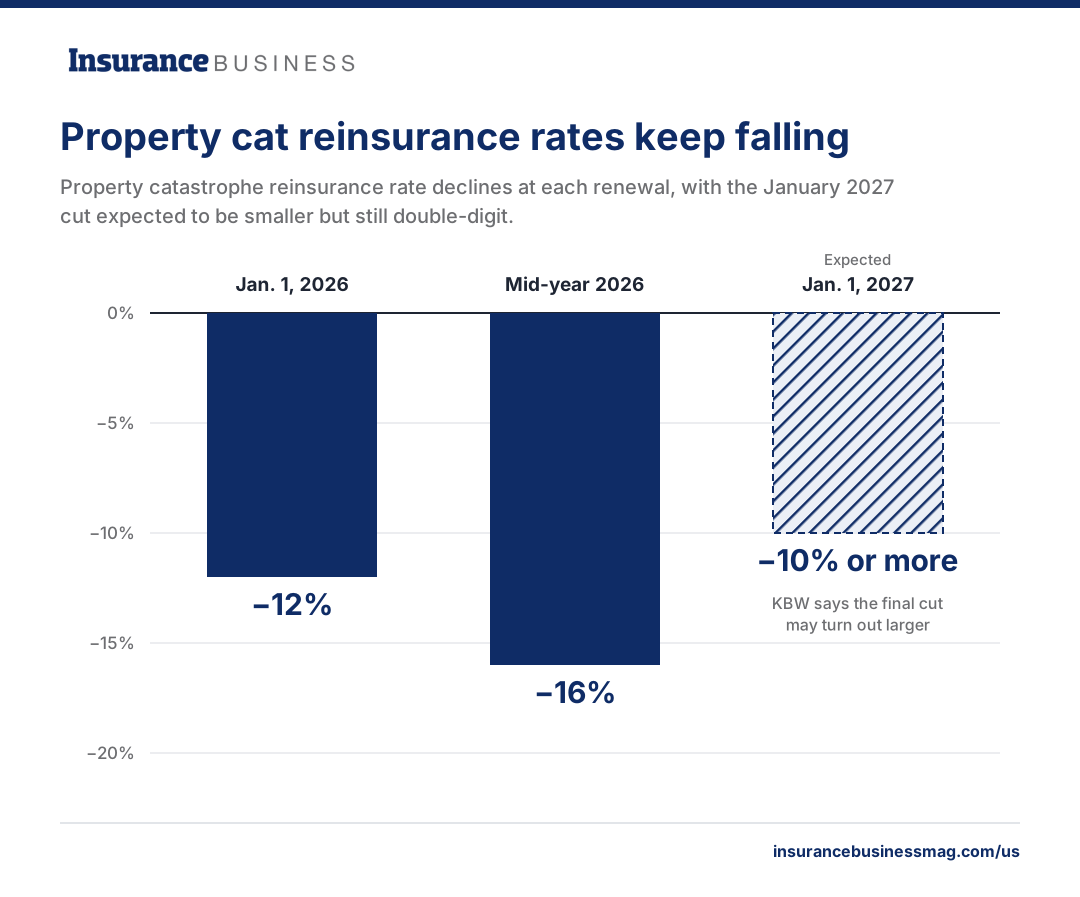
That easier access arrives as pricing softens. KBW, an insurance-focused investment bank, expects property catastrophe excess-of-loss reinsurance rates to fall at least 10% at the January 1, 2027 renewals. Excess-of-loss reinsurance is cover that pays once an insurer’s catastrophe losses pass a set threshold. KBW’s expected cut is smaller than those at the January 1 and June 1, 2026 renewals. KBW added that actual January pricing is usually worse than the expectations set at the Monte Carlo meetings each September. Catastrophe bonds are also adding to the competition.
AM Best reported that 144A property catastrophe bond issuance reached a first-half record of $17.3 billion in 2026. These are cat bonds sold to institutional investors under the US Rule 144A exemption.
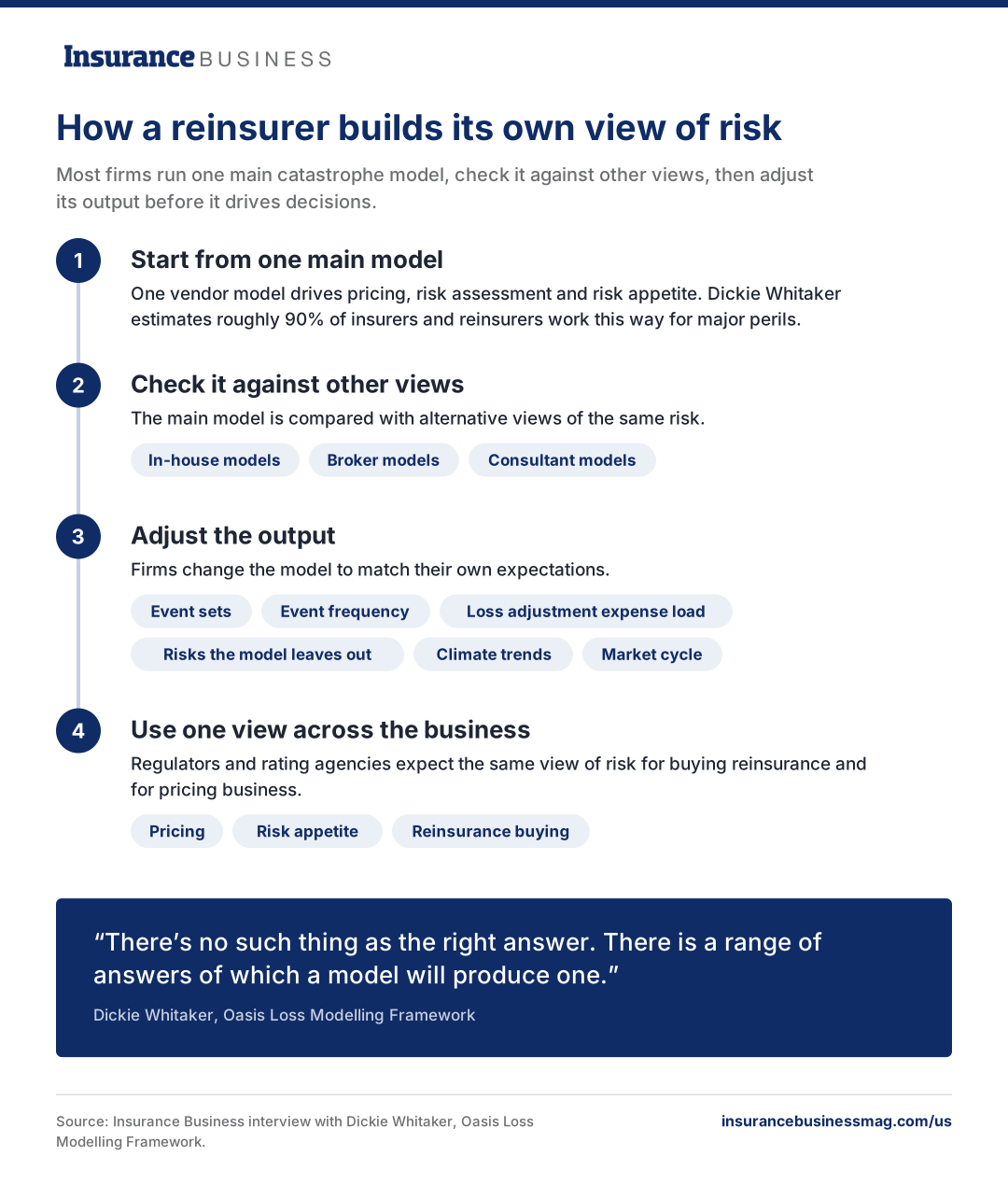
Asked where reinsurers look when weighing those cuts, Whitaker described a single main model that drives decisions, with other models used to check it. He estimated that roughly 90% of insurers and reinsurers run one main model for pricing, risk assessment and risk appetite. They then compare it against views they build themselves or obtain from brokers and consultants. That applies to major perils, he said; practice for minor perils may differ.
Regulators and rating agencies encourage that consistency. “What they don’t want is we buy reinsurance with one model and we price insurance with another model,” Whitaker said.
Reinsurers then adjust the main model’s output to reach their own view of risk. “There’s no such thing as the right answer. There is a range of answers of which a model will produce one,” Whitaker said. Firms change the event sets (the catalogue of simulated catastrophes a model runs) and the frequency of those events. They add loads for loss adjustment expenses, the cost of handling claims, and for risks the model leaves out. They also adjust for climate trends and the market cycle. “It’s a sophisticated tool and it should be used in a sophisticated way,” he said.
Inside most reinsurers, a head of research and a small team decide whether each model suits each use, Whitaker said. Team members are usually meteorologists or seismologists by training. He described two skills that team needs:
“The difference between the best firms in the space and the less good firms is their ability to do that, to make the right decisions at an underwriting level and at an exec level,” Whitaker said. Those teams also have to explain their choices to investors, regulators and rating agencies.
Oasis has been developing model evaluation standards to cut the time research teams spend extracting basic facts from each vendor. The standards set common questions so that model providers supply information in a consistent format, Whitaker said.
At the start of this year, Oasis’s board asked for more model choice, Whitaker said. Oasis is adding models for riots and strikes, political risk and cyber. It is also adding new natural catastrophe models, including one from a startup in Berkeley, California. Model developers can build on Oasis’s free platform instead of writing their own software, which standardizes how models plug in.
Getting any new technology into a large insurer or reinsurer is hard, Whitaker said. Compliance, security and privacy reviews take time and money, and that has held back some firms from licensing alternative models. Moody’s first announced plans to run Oasis-based models on its platform in 2023. In February 2026, Oasis launched Oasis SaaS, an industry-owned, vendor-neutral hosting service that Whitaker chairs.
Moody’s is integrating Oasis SaaS into its IRP, according to a release published by PreventionWeb. Reinsurance News reported Moody’s as saying the link gives users access to more than 300 Oasis-based models alongside more than 400 Moody’s RMS models in a single workflow.
Whitaker ranks interest in sophisticated modeling by buyer type:
Managing general agents form a separate group that often builds modeling into its underwriting. The more interested a buyer is, the more likely it is to look beyond the legacy vendors, he said.
US rules widen that split. Florida, and to a degree California, approve models for use in rate filings, Whitaker said. That anchors primary carriers to approved models, raises barriers for new model entrants, and rules out blending models in filings. Reinsurers still answer to regulators and rating agencies, but their scrutiny is different. Whitaker said that leaves reinsurers, like insurance-linked securities investors, freer to try different approaches.