The specialty insurance market is approaching a point where abundant capacity, soft pricing and deteriorating long-tail loss trends may no longer be able to coexist.
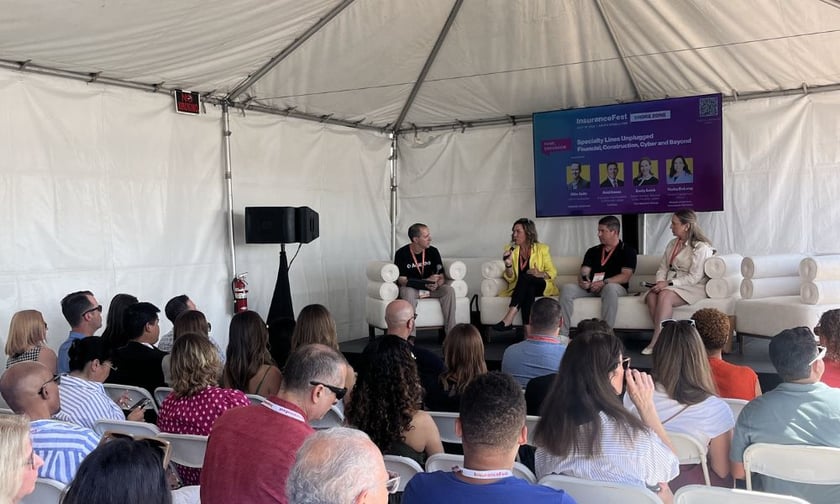
During a panel titled Specialty Lines Unplugged – Financial, Construction, Cyber and Beyond at InsuranceFest 2026, senior brokers and underwriters discussed both opportunities and challenges in the sector, which has been booming in recent years.
Yosha DeLong, global engagement officer at Mosaic Insurance, said current conditions were raising questions about how sustainably carriers could continue deploying capital.
“We’re at a very pivotal tipping point across the industry and across all lines,” she said. “We’re going to start to see one of those things pull back. Either pricing will increase or capacity will pull back.”
The panel, covering financial lines, cyber, construction and emerging technology risks, repeatedly returned to the need for specialty insurers to move beyond product silos and build programs around the way claims develop.
Reid Eanes, executive vice president and co-practice leader at Lockton, pointed to an autonomous trucking company as an example of how a single event could trigger multiple coverages, meaning placement required D&O, E&O, cyber and casualty policies to work together so a claim would not produce dispute.
“A failure of the technology can lead to both economic damage and bodily injury,” Eanes explained. “It can lead to securities or regulatory scrutiny of the board and its oversight of safety programs and the technology itself.”
According to DeLong, Mosaic has taken a similar approach with a digital-assets product combining cyber, technology E&O, crime and professional-liability coverage – “packaging it all together so there’s no finger-pointing when a claim comes in.”
“It’s about dovetailing and breaking down the traditional silos we’ve seen in the insurance industry in the past, and trying to find real solutions for clients across the board,” DeLong said.
At the same time, pricing across several specialty classes remains under pressure.
Emily Selck, senior director and national cyber practice leader at The Baldwin Group, lamented the state of the cyber market, arguing that the market could no longer justify inadequate pricing by claiming the product was still too immature. While she has noted some rate increases in small and middle-market cyber accounts, pricing still appeared disconnected from the risks.
“We’re well into adolescence and maybe even teetering into the teenage years of this product,” she said. “I’m definitely seeing rate (hardening), but even that still feels like, ‘Are you kidding me right now?’
“Maybe we need to think about specialty lines and how we can actively underwrite a risk in a way that is different from what our predecessors have done.”
Eanes argued that insurers were pricing according to available capital rather than underlying exposure. He pointed to D&O accident years from 2021 to 2023, where reserve adjustments and unresolved securities litigation could eventually force a correction.
He estimated an inflection point could arrive within 12 to 18 months, although he did not expect it during 2026.
Artificial intelligence is adding another layer of exposure in the specialty insurance space.
Selck said businesses were still struggling to define how they were using AI and what controls applied, particularly when confidential or personal data was involved. “I think we’re prepared as an industry to respond to this risk in a way that is meaningful and provides coverage, but we’re still a little bit in the dark about what it looks like,” she said.
Eanes, on the other hand, framed AI as a governance issue extending beyond technology departments.
“It’s a board-level issue, not simply a CTO or IT-team issue. Organizations need to make sure they have the strongest governance possible. However… organizations aren’t always sure how they’re using it,” he said.
“From an external perspective, we’re also trying to predict how AI will disrupt operations and industries as a whole. We’re helping clients look around the corner at how it affects them competitively and from a financial-margin perspective.”
The panel also identified data centers as a major underserved segment. Investment in hyperscale facilities had outpaced insurance product development and capacity, leaving the industry to insure projects worth tens of billions of dollars.
At the submission level, the panel stressed that narrative and transparency remained critical. DeLong emphasized that a strong submission should explain a client’s risk journey rather than rely only on binary application answers.
“Establishing those relationships and building trust in advance really helps,” she told brokers. “You can start to understand who the client is, who they are as an organization, what their concerns are and whether you can address them.”
Eanes warned brokers and clients should avoid becoming complacent during soft conditions.
“We’re preparing for clouds on the horizon,” he said. “They’re not here yet, but you don’t want to become so used to soft-market conditions that you fail to build the trust with underwriters and the marketplace that’s necessary to succeed in a hard market.”