For most of 2026, the insurance story coming out of the Middle East has been a maritime one: tankers idling outside the Strait of Hormuz, war risk premiums quoted in whole percentage points of hull value, and governments trying to backstop a marine market that had largely stepped back. This week, the runway has become part of the story.
Attacks on two Saudi Arabian airports have killed three people and injured dozens, the kingdom's General Authority of Civil Aviation (GACA) said today. One person died and eight were hurt at King Khalid International Airport in Riyadh. At Abha airport in the southwest, two were killed and 28 wounded. The authority said the strikes came on Tuesday and Wednesday but did not say which happened when, Reuters reported.
Those killed were a Sudanese man in Riyadh and two women, one Moroccan and one Algerian, in Abha, Bloomberg reported, citing GACA, which said both airports sustained some material damage. Yemen's Iran-aligned Houthis claimed both strikes.
The group also went after Aden's international airport on Wednesday with ballistic missiles and explosive-laden drones, according to Yemen's Transport Ministry. One missile came down near the runway minutes before a flight from Cairo was scheduled to arrive. Aden is the main international gateway for the parts of Yemen outside Houthi control.
The airport strikes are the latest turn in a Yemeni conflict that has been pulled back to life by the wider US-Iran war. Since early September, the Houthis have pushed south toward the Bab el-Mandeb, the narrow strait at the bottom of the Red Sea that has taken on outsized importance for energy shipments now that traffic through Hormuz is so heavily restricted.
This week, Yemeni government troops backed by Saudi-led coalition airpower launched a counteroffensive to retake ground near the strait and around the port town of Mocha, though it is not yet clear whether those gains will stick.
The human toll is mounting. A total of 201,217 people have been forced from their homes since the fighting began, according to figures released Wednesday by the International Organization for Migration. "People are running for their lives and finding nowhere safe to go," said Amy Pope, the agency's director general, who appealed for more funding for food and shelter.
The coalition said early Wednesday that it had shot down a Houthi ballistic missile north of Riyadh, and later said it had destroyed the launch platform, Bloomberg reported. Saudi Arabia, meanwhile, is lining up outside help: Turkey is sending mainly defensive and technical support, and Syria is weighing a Saudi request for military assistance, according to officials who spoke to Reuters.
Read next: Houthis declare Red Sea blockade - and insurers face a two-front crisis
None of this comes out of nowhere for aviation underwriters. The Houthis first hit Abha's airport on July 13, and their military spokesman used the moment to warn every airline away from Saudi airspace, Khaleej Times reported at the time. Saudi authorities shut Abha temporarily after that strike and at least eight airlines cancelled flights, aviation trade title Travel Extra reported, adding that Lufthansa Group had suspended its Riyadh and Dammam flights until October 24. A Houthi-run coordination body repeated its warning to airlines on Monday as the coalition's offensive got underway.
Regulators have started to respond. On September 30, the European Union Aviation Safety Agency issued Conflict Zone Information Bulletin CZIB-2026-09, advising operators not to fly at any altitude in a designated area of the Jeddah flight information region near the Yemeni border, and to take care in the rest of it. The bulletin runs until November 16. Saudi airspace itself has not been formally closed.
For the London market, the timing is awkward. Hull war rates reset sharply after Russia's invasion of Ukraine, when Western sanctions stranded hundreds of leased airliners in Russia, and insurers are still working through those claims. WTW's latest airline renewal outlook says hull war capacity remains plentiful but expects tougher negotiations through 2026. Law firm Kennedys has reported increases of 10% or more even for lower-risk carriers, and far steeper rises for airlines on Middle East routes, as detailed in coverage of how the Iran conflict is reshaping airline insurance pricing.
Gulf airports have taken direct hits before in this war. Iranian strikes damaged facilities in Dubai, Abu Dhabi, Bahrain and Kuwait in its opening days, and a later attack caused substantial damage to a Kuwait airport passenger terminal. What is new is a non-state group reaching the Saudi capital's main airport while also fighting a ground war on the kingdom's doorstep.
Read next: Iran conflict pressures global aviation insurance market
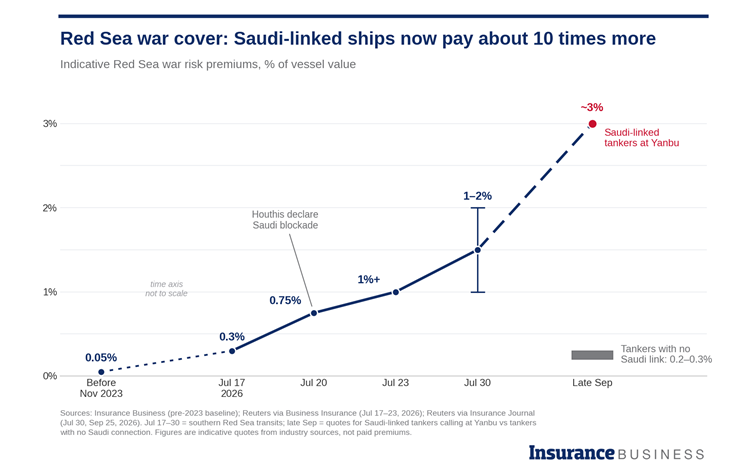
On the water, the repricing started months ago. When the Houthis declared a naval blockade of Saudi Arabia on July 20, indicative war risk premiums for southern Red Sea voyages more than doubled almost immediately, from about 0.3% of a ship's value to around 0.75%, and passed 1% within days after attacks on Saudi tankers, insurance sources told Reuters, as reported by Business Insurance.
On July 29, the Lloyd's Market Association's Joint War Committee moved the northern edge of its southern Red Sea listed area from latitude 18°N to 25.5°N in circular JWLA-034, bringing Jeddah and Yanbu inside the zone. By the end of July, quotes for those two ports had jumped to about 1%, Insurance Journal reported.
Since then, the market has split in two. By late September, quoted war risk premiums for Saudi-linked tankers calling at Yanbu had climbed to around 3% of a vessel's value, while tankers with no Saudi connection typically paid 0.2% to 0.3%, four industry sources told Reuters, as Insurance Journal reported. That works out to roughly $3 million for a single voyage from Yanbu. The jump followed the Houthis' capture of Perim Island, in the middle of the Bab el-Mandeb.
For perspective, the same Red Sea transit cost a nominal 0.05% of hull value before the Houthis began targeting ships in late 2023, a charge many underwriters simply waived, according to an earlier analysis of what the original Red Sea attacks meant for war insurance.
The stakes are higher this time because the Red Sea is doing work Hormuz no longer can. Saudi Arabia has leaned heavily on its East-West pipeline to Yanbu to keep crude moving, and the Bab el-Mandeb carries roughly 7% of the world's oil supply, The Hill reported. The Houthis say only Saudi-linked vessels are in their sights, and conflict monitor ACLED found that seven of 10 ships recently targeted were Saudi-flagged or Saudi-owned. But maritime security firm Ambrey has warned that the group has hit ships over outdated or mistaken affiliations before.
Read next: Washington's $40 billion Hormuz insurance fix: zero takers
The immediate questions are about wording and aggregation rather than headline rates. Airport operators and concessionaires will want to know whether their property and liability programs carve out war and terrorism, and whether any stand-alone political violence cover responds to a drone or missile strike claimed by a non-state group. Airlines with Saudi exposure face a tougher conversation.
Aviation war insurers can give seven days' notice to cancel cover or change terms during a major conflict, although WTW says that during the Iran war so far, carriers have leaned on additional premiums rather than geographic exclusions to keep cover in place.
Cargo and supply chain clients have their own exposure. Goods held at damaged airports, delayed shipments and contingent business interruption claims all sit in different policies, often with different war exclusions. The marine market has shown it can rebuild capacity quickly, as with the Lloyd's and Chubb consortium for Hormuz war risk, but that capacity comes with selective underwriting and pricing tied to real-time intelligence.
In aviation war, the issue for now is price and terms rather than a shortage of capacity. With airspace warnings in force, a ground war near the Bab el-Mandeb and missiles now reaching the Saudi capital, underwriters are likely to price Saudi aviation risk on a much shorter fuse than they did a month ago.
Read next: Larak Island strikes add pressure to an already stressed war-risk market