The NFL's insurers have spent 14 years in court arguing over who should pay for the league's head-injury bill. This week they got a fresh reason to dread the answer.
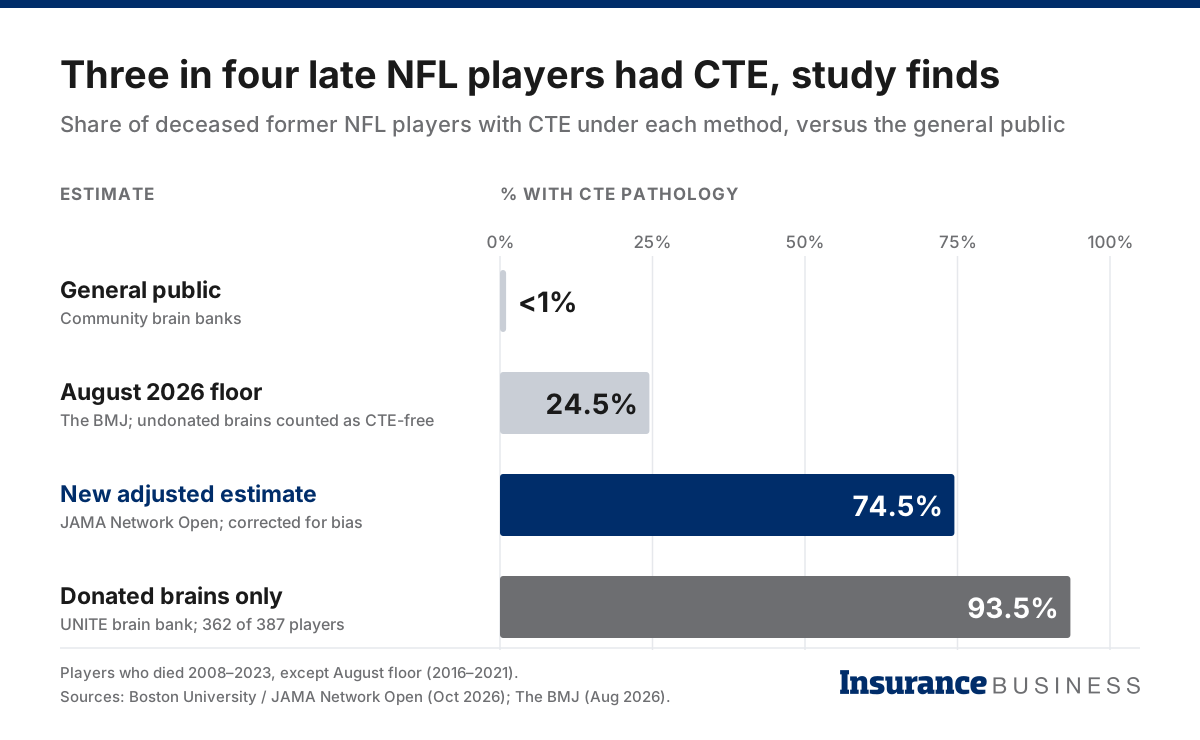
In a paper published October 28 in JAMA Network Open, researchers estimated that 74.5% of the 2,362 former NFL players who died between 2008 and 2023 had the tell-tale brain changes of chronic traumatic encephalopathy, the degenerative condition linked to repeated blows to the head. Run the arithmetic and that is roughly 1,760 men.
Those are shocking numbers for the carriers still in the fight, and for the 32 clubs that ultimately stand behind the league. The estimate is three times the floor the same research group published in August, and it is the highest population-level figure yet. It also arrives just four weeks after a New York appeals court handed the NFL a largely favorable ruling against its remaining liability insurers, and at a time when underwriters writing contact-sport risk at every level, from pro leagues down to youth football, were already tightening terms.
The trouble with counting CTE has always been the samples. The disease can only be confirmed by examining brain tissue after death, and the brains that reach researchers tend to come from families who already suspected something was wrong. That makes brain-bank figures look scarier than reality, perhaps by a lot.
Of the 387 former players examined through the UNITE brain bank, 362, or 93.5%, had CTE, according to the Boston University release on the study. To correct for that skew, the team pulled death-certificate data from the CDC's National Death Index for every player who died in the 16-year window, then compared donors with non-donors on position, career length, age at death and recorded illness. Players with cognitive problems turned out to be about five times more likely to end up in the brain bank. Adjusting for that pulled the estimate down to 74.5%.
Even the corrected figure is a striking one. In community brain banks, which take donations from the general public, fewer than 1% of brains show CTE. The researchers also estimated that about 27% of the players studied had dementia.
"I had to double-check the numbers," Yorghos Tripodis, the study's senior author and a professor of biostatistics at Boston University School of Public Health, told NBC.
The new estimate also triples the same group's figure from August, when a study in The BMJ found CTE in at least 24.5% of the 878 former players who died between 2016 and 2021. That earlier number was deliberately a floor: it counted every brain that was never donated as disease-free. Our coverage of the August findings noted that even the conservative figure put fresh pressure on the league's carriers.
"Providing a precise estimate for the prevalence of CTE among deceased NFL players helps define the scale of the problem," said lead author Julia Gallini, a doctoral candidate at the school, in the university's statement.
Read next: Head injuries, asbestos and PFAS all meet in this trillion-dollar insurance niche
The research arrives four weeks after the most consequential ruling yet in the NFL's battle with its liability insurers, which the league started in 2012 when former players first sued over head injuries.
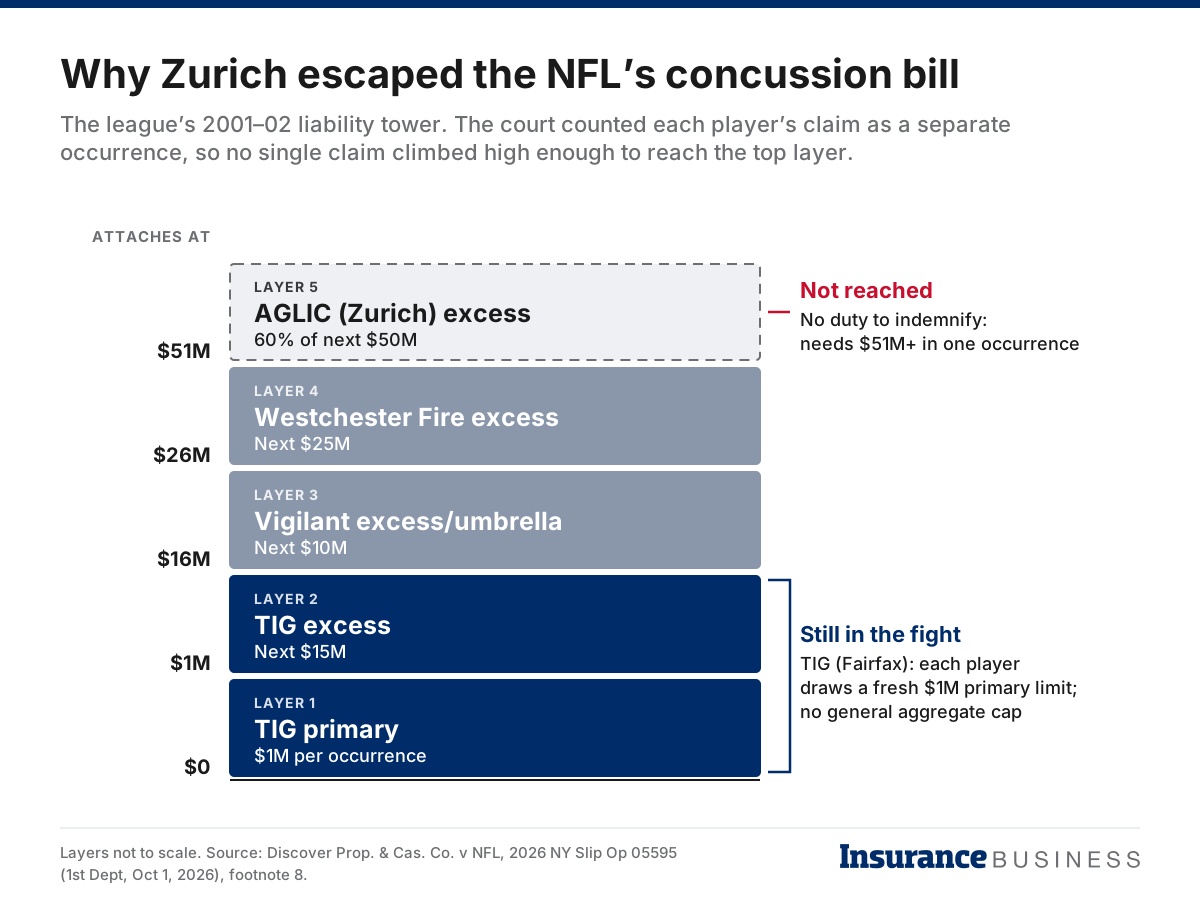
In Discover Property & Casualty Co. v National Football League, a unanimous First Department panel held that each former player's claim is at least one separate occurrence under the primary policies written by Fairfax Financial's TIG unit, along with North River and U.S. Fire. The court also found the league's class settlement reasonable and threw out TIG's argument that NFL football is a "product", which might have capped its exposure under a products aggregate. Zurich's American Guarantee and Liability unit, sitting in a fifth excess layer, walked away owing nothing because no single player's claim climbs that high.
One line in the opinion is worth flagging for anyone who writes long-tail casualty. The panel said the occurrence is the development of neurodegenerative disease itself, not the hits taken on the field. A credible estimate that three in four deceased players had that disease is exactly the kind of evidence that informs how often such occurrences happen.
The ruling carries a message for the clubs, too. TIG argued the league had suffered no loss because the settlement money came from its 32 member teams. The panel disagreed: because the NFL is an unincorporated association, a payment by its members counts as a payment by the insured, according to one New York lawyer's analysis of the decision. Put simply, the teams' balance sheets and the league's insurance program rise and fall together, and a league-wide disease estimate lands on both.
Not everything was settled. Whether TIG withheld consent to the deal in bad faith, and whether the league gave timely notice, go back to the trial court. A trial once pencilled in for October 13 was pushed back pending the appeal, and sports business reporter Daniel Kaplan wrote after the ruling that it is unclear whether one will happen at all.
The study does not reopen the class settlement. That uncapped, 65-year program pays for qualifying diagnoses such as ALS, Parkinson's, Alzheimer's and moderate or early dementia, but it only compensates "Death with CTE" when a player died, and was diagnosed, before April 22, 2015, as the Third Circuit has noted. The fund covers players who retired before July 7, 2014. As of October 19, it had approved 2,226 awards worth about $1.74 billion, according to figures compiled from the program's official statistics.
The bigger question for carriers sits outside that fund: players who retired after mid-2014, the roughly 1% who opted out, and the much larger pool of college, high school and youth players whose exposure is written on general liability, accident and participant policies. Tripodis has made the point that the disease tracks lifetime hits rather than a single pro career. "More than 20 million men alive today in the U.S. have played football," he told ABC News.
Read next: Concussion risks raise the stakes for sports organizations
Underwriters have not been waiting for a definitive number. The contact-sports corner of a sports insurance market now worth roughly $2 billion in premium has been repricing head trauma for years, and Amwins-affiliated underwriter SMIC has described three ways carriers tend to handle traumatic brain injury exposure: turn it down, write it with a sublimit or exclusion, or price it in full and live with the volatility.
The middle option is increasingly the default. North of the border, NFP's Sarah Hanson, who places coverage for Rugby Canada, said head-injury wordings vary widely and that carriers routinely carve out long-term neurological risk. "Specifically, neurodegenerative conditions can be excluded," she said.
In Australia, Zurich went further, stripping concussion, CTE and post-concussion syndrome from total and permanent disability cover for AFL players from May 2026 and citing continued uncertainty over the long-term scale of CTE risk.
That word, uncertainty, is the one this study goes after. Better data can push the market in two directions at once. It can justify harder terms for teams, schools and leagues that keep the exposure. Or it can give carriers enough confidence in the size of the risk to write it rather than walk away. For brokers, the practical upshot is the same either way: expect more questions about concussion protocols, return-to-play rules, waivers and claims history at renewal.
Read next: The $2 billion sports insurance market - and the risks reshaping it
The authors are careful about the limits. The 74.5% figure describes former players who died in one 16-year window, many of whom played long before today's concussion protocols and helmet designs. It says nothing definitive about living retirees or current rosters. It also counts any CTE pathology, including early changes that may never have produced symptoms; NBC noted that plenty of people with signs of the disease never develop them.
The development that could matter most for claims is the one researchers are chasing next: a way to diagnose CTE in living people. Australian law firm Barry Nilsson has warned insurers that CTE claims are likely to grow sharply if the condition becomes diagnosable before death. A claim that today can only crystallize after an autopsy could, in that world, arrive while the claimant is still in his 50s.
Tripodis suggested that day is closer than it was. "Discoveries from the brain bank have already brought us significantly closer to a diagnosis during life," he said in the university's statement.
The NFL, for its part, said in a statement that it "continuously strives to make the game of football safer," including through strategies to cut concussions and head impacts. For the carriers still on the hook, and the ones deciding whether to write the next generation of football risk, the debate has moved on from whether the hits matter. It is now about how much they cost, and who pays. On this week's numbers, that makes for grim reading.