
Californians choose a new insurance commissioner on Nov. 3, and whoever wins will take charge of a homeowners market that paid out far more than it took in last year. According to the National Association of Insurance Commissioners' 2025 market share reports, California's homeowners insurers incurred about $1.70 in direct losses for every dollar of premium they earned in 2025. Nationally, the figure was about 55 cents.
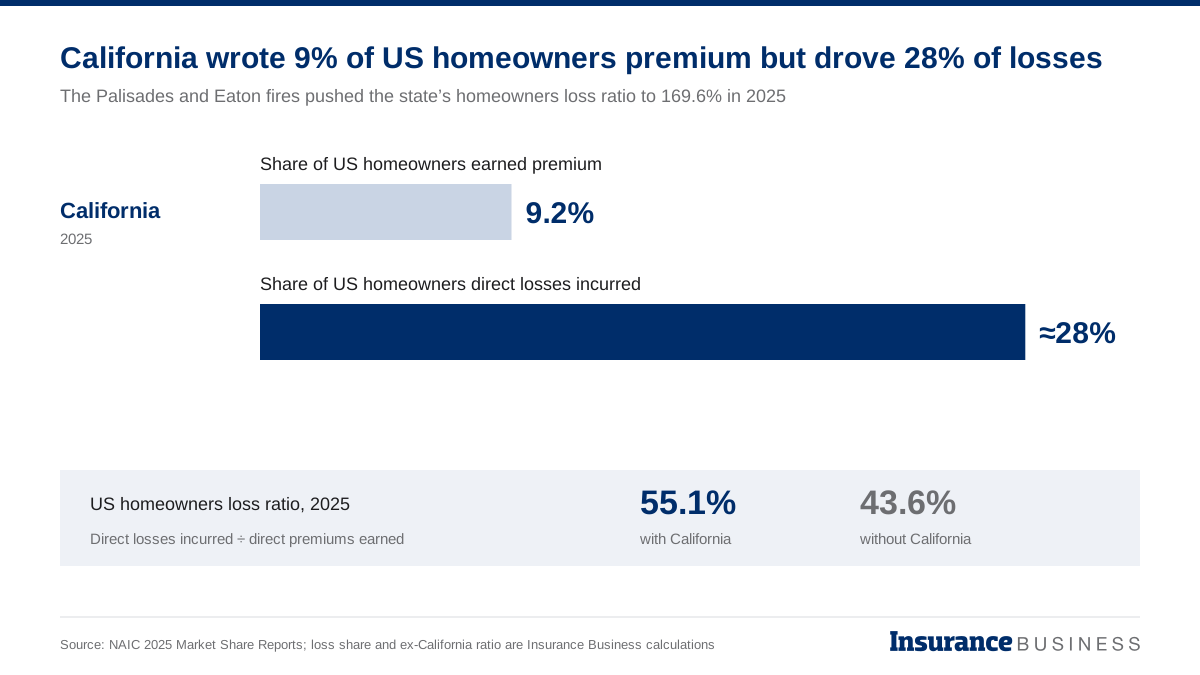
That gap is wide enough to seriously affect the national results. California produced 9.2% of US homeowners earned premium but, by Insurance Business's calculation, about 28% of the losses, roughly $28.2 billion on a loss ratio of 169.6%. Take the golden state out and the countrywide loss ratio drops from 55.1% to about 43.6%. Why would carriers even want to be there?
Most of that traces back to January 2025, when the Palisades and Eaton fires swept through Los Angeles County. By Nov. 17, insurers had paid $22.4 billion on 42,121 claims, according to the California Department of Insurance's wildfire claims tracker. That total also covers businesses, living expenses and vehicles, and includes the FAIR Plan and surplus lines writers, so it isn't a direct match for the NAIC homeowners line, though it gives a sense of scale. Industry groups pointed to the same figure when California wildfire claims passed $22 billion.
The two candidates to succeed term-limited Commissioner Ricardo Lara have drawn very different lessons from those losses, as Insurance Business detailed in its look at the commissioner race. State Sen. Ben Allen, whose district includes Pacific Palisades, would keep private insurers at the center of the market, with faster rate reviews, continued use of catastrophe models and reinsurance costs in pricing, and tougher claims oversight. Former San Francisco Supervisor Jane Kim would create a public, nonprofit insurer for natural disasters and tighten pricing and claims rules for private carriers. Both have promised harder enforcement on slow claims and closer oversight of the FAIR Plan.
That turns the 2025 numbers into more than a look back. They show how much carrier capital California consumed in one year, and they set the backdrop for the decisions the next commissioner will make on rate filings, on bringing carriers back and on the future of the FAIR Plan. Brokers will feel those decisions in what they can place and at what price.
California was the third-largest homeowners market in the country in 2025, with $17.73 billion of written premium behind Texas and Florida, and the damage fell unevenly across its biggest carriers.
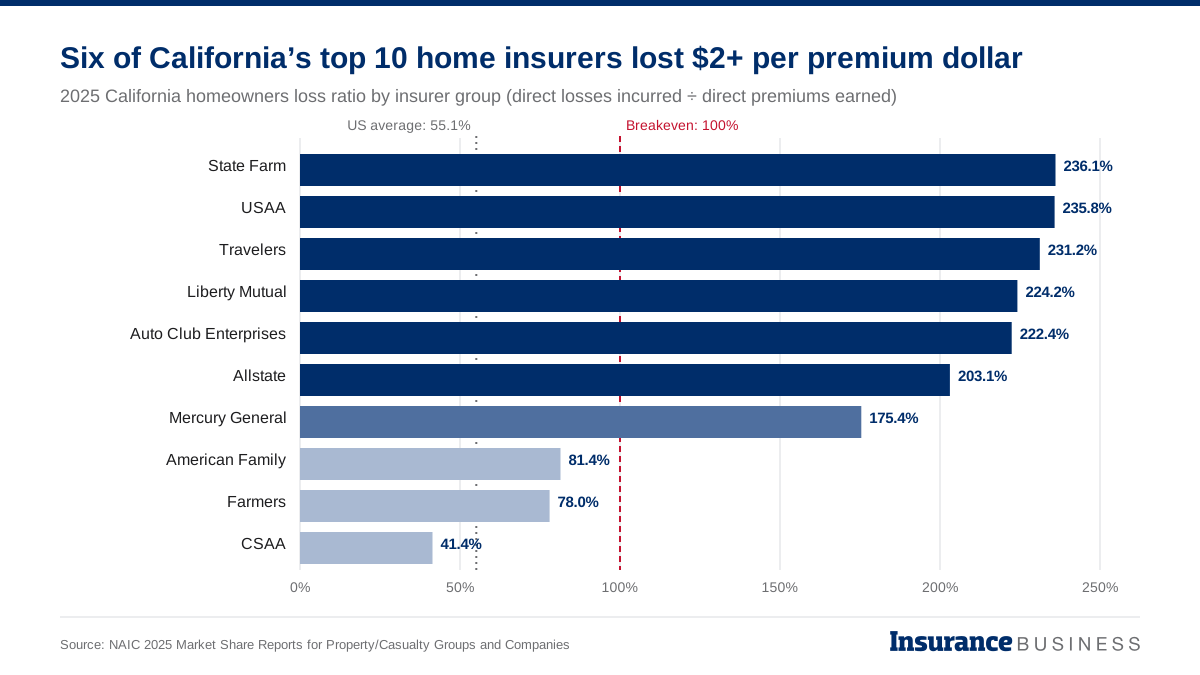
State Farm, the state's largest writer, incurred $2.36 in losses for each dollar of premium earned, a loss ratio of 236.1%. USAA, Travelers, Liberty Mutual, Auto Club Enterprises and Allstate were all above 200%, and Mercury General was at 175.4%. At the other end, Farmers, the No. 2 writer with 14.3% of the market, came in at 78.0%, with American Family at 81.4% and CSAA at 41.4%.
The NAIC tables don't explain the spread, though how much of each book sat in the burned neighborhoods is the obvious place to start.
For two California-heavy groups, the losses carried through to their national results. Auto Club Enterprises posted a countrywide homeowners loss ratio of 167.4% and Mercury General 137.8%, against 55.1% for the industry.
Several of the hardest-hit carriers, including State Farm, USAA, Travelers, Mercury and Auto Club of Southern California, have since sought rate increases or filed to expand under the state's new rules, so their 2025 losses will shape what brokers can place in the year ahead. State Farm's California unit is also in a dispute with its regulator: in May the Department of Insurance filed an enforcement action alleging it mishandled wildfire claims and is seeking penalties and a possible license suspension, allegations State Farm has rejected. The next commissioner will inherit that case. For agencies with large State Farm books, it adds a layer of uncertainty on top of rising premiums.
Read next: California sues to take State Farm's license away and seeks record penalties
The losses explain much of what California brokers are seeing at renewal. Regulators approved a 17% emergency increase for State Farm in 2025, later confirmed in a March settlement, and the FAIR Plan's 29.1% rate increase took effect Oct. 15. At the same time, Farmers, Travelers and AAA SoCal are among the carriers that have committed to write more homeowners business under Lara's Sustainable Insurance Strategy, the Department of Insurance said in May. The returning capacity is real cover, but it comes with higher prices, tighter underwriting and more emphasis on mitigation.
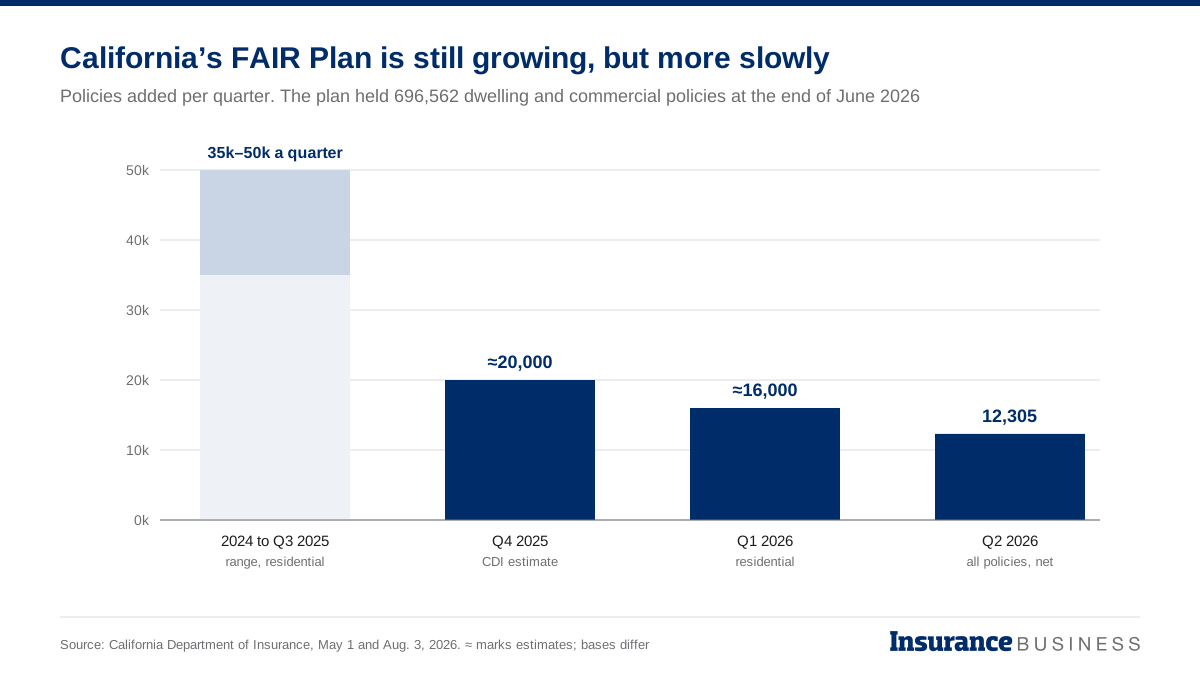
The FAIR Plan shows the same shift. Its growth slowed to 1.9% in the second quarter of 2026, the third straight quarter of slowing, and the department estimates about 24,000 policies left the plan in April and May, according to a CDI release on Aug. 3. It still held 696,562 dwelling and commercial policies at the end of June.
For producers, that book is now an opportunity as much as a holding pen. FAIR Plan prices are rising, and a new state law requires the plan to share policyholder data with private insurers and brokers to steer clients toward the voluntary market. Agencies that re-market those accounts early are best placed to win them back. How quickly that happens will depend partly on the election: Allen would keep the current rate framework, which carriers have broadly backed. Kim would add tighter pricing and claims rules, which her supporters say would protect policyholders and her critics say could slow insurers' return.
Read next: California law forces FAIR Plan to share policyholder data with private insurers
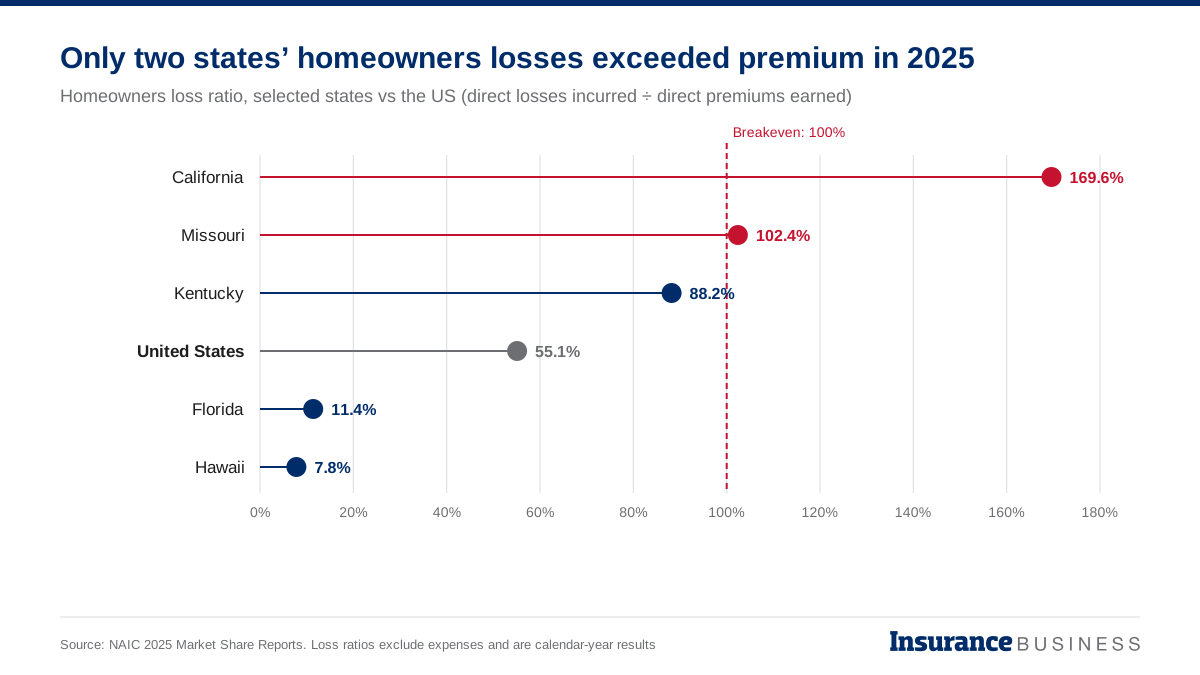
California was not the only market where big writers lost money on homeowners, and outside the state two names come up repeatedly: State Farm and Erie. State Farm, which holds 25.8% of Missouri's homeowners market, ran a 140.0% loss ratio there, helping make Missouri the only other state above 100% overall, at 102.4%. It was also at 109.7% in Wisconsin, an American Family-led market, and 101.0% in West Virginia. Erie posted 106.1% in West Virginia and 140.2% in Kentucky, a state whose overall ratio was 88.2%.
None of these is a wildfire market, and the losses there get less attention than California's. For agents in those states, results like these often show up later as rate filings, higher deductibles or stricter roof rules, although the data don't show which carriers will act.
Florida tells a different story. It wrote $18.83 billion of homeowners premium in 2025, second only to Texas, where State Farm led with 19.7% of a $20.48 billion market. Florida is also the most fragmented large market in the country: its 10 biggest writers held 59.2% of premium, the lowest top-10 share of any state, and none had more than 8%.
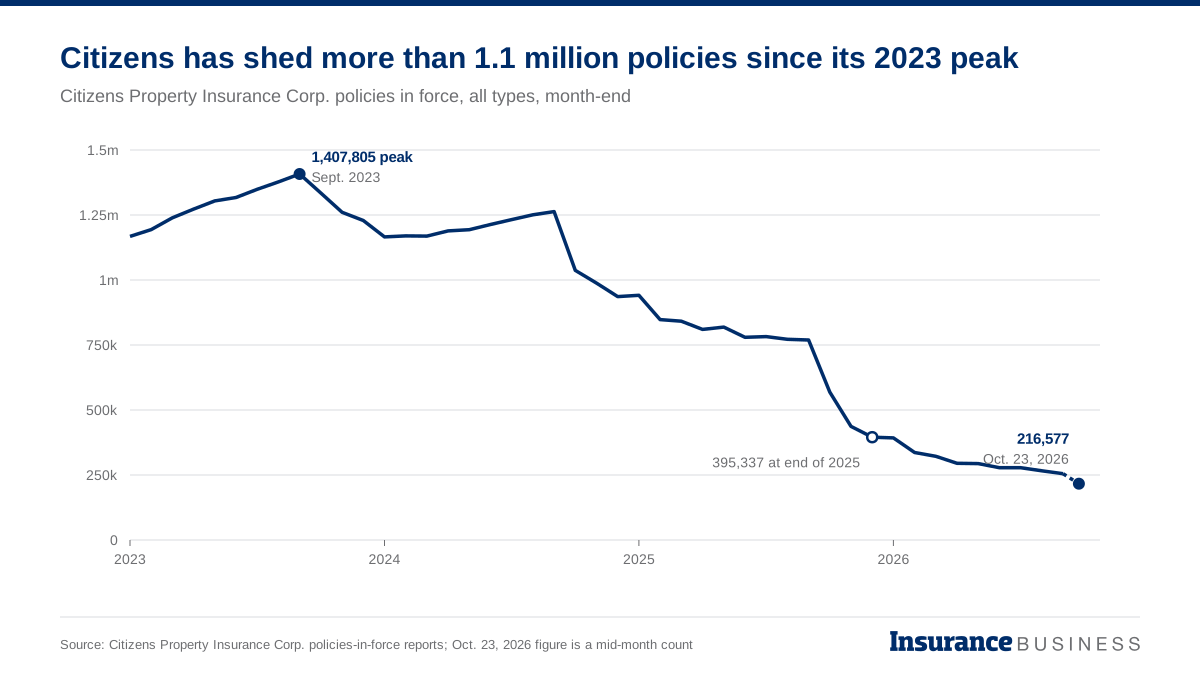
Citizens Property Insurance Corp. finished first with 7.98%, just 0.14 of a point ahead of Florida Peninsula Holdings at 7.84%, and it is shrinking fast. Citizens wrote $1.50 billion of Florida homeowners premium last year but earned $2.13 billion, a $632 million gap that was the largest written-versus-earned shortfall among top-10 writers in any state. Its monthly reports show 395,337 policies of all types in force at the end of 2025 and 254,836 on Sept. 30, 2026, a 35.5% drop. By Oct. 23 the count was 216,577, down from a peak of 1,407,805 in September 2023.
Read next: Citizens cuts policy count to 270,000 amid non-renewal push
On losses, Florida had an unusually good year. Its 11.4% homeowners loss ratio was the second lowest in the country after Hawaii's 7.8%, helped by a season in which no hurricane made landfall in the continental US for the first time since 2015, according to NOAA. The NAIC cautions that loss ratios are calendar-year results that don't measure overall profitability and that property lines, as we have seen, can swing sharply from year to year.
That caution is especially important for Florida agents. Many of the carriers that grew by taking policies out of Citizens have not yet had a major storm test their larger books, so a clean 2025 says less about their staying power than it might appear. Placing clients with them still calls for a close look at financial strength and reinsurance.
Nationally, homeowners insurers wrote $188.95 billion of direct premium in 2025. State Farm wrote $35.27 billion of it, an 18.67% share and almost twice Allstate's 9.40%, according to NAIC figures that also appear in the Insurance Information Institute's rankings. USAA followed with 7.01%, then Liberty Mutual with 5.50% and Farmers with 5.46%. Even with California in the mix, State Farm's national homeowners loss ratio was 74.4%, compared with 55.7% for Allstate, 61.4% for USAA and 49.9% for Liberty Mutual.
The line as a whole is less concentrated than auto, with the top 10 homeowners groups writing 62.4% of premium against 76.8% in private passenger auto. What sets State Farm apart is breadth. It is the largest homeowners writer in 41 of the 50 states and the District of Columbia, while no group leads more than 24 in private auto. Its share in the markets it leads runs from 12.4% in Maine to 33.7% in Illinois, and it tops 30% in Alaska, Hawaii and Oklahoma as well. Eight other groups split the remaining 10 markets, with Citizens leading in Florida and Travelers in Connecticut and DC.
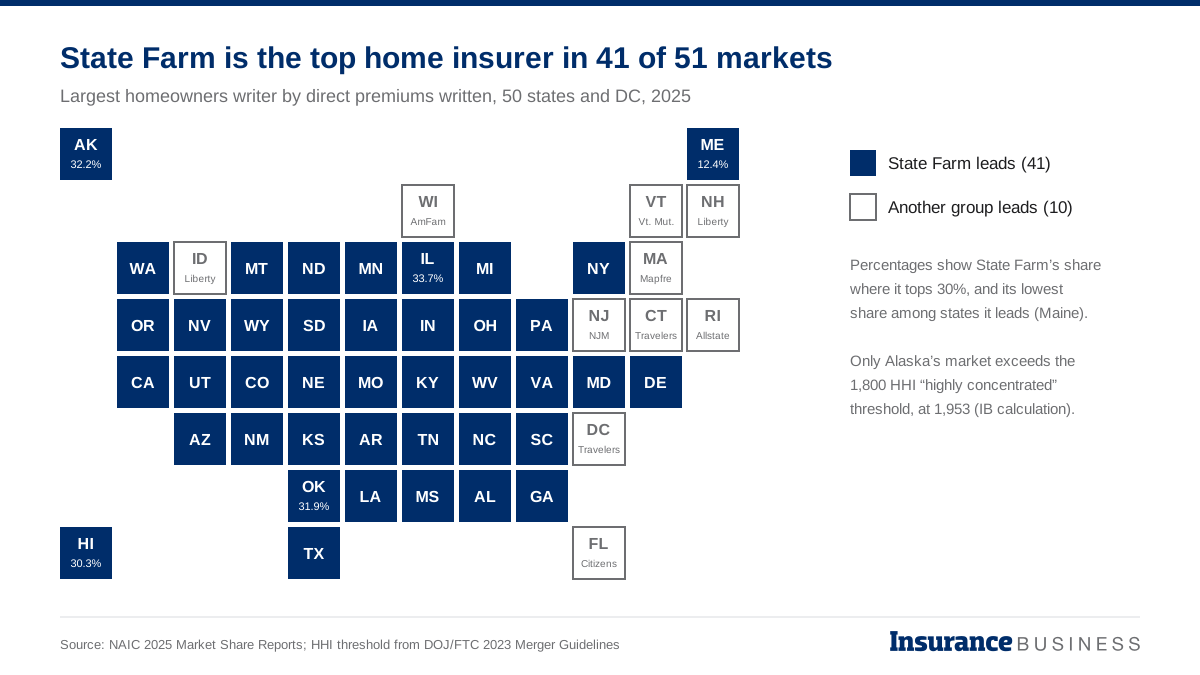
Only one state's homeowners market scores above 1,800 on the Herfindahl-Hirschman Index, the level the 2023 Merger Guidelines treat as highly concentrated. Insurance Business puts Alaska at 1,953.
Read next: Slide Insurance Q1 profit jumps 51% as Citizens depopulation pays off
That breadth makes State Farm's appetite a risk that many agencies share. Before the fires, it had already cut about 72,000 California homeowners policies, according to Insurance Business reporting. A similar pullback by the leading writer in any of its 41 markets would reach local books quickly, which is a good reason for agencies to keep more than one homeowners market open.
The Nov. 3 result will set the direction of the country's largest property insurance market for at least the next four years, including how the Sustainable Insurance Strategy is applied, how the FAIR Plan is run and how the State Farm enforcement case ends. Beyond California, the FAIR Plan's next quarterly figures and Citizens' continuing shrinkage will show whether residual markets keep handing business back to the private market, and whether the carriers taking it on are priced for a bad year as well as a good one.